Medieval Europe · 12 April 1204
The Horses of San Marco
A crusade aimed at Egypt sacks the greatest Christian city instead
look closer
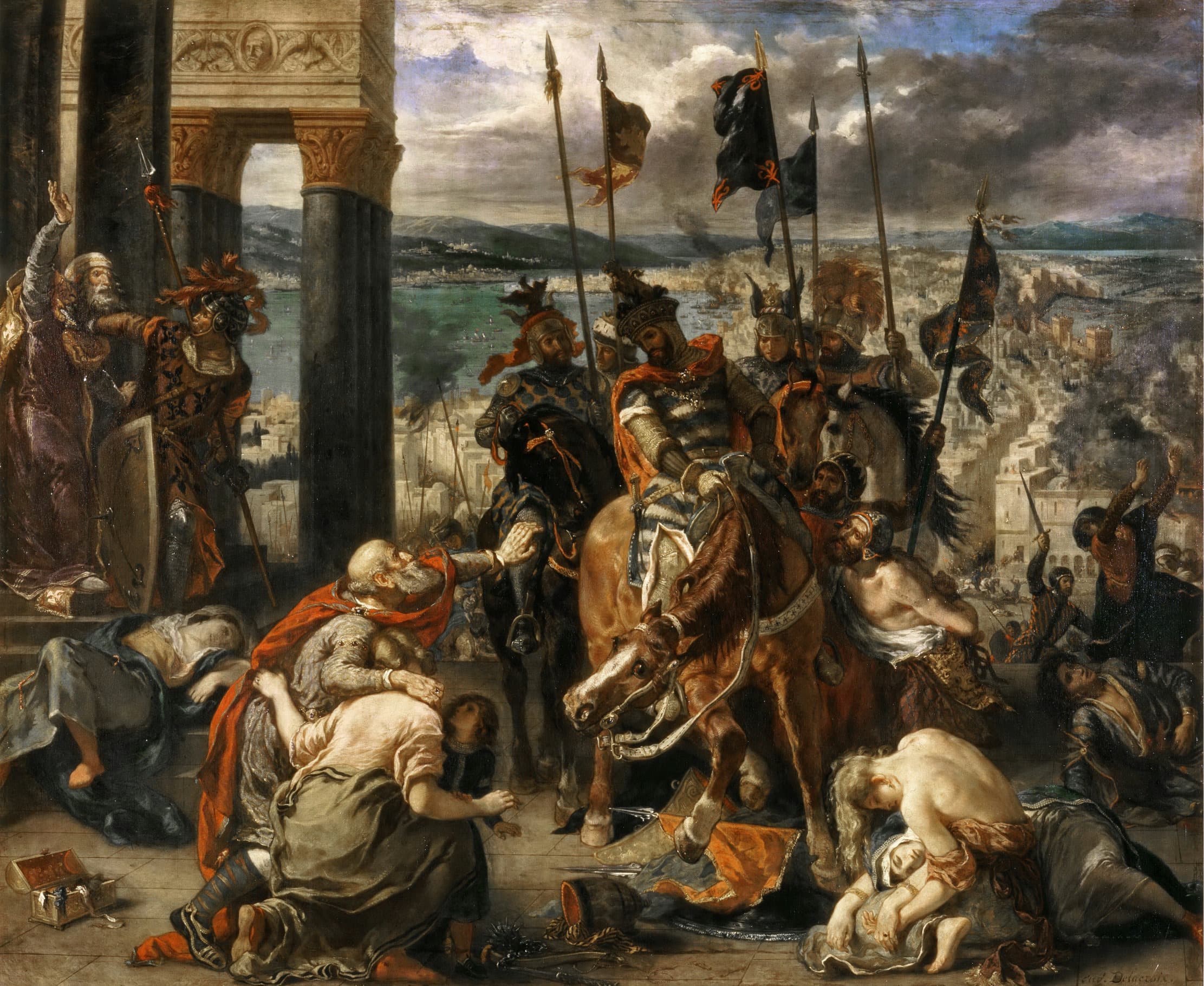
The crusaders ride in slowly, almost bored. Behind them the harbor water is green, and smoke goes up over the city. Their leaders divided the empire between them, and the Venetians made Baldwin of Flanders its emperor.
It was meant to sail for Egypt. The Fourth Crusade set out to strike at Muslim power through the Nile, and instead, on the thirteenth of April 1204, its soldiers were looting the largest Christian city on earth. The crusaders had contracted with Venice for a fleet they could not afford. To work off the debt they let themselves be steered, first to sack a Christian town on the Adriatic, then to Constantinople itself. There they were drawn into a Byzantine succession quarrel. The money they had been promised never came, and the men the city had hired laid siege to it. On the twelfth the walls facing the harbor gave way. What followed was three days that the city, a thousand years old, never recovered from. They took it apart. The soldiers stripped the churches of their silver, pried the enamels off the altars, melted down ancient bronze statues for the weight of the metal. In the Hagia Sophia, a Greek chronicler wrote, they set a woman on the patriarch’s throne to sing while they drank from the sacred vessels. They led mules into the sanctuary to carry the plunder out, and the animals slipped on the marble and were run through where they fell. Niketas Choniates, who watched his own city looted and had every reason to exaggerate but the detail of a man who was there, recorded all of it. The relics went west by the shipload. So did the four bronze horses from the Hippodrome, gilded, larger than life, each the better part of a ton. They were cast in antiquity and hauled off to Venice. There they were set over the door of the basilica of San Marco, and they stood watch on the piazza for the next five and a half centuries. The crusade never did reach Egypt, or Jerusalem. Instead the western knights carved the empire up among themselves and made one of their own the emperor of it. Boniface of Montferrat, who had led them, expected the crown. The Venetians thought he was already too tied into the East and blocked him, and the title went to Baldwin of Flanders instead. The Latin empire they founded on the ruins lasted 57 years. Then the Greeks took their city back, poorer and smaller and never again what it had been. In Rome, Pope Innocent had called the crusade and forbidden the attack in so many words. He celebrated the victory first. Then the reports of the sack reached him, and he wrote that these soldiers of Christ had turned their swords against Christians and drenched themselves in the blood they were sworn to spare. Eugène Delacroix painted the entry more than six centuries later, in 1840, on a commission from King Louis-Philippe for the history galleries at Versailles. He gave it a strange, low heat. The mounted knights come on in the middle distance, unhurried, almost bored. Across the whole foreground the conquered kneel and plead and die, a girl’s body sprawled at the lower right, an old man reaching up from the dust. The city and its harbor spread out behind under a bruised sky. It is a victory picture painted as a reproach, hung in a palace built to glorify French arms. The horses are still on the front of San Marco, in copy. The originals moved inside, out of the weather, in the twentieth century.