Medieval Europe · July, 1191
The Lionheart at Acre
Two kings take a city in a month, then the killing that follows outlasts them both
look closer
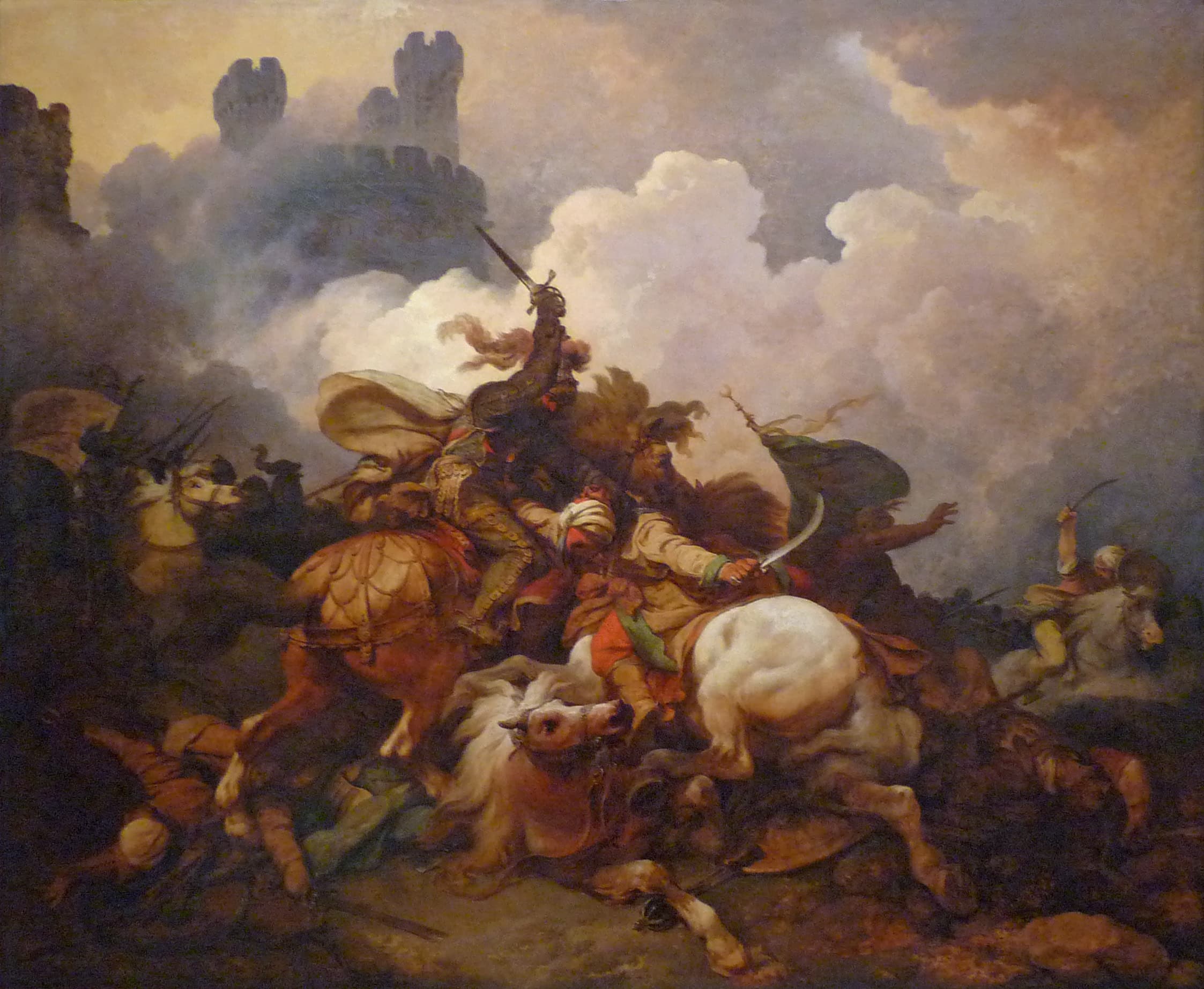
Richard holds his sword straight up, and a pale plume streams off his helmet. Under him the chestnut horse wears a gold cloth. Loutherbourg invented this duel, and no chronicle of the siege records it.
Nobody had taken Acre in two years of trying. The city sits on a spur of the Levantine coast with the sea on two sides, the best harbor in the kingdom the crusaders had lost. Since 1189 a Christian army had been camped in front of its walls, itself ringed by Saladin’s army camped behind them. Everyone was besieging and besieged at once. Men died there of fever and hunger by the thousand across those two years, in numbers no assault ever matched. Then, in the spring of 1191, the kings arrived. Philip Augustus of France came first, then Richard of England, the one they already called the Lionheart, who had seized Cyprus on the way out. With their siege engines and their rested troops the thing was decided in about a month. On the twelfth of July the garrison surrendered. The terms were precise and written down. The defenders would go free in exchange for the True Cross, the relic Saladin had captured four years earlier at Hattin, along with a ransom in gold and the release of 1,600 Christian prisoners. Saladin, negotiating from outside for a garrison he no longer commanded, agreed to pay in installments. The first deadline came. The money and the Cross did not, or not all of it, and each side later blamed the other for the delay. Richard grew certain he was being played. What he did next his own admirers recorded without flinching. On the twentieth of August he had the prisoners, some 2,700 of them, marched out onto the plain in full view of Saladin’s lines and killed. The men were roped together, and the killing was done with swords where the watching army could count it. Saladin, who could not reach them in time, is said to have executed his own Christian captives in answer. Then Richard turned south toward Jaffa and Jerusalem. The two of them fought the rest of the war as near equals and never met face to face, though later legend could not resist inventing the meeting. Legend got the painting too. Philippe de Loutherbourg painted this around 1807, near the end of his life. He was an old scene-painter for the London theaters who knew how to build a sky, and he gave the Third Crusade the duel it never had. Richard rears up on a chestnut charger, sword flung overhead, cutting down a turbaned rider who topples backward off a white horse, a broken castle floating in the smoke behind. No such single combat is in the chronicles. It is the crusade as the nineteenth century wanted it, one bright king against one dark enemy, with the fever camp and the roped prisoners left out of the frame. In 1789 Loutherbourg and his wife were healing the sick by the laying on of hands at their house on Hammersmith Terrace, and a pamphlet that year counted 2,000 cures.