Medieval Europe · 26 August 1346
The Blind King’s Charge
At Crécy the flower of French chivalry rides into English arrows
look closer
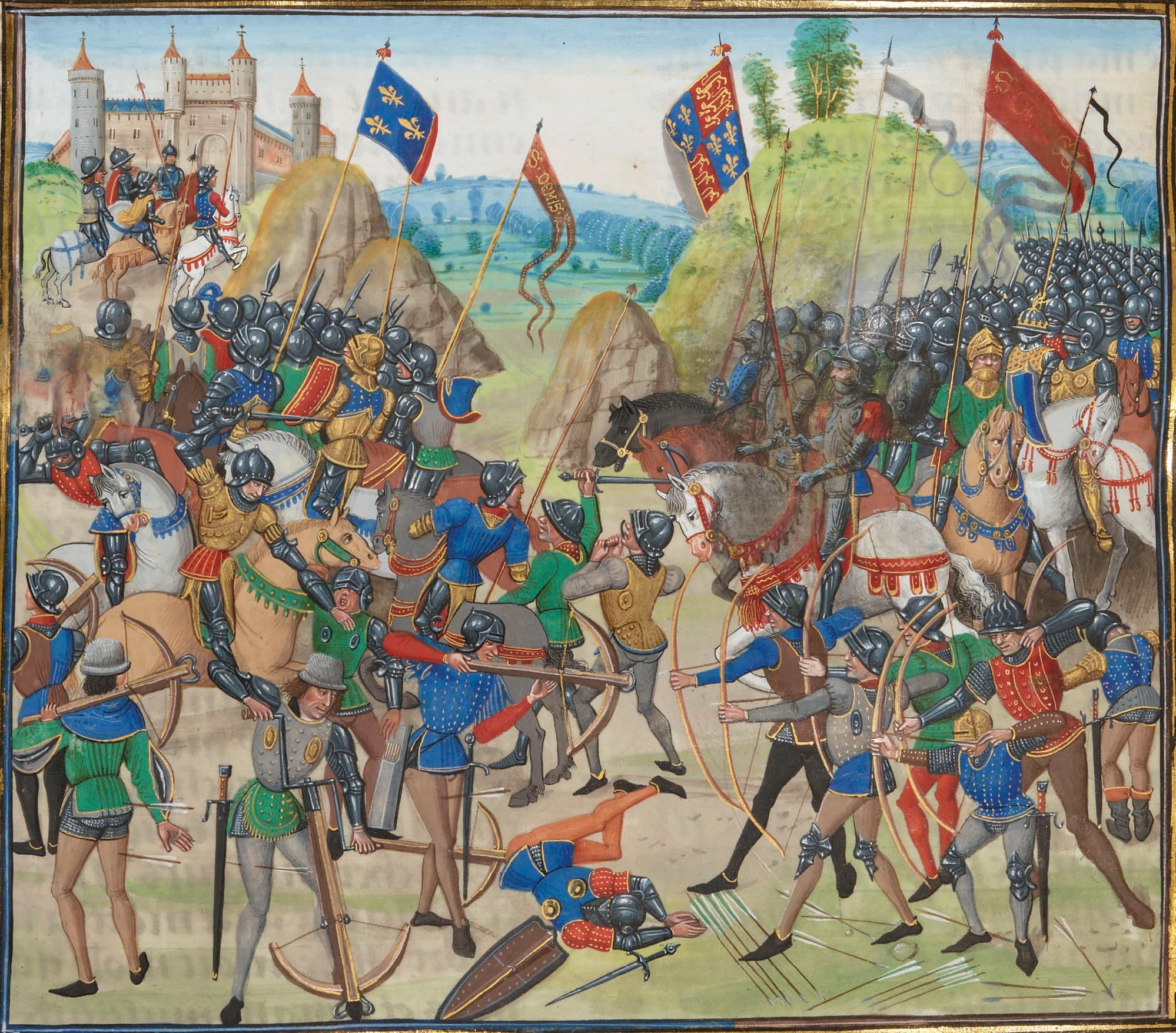
English and Welsh archers stand at full draw in short bright coats. Their bows are nearly as tall as the men holding them. They shot faster and farther than the crossbows sent against them, and that gap decided the day.
John of Luxembourg, King of Bohemia, was about 50 and completely blind. On the evening of the twenty-sixth of August, 1346, near the village of Crécy in Picardy, he asked to be led into the middle of a battle he could already hear going wrong. He was fighting for the French, and from the sound of it the French were losing: the crossbowmen thrown back, the first cavalry charge broken. He told the knights around him to tie their horses’ reins to his so that he could ride in among them and strike at least one blow with his own sword. They did it. They went forward roped together, and in the morning they were found in a heap, the king dead in the middle of them, the horses still bound. What had wrecked the French was distance. Edward the Third had put his army on a low ridge, with the archers on the wings. The English and Welsh longbowmen could shoot far faster and farther than the Genoese crossbowmen hired to answer them. A rain shower had come through before the fighting, and the story is that it slackened the Genoese bowstrings while the English kept theirs dry under their hats. The crossbowmen were driven back into their own advancing cavalry. The French knights, furious, rode over their own hired men to get at the enemy, then died in front of the arrows in wave after wave. It went on into the dark. When it was over the French had lost a catalogue of their greatest lords, and the shape of war had shifted a little on its hinges, away from the mounted knight. The painting is a miniature from a copy of Froissart’s Chronicles, illuminated by Loyset Liédet around 1470, more than 120 years after the battle. It lays the whole field out flat and legible. The English archers bend their bows on the right. On the left the Genoese with their crossbows give way, and a dead man-at-arms lies face down in the grass at the bottom of the field. Froissart, who talked to men on both sides, is where most of what we know comes from. The good stories come from him too, which is a warning as much as a gift. One of those stories concerns the dead blind king. The legend says that Edward’s son, the 16-year-old prince later called the Black Prince, took John’s crest of ostrich feathers and his motto, two German words meaning I serve. Every Prince of Wales since has carried the feathers and the motto. It is a good story and probably not true. It first turns up in writing in 1376, the year the Black Prince died, and there is no sign King John ever used either the feathers or the words. He bore, of all things, a crest of vultures’ wings.