Medieval Europe · 24 September 1326
The She-Wolf Comes Ashore
A queen lands with an army to take the throne from her own husband
look closer
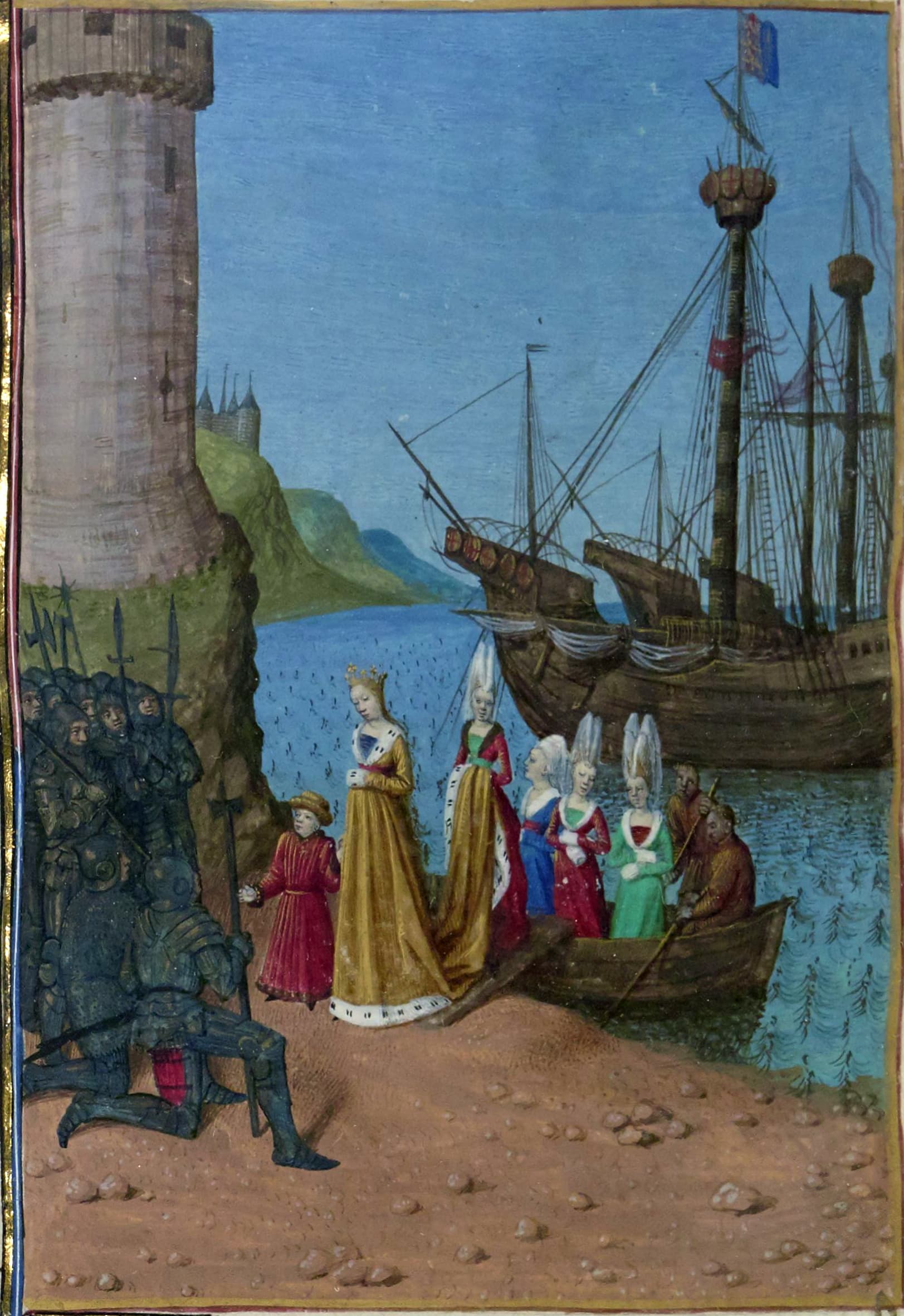
Isabella of France is in gold and ermine, with a crown on her head. A boy in red is at her knee. She crossed the sea to pull her own husband off the throne, and inside a year he was dead.
She landed on the Suffolk coast on the twenty-fourth of September, 1326, with about 1,500 hired soldiers and her 13-year-old son at her side. Isabella of France was Queen of England and had come to unmake the King of England, who was her husband. She had gone to Paris the year before on a diplomatic errand and simply not come back. There she took up with Roger Mortimer, an exiled baron who had escaped the Tower of London by drugging his guards. The two of them built a small invasion out of mercenaries, English exiles, and grievances, of which the country had a great many. Edward the Second had spent 20 years handing his affections and his patronage to favorites, first Piers Gaveston, then the Despensers, and the barons had spent 20 years hating them for it. When Isabella came ashore, the kingdom did not resist her; it changed sides. Edward fled west toward Wales with the younger Despenser and almost no one else. He was run down in November, and by January his own parliament had forced him to give up the crown to his boy, who became Edward the Third. In September of 1327, imprisoned at Berkeley Castle in Gloucestershire, the old king died. The story that his keepers killed him with a red-hot iron, so as to leave no mark, is a later invention. It gets repeated because it is unforgettable, and because it fit what people wanted to think about him. What is near certain is that he was murdered, and that the order came from the men now running the country in his son’s name. The painting here is not a scene of any of that. It is a manuscript miniature by Jean Fouquet, made in the 1450s for a royal copy of the Grandes Chroniques de France. It shows the landing as a court occasion. Isabella steps onto a red shore in a gold gown. Her ladies come out of a great ship behind her, and a wall of armored men waits at the left, spears against the sky. Fouquet painted it more than a century after the event, in the clothes and rigging of his own day. That is how medieval chroniclers usually pictured the past, with no sense that it had ever looked different. Isabella and Mortimer ruled for three years, badly and greedily, until the boy king grew up enough to end it. In 1330 Edward the Third had Mortimer seized in Nottingham Castle and hanged. His mother he did not touch; she kept her lands and lived nearly 30 more years in comfortable retirement. The name she is remembered by, the She-Wolf of France, she never heard in her life. The poet Thomas Gray hung it on her four centuries later. He borrowed it from a line Shakespeare had aimed at a different queen, and wrote of her tearing the bowels of her mangled mate. In her own century people mostly thought well of her.