The Age of Sail · 29 April 1770
The Botanist’s Bay
Two men with spears bar a beach on the far side of the world
look closer
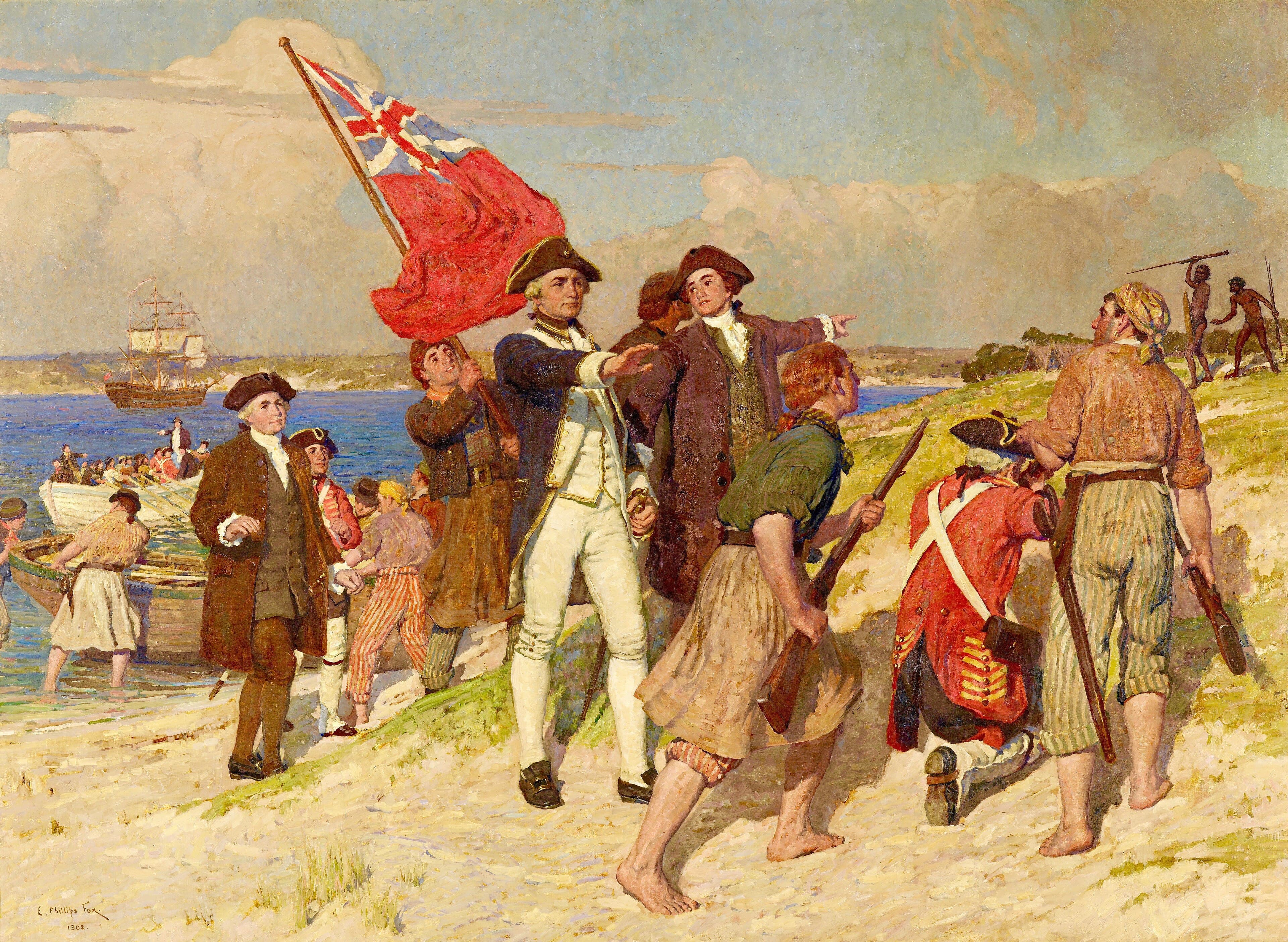
Cook stands in the middle in a navy coat and white breeches. His right arm is thrown out to hold back the men behind him. He was 41 that day and still only a lieutenant, and the fame was all ahead of him.
Two men of the Gweagal stood at the waterline and would not move. It was 29 April 1770, and a ship’s boat from the Endeavour was pulling for a low sandy beach that no European vessel had entered, with James Cook in the stern. The two men shook spears and shouted in a language nobody aboard could read, and they were plainly telling the boat to go back. Cook was a farm labourer’s son from Yorkshire who had taught himself the mathematics of the sea. He had spent months charting New Zealand before turning west into open water on a hunch that a coastline lay there. It did. It also had people on it, and they were saying no. Cook did not want a fight and did not get out of one cleanly either. By his own journal he first fired a musket between the two men to frighten them, and when that failed, fired again with small shot and hit one in the legs. The man ran up the beach, came back with a shield and more darts, and the two of them threw their spears before the sailors’ numbers drove them off into the trees. Nobody died. The English walked up to a cluster of empty bark huts, found children hiding inside, left some beads and cloth as a clumsy peace offering, and took the abandoned spears back to the ship. First contact on that shore lasted an afternoon and began with a shot. Cook had meant to call the place Sting-Ray Harbour, for the rays his men speared in the shallows. He crossed it out. Joseph Banks and Daniel Solander, the two naturalists he carried, came back from the scrub loaded with plants nobody in Europe had ever described. Cook renamed the whole inlet Botany Bay, a bay named for its weeds. By tradition the first man to set foot on the sand was not Cook. It was the midshipman Isaac Smith, his wife’s young cousin, sent over the bow at Cook’s word. The painting is a long afterthought. E. Phillips Fox made it in 1902, more than a century on, commissioned when Australia had just become a federation and wanted a founding scene on its walls. So Fox gives it the light of a proud beginning. Cook stands centre in his blue coat, the red ensign snapping overhead, a marine kneeling with his musket. The two Gweagal men are in the picture too, up on the rise at the right, pushed to its edge. The flag and the spears are up at the same moment, at opposite ends of the same canvas.