The Age of Sail · 13 September 1759
Modern Dress
A general dies winning Quebec, and the painter refuses to put him in a toga
look closer
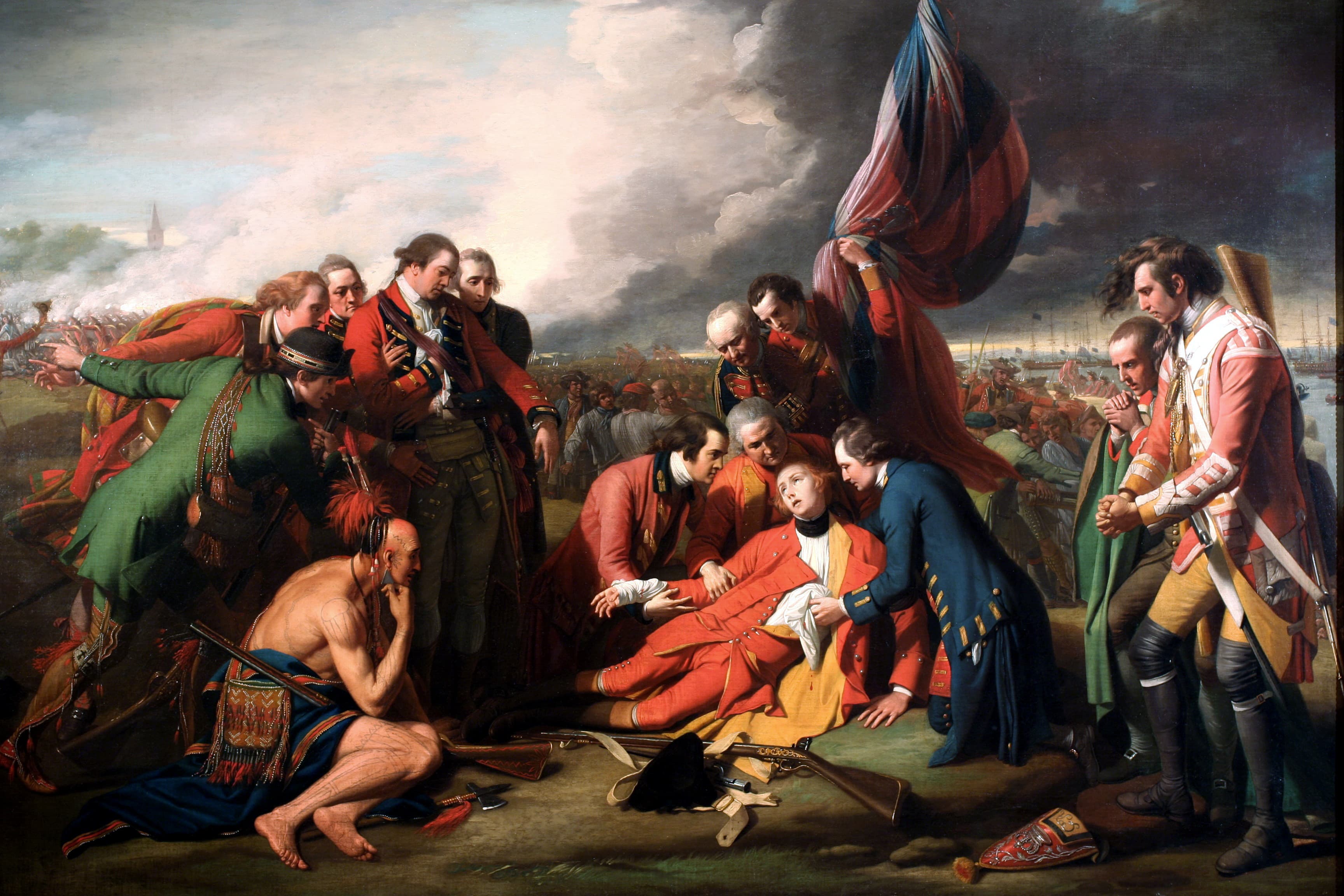
Wolfe lies white and slack in a ring of officers. One of them presses a cloth to his chest. Most of these men were somewhere else on the field when he died, and West grouped them around him for the picture.
On the morning of 13 September 1759, James Wolfe had 32 years behind him and a few hours ahead. In the dark his army had climbed a goat path up the cliffs above Quebec, hauling itself hand over hand to the flat farmland the French thought no one could reach. By dawn about 4,500 redcoats stood in line on the Plains of Abraham with their backs to the river. The French came out to meet them and fired too soon, at too great a range. Wolfe’s men waited, muskets double-shotted, until the enemy was 40 paces off, then fired one volley so exact that a British officer called it a single cannon going off. The French line broke inside a quarter of an hour. In that quarter of an hour Wolfe was hit three times: the wrist, the body, and finally the chest. They carried him to the rear. The story his aides told afterward is that a man came running with the news that the French were fleeing. Wolfe, who had seemed past hearing, roused enough to give an order about cutting off their retreat. Then he said, now God be praised, I will die in peace, and did. His opposite number, the Marquis de Montcalm, took a musket ball through the body in the same battle and died the next morning inside the town he had failed to hold. Two commanders, one field, one day. Benjamin West, an American painter working in London, painted the death 11 years later on a canvas 7 feet wide, and broke a rule to do it. History paintings dressed their heroes in the robes of ancient Rome; that was what made them noble. Joshua Reynolds himself came to the studio and warned West that soldiers in coats and gaiters would sink the picture. West kept the coats. The men who fought at Quebec, he said, wore the habits of their own time, and the truth of the event was the reason to paint it. George III would not buy the thing at first for exactly that reason, then changed his mind and ordered a copy for himself. Most of the grieving officers around Wolfe were not actually beside him when he died. West grouped them the way painters had grouped mourners around the dead Christ for 300 years. A soldier reads as a martyr without a word of scripture. The half-naked figure watching from the left, chin on fist, was never at the battle at all. He is an idea of the New World, added for the composition. William Woollett’s engraving of the painting went out by the thousand and made everyone involved rich. Wolfe had been dead for years, and was still winning.