The Renaissance · c. 1591
The Emperor in Season
A portrait of the emperor built from four harvests at once
look closer
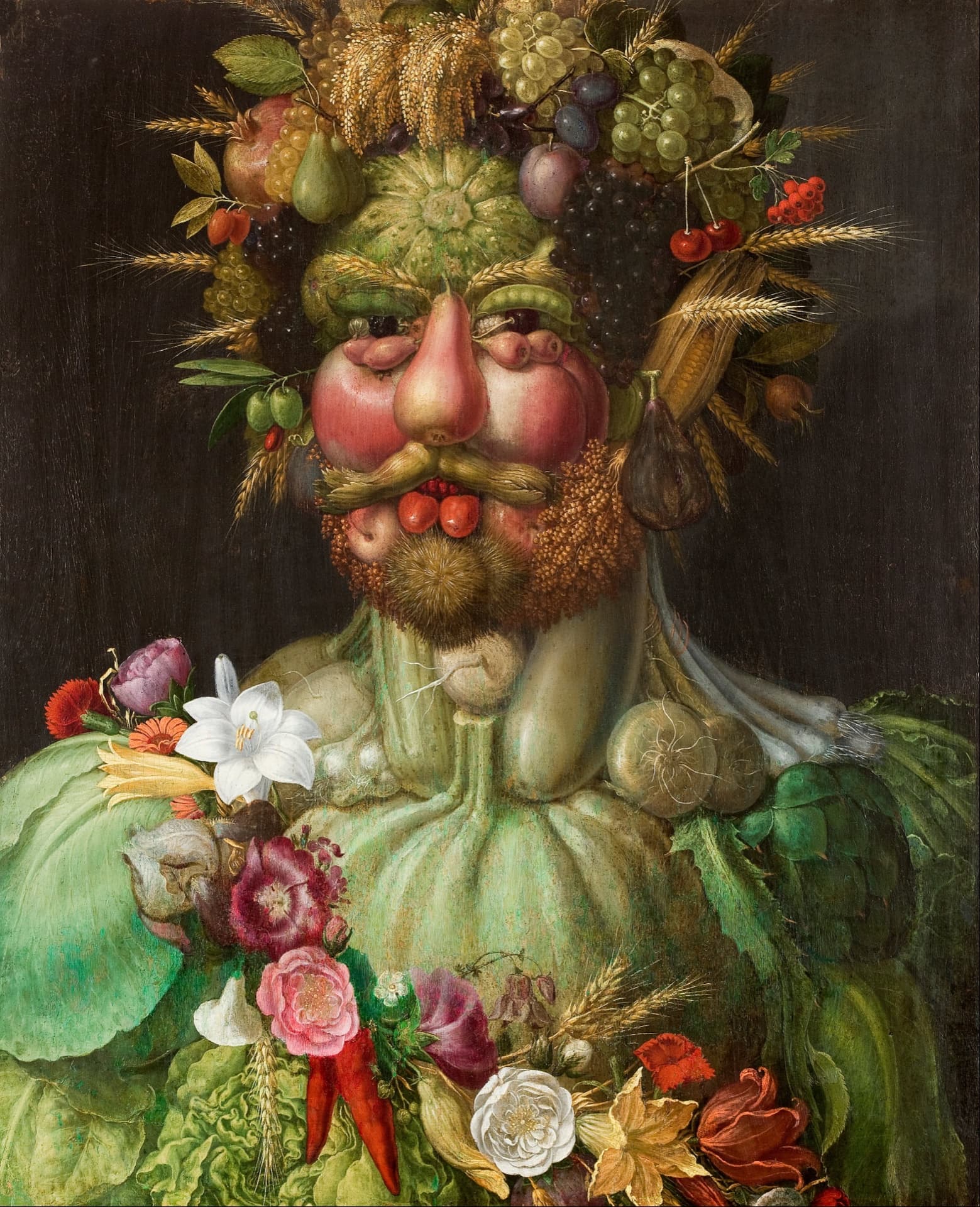
Ears of wheat make the eyebrows, and a split pea pod makes each eyelid. Under each lid the eye is a dark cherry. The nose is a pear, and it stands stem upward between two apple cheeks.
Giuseppe Arcimboldo spent a quarter century as court painter to the Habsburgs in Vienna and Prague, and his official duties were conventional: portraits, festival designs, costume schemes for tournaments. His fame rested on the sideline: composite heads, faces assembled entirely from painted things, fruit, fish, roast birds, books, kitchenware, each one a catalogue pretending to be a person. The emperors could not get enough of them. When he finally retired to his native Milan in 1587, Rudolf II let him go on the understanding that the pictures would keep coming. The last and best arrived in Prague around 1591: the emperor himself as Vertumnus, the Roman god of the turning year. The portrait is botanically ruthless. Rudolf's cheeks are apples, his nose is a pear, his eyelids are open pea pods, his chin is a chestnut burr. Wheat, grapes, cherries and plums crowd the crown of his head, and cabbage leaves carry the imperial shoulders. Contemporaries counted the species and found all four seasons growing at the same time. That was the entire message, and a poem written to go with the picture spelled it out. Under Rudolf, the empire enjoys every season's abundance at once, a permanent golden age with a pear for a nose. Rudolf, whose court ran to alchemists, astronomers and a pet lion, was delighted, and made the painter a Count Palatine for it. The golden age proved less durable than the vegetables. Rudolf died after his own brother pushed him off the throne. The collection he had piled up in Prague Castle was the greatest cabinet of wonders in Europe. Swedish troops looted it in the last year of the Thirty Years' War, and Vertumnus went north in a baggage wagon. The Swedish inventory listed it as item 351, a face of fruit. Queen Kristina found Arcimboldo old-fashioned and let it go; it hangs today in Skokloster Castle, war booty that never went home. Arcimboldo himself died in 1593 and was forgotten with impressive speed; for three centuries the composite heads were filed under curiosities, until the Surrealists found him in the 1930s and declared him a father. Dalí borrowed the double-image trick outright. The painting keeps a courtier's joke in plain sight. Where the emperor's ear belongs, Arcimboldo painted an ear of maize with the husk peeled back and the kernels showing. It was a New World crop, barely a century old in Europe, serving as the ear of the Holy Roman Emperor.