The Machine Age · 1 May 1893
The City Made of Light
Chicago builds a city out of white plaster and lights it with 200,000 bulbs
look closer
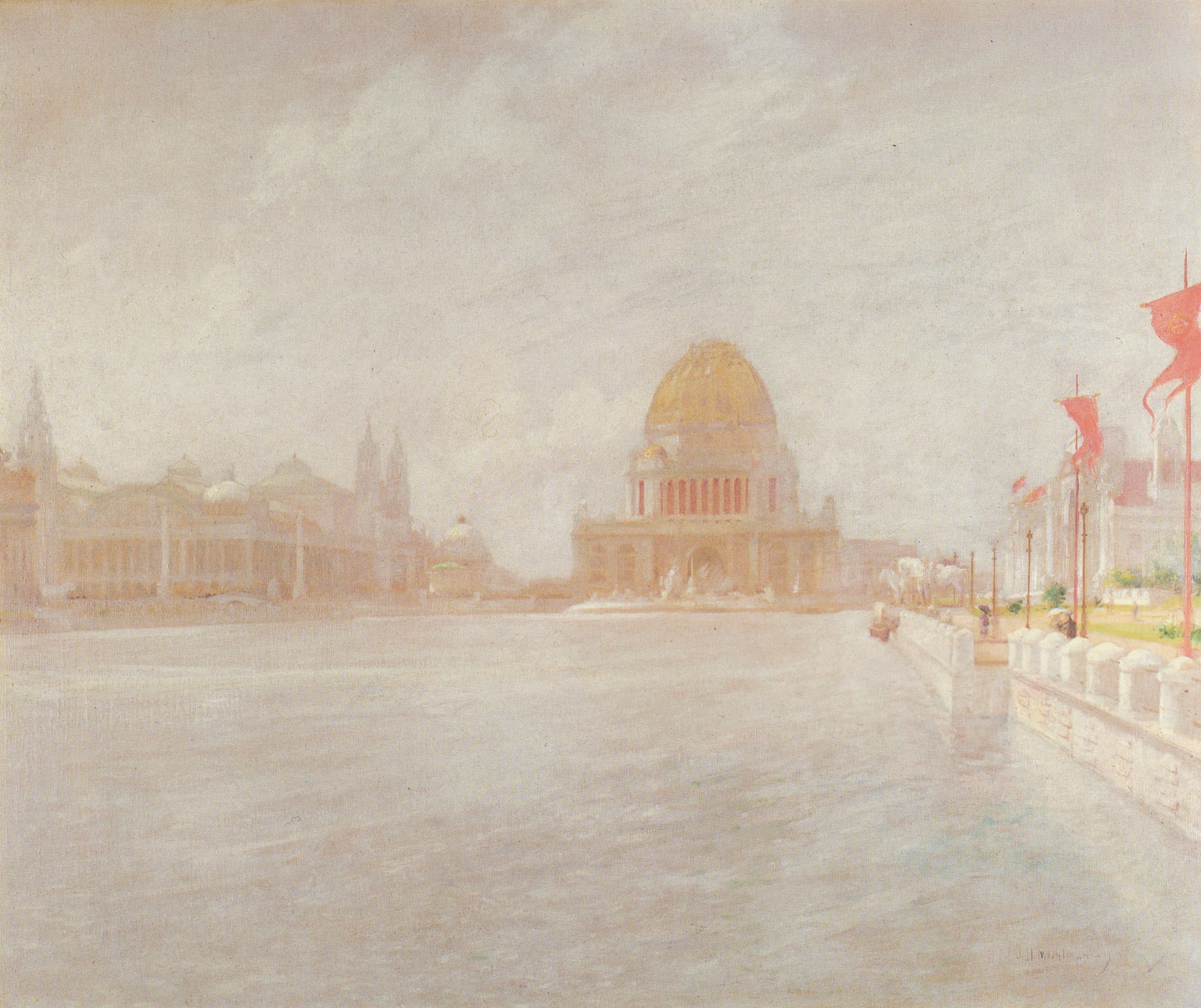
The gilded dome of the Administration Building rises at the head of the basin. Red columns stand in the shadow under it. Twachtman painted this court by daylight, and after dark the same court was strung with bulbs.
President Grover Cleveland laid his hand on a single gold telegraph key and pressed it, and a made-up city of white plaster began to run. It was noon on the first of May, 1893, in Jackson Park, Chicago. The engines turned, the fountains threw water a hundred feet up, flags dropped from the roofs. The fair was called the World’s Columbian Exposition, timed a year late to mark four centuries since Columbus. Its core of columned halls was faced in staff, a cheap mix of plaster and jute that photographed like marble. People called it the White City, and it earned the name twice: once by daylight for the plaster, once after dark for the light. The light also settled a fight. The contract to power the fair had come down to two bids. Thomas Edison’s people at General Electric offered direct current, the system already wired into American cities. George Westinghouse offered the alternating current that Nikola Tesla had patented, and bid it at 399,000 dollars, well under Edison. Westinghouse won. The fair ran on Tesla’s current from a dozen thousand-horsepower generators and burned more than 200,000 lamps, proof at the scale of a small city that AC could be trusted. General Electric struck back by forbidding the use of Edison’s patented bulb on the grounds. Westinghouse simply designed a different bulb, a two-piece stopper lamp that dodged the patent, and made a quarter of a million of them by hand to fill the sockets. Most of the people who came had never stood in electric light. In six months 27 million of them passed through, better than a third of everyone in the country. Many wrote that the night was the thing they could not describe: the whole court outlined in bulbs, searchlights sweeping the sky, the water lit from beneath. A Pittsburgh engineer named George Ferris had answered the fair’s call for something to rival the Eiffel Tower. His wheel stood 264 feet high and carried 36 cars the size of streetcars, turning slowly over the Midway. The light is what the visitors kept. The end was not the jubilee anyone planned. On the evening of the twenty-eighth of October, two days before the close, a disappointed office-seeker named Prendergast walked into the mayor’s house and shot Carter Harrison dead in his own hall. The grand closing ceremony became a memorial instead, the flags at half-staff over the white plaster. Fire took most of the buildings in July 1894, and staff had never been built to last a winter. John Twachtman, an American painter who worked in soft broken color, was there, and the canvas he left is not the electric night at all. He painted the Court of Honor by pale day, the gilded dome and the white halls half dissolved in haze, the whole marvel already looking like something remembered. The canvas is in Columbus, Ohio now, its plaster city gone to mist a year before fire took the real one.