The Machine Age · June 1889
The Window Facing East
Locked in an asylum, a painter builds the night sky from memory
look closer
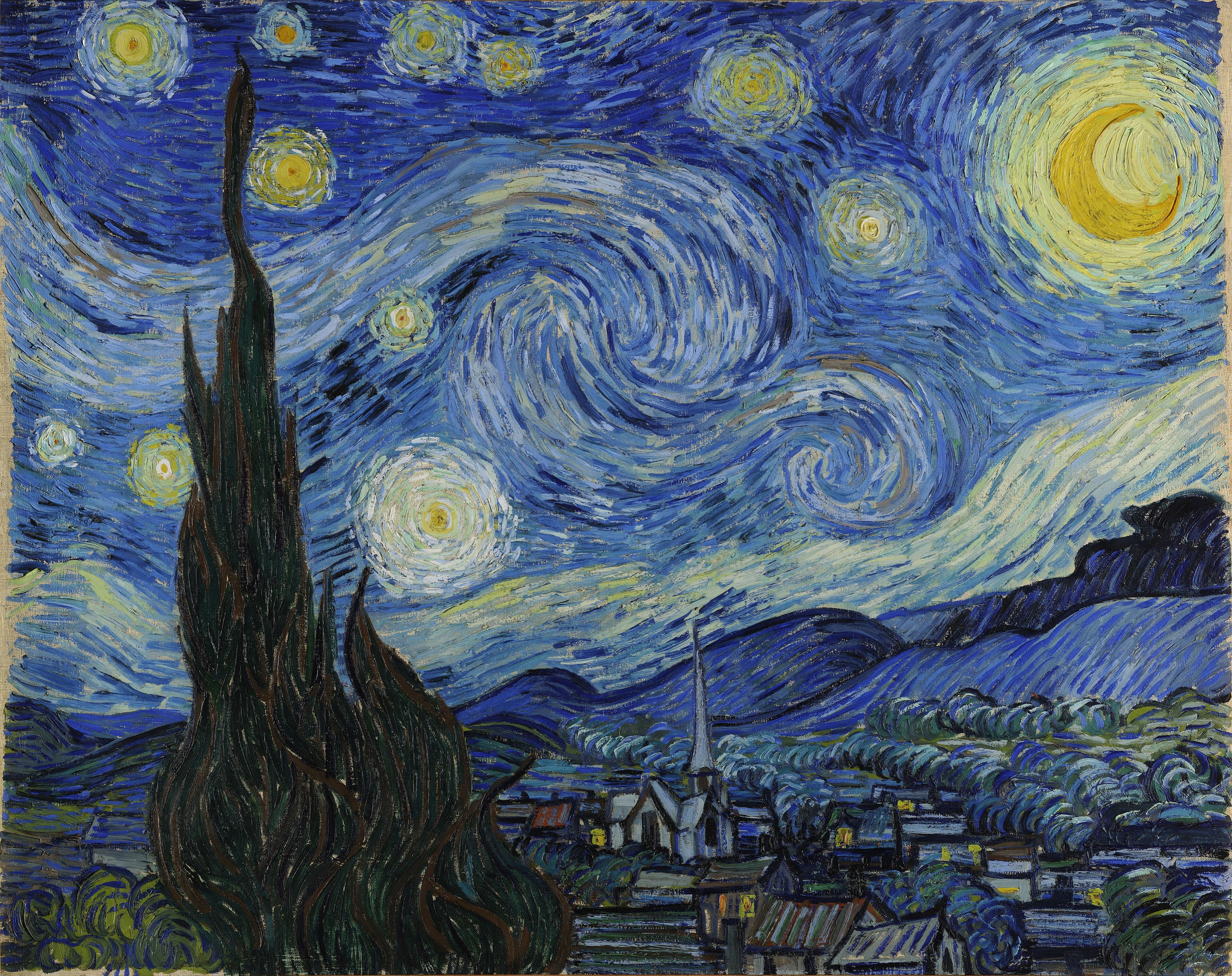
Two waves roll through the middle of the sky. Each one is built from separate thick strokes of blue and white. Van Gogh painted them indoors, in daylight, from memory.
On the eighth of May, 1889, Vincent van Gogh checked himself into an old monastery outside the town of Saint-Rémy, in Provence, that had been turned into an asylum for the mentally ill. He went of his own accord. The months in Arles had ended badly: the winter he cut off part of his own ear, the petition from frightened neighbors, the spells when he did not know himself. At Saint-Paul-de-Mausole he took two small rooms and the run of a walled garden, and the doctors let him keep painting. He had a bedroom on the upper floor with an iron grille across the window, and the window faced east, over a wheatfield and a low line of hills. He watched that window in the dark. In a letter to his brother Theo he wrote, this morning I saw the countryside from my window a long time before sunrise, with nothing but the morning star, which looked very big. The morning star is the planet Venus, and in June of 1889 it stood bright in the hour before dawn. Some weeks after writing that line he painted the night sky he had been studying, and he painted it in daylight, from memory, in a room where he was not allowed to work outdoors alone. The sky in the picture is a pre-dawn sky reassembled by a man looking at a blank wall. Almost nothing in the painting is the view. The hills are roughly the hills of Saint-Rémy, but the village underneath, the huddle of houses and the tall thin church steeple, was never there. Van Gogh invented it, and the spire he gave it belongs more to the Dutch churches of his childhood than to anything in Provence. The one great vertical shape that is real to him is the cypress on the left, the dark flame that climbs past the top edge of the canvas. He loved cypresses that year and could not stop looking at them. He told Theo one was beautiful as regards lines and proportions, like an Egyptian obelisk. In Provence the cypress is the tree people plant in graveyards. He stayed at the asylum a year and worked at a furious rate between his attacks, more than a hundred canvases in twelve months. In the spring of 1890 he left for a village near Paris. He shot himself that July and died two days later, on the twenty-ninth, at 37. He had sold almost nothing and had no reason to think the night sky he built from memory would outlive him by a week. It hangs now in New York, which got it in 1941 by trading away two Cézannes and a Toulouse-Lautrec. The moon in it is wrong as well. Astronomers have worked the sky back to that June and found a moon more than half full, and he painted a crescent. The record kept the date. The canvas keeps the invention.