Ancient Rome · 24 August, AD 410
The City Taken
For the first time in eight centuries, a foreign army is inside the walls of Rome
look closer
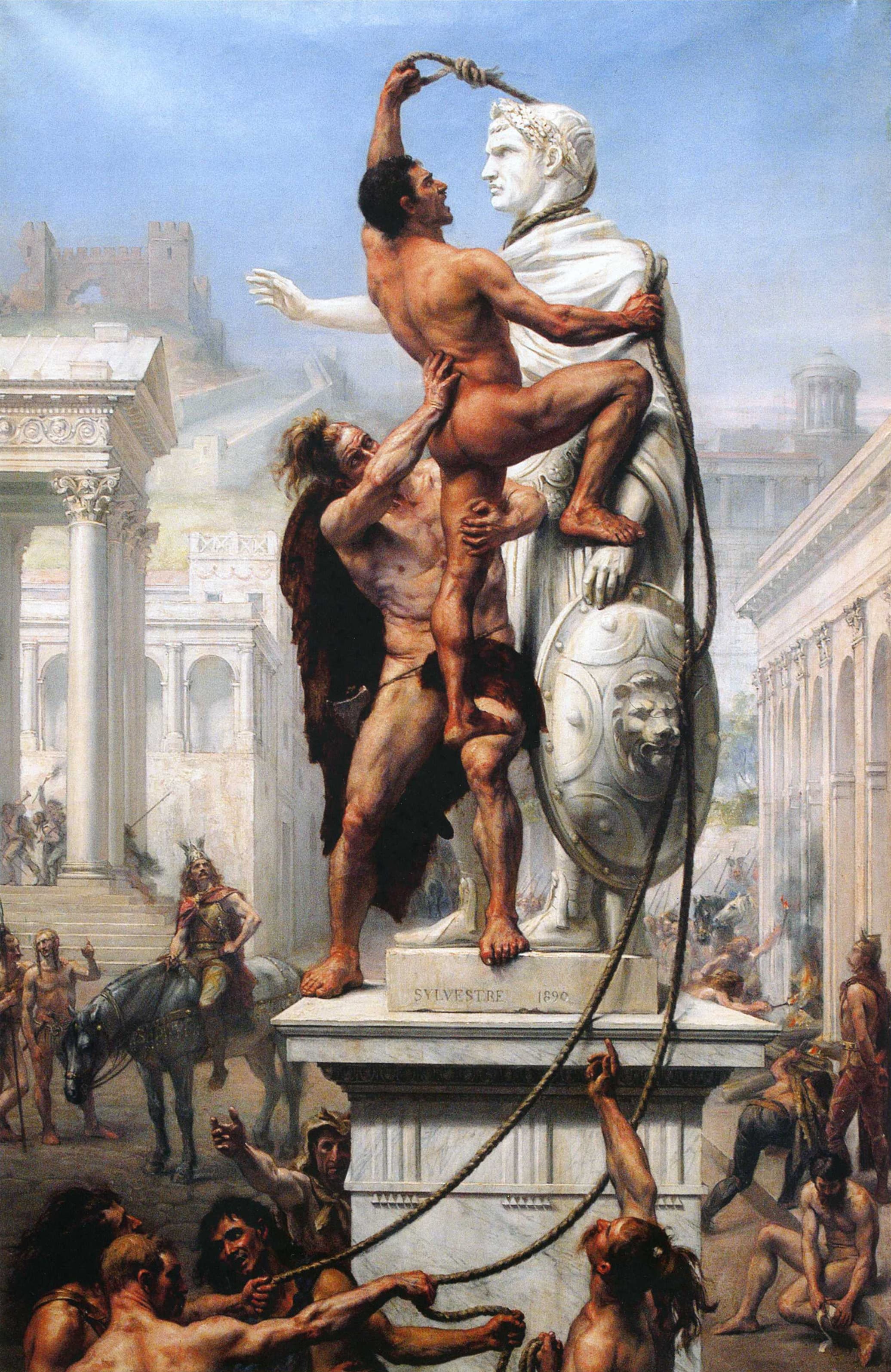
A Goth drops a rope over the head of the marble emperor and shouts up into its face. The laurel crown is still there. The statue's white hand is still held out at the left, in the middle of a speech.
On the night of the twenty-fourth of August, 410, the Salarian Gate opened from the inside, and Alaric’s Goths came into Rome. No enemy had been inside the walls for almost 800 years, not since a Gaulish raid the city half-remembered as a nightmare. Alaric had besieged Rome twice already and bargained each time. He wanted land and rank for his people inside the empire, not its capital. The court at Ravenna kept refusing, until there was nothing left to do but take the city and see what that bought. What followed was three days of plunder, and by the standard of sacked cities it was almost restrained. Alaric was a Christian, an Arian, and he ordered the great churches of Peter and Paul left alone as places of refuge; anyone who reached them was to be spared. Buildings burned, the old Senate house among them, and the emperor’s half-sister Galla Placidia was carried off, later to marry a Gothic king. Then the Goths simply left, moving south, and Alaric was dead of illness within months. The shock was out of all proportion to the damage. Rome had not been the seat of government for years, but it was the idea the whole world had agreed to believe in, and the idea had been proved to bleed. Word reached a cave in Bethlehem where Jerome sat translating the Bible into Latin, and it stopped him cold. In the city which had taken the whole world, he wrote, the whole world has been taken, and confessed that for days he could not work for grief. Across the Mediterranean in North Africa, a bishop named Augustine heard the same news and started to write. Pagans were saying Rome fell because it had abandoned its old gods for Christ. Augustine answered them across 22 books over the next 13 years, arguing that no earthly city was ever the eternal one. That reply is The City of God. Joseph-Noël Sylvestre painted the moment in 1890 and aimed it straight at the gut. A colossal marble emperor stands on his pedestal, calm and blank-eyed under a laurel crown. Two barbarians swarm up his body with a rope, one standing on the other’s shoulders to reach the neck. Below them men haul on the line, and the city behind stands in haze without a flame in sight. It is invention, not report. There is no record of the Goths toppling a specific statue like this; Sylvestre built one image to carry the whole meaning of the day. He even signed it in the marble, carving Sylvestre 1890 into the plinth of the emperor his painting is pulling to the ground. On the left, on a grey horse, Alaric watches it happen and does nothing.