Ancient Rome · AD 80
The Turn of a Thumb
A hundred days of games open a new arena, and a gesture nobody can quite read
look closer
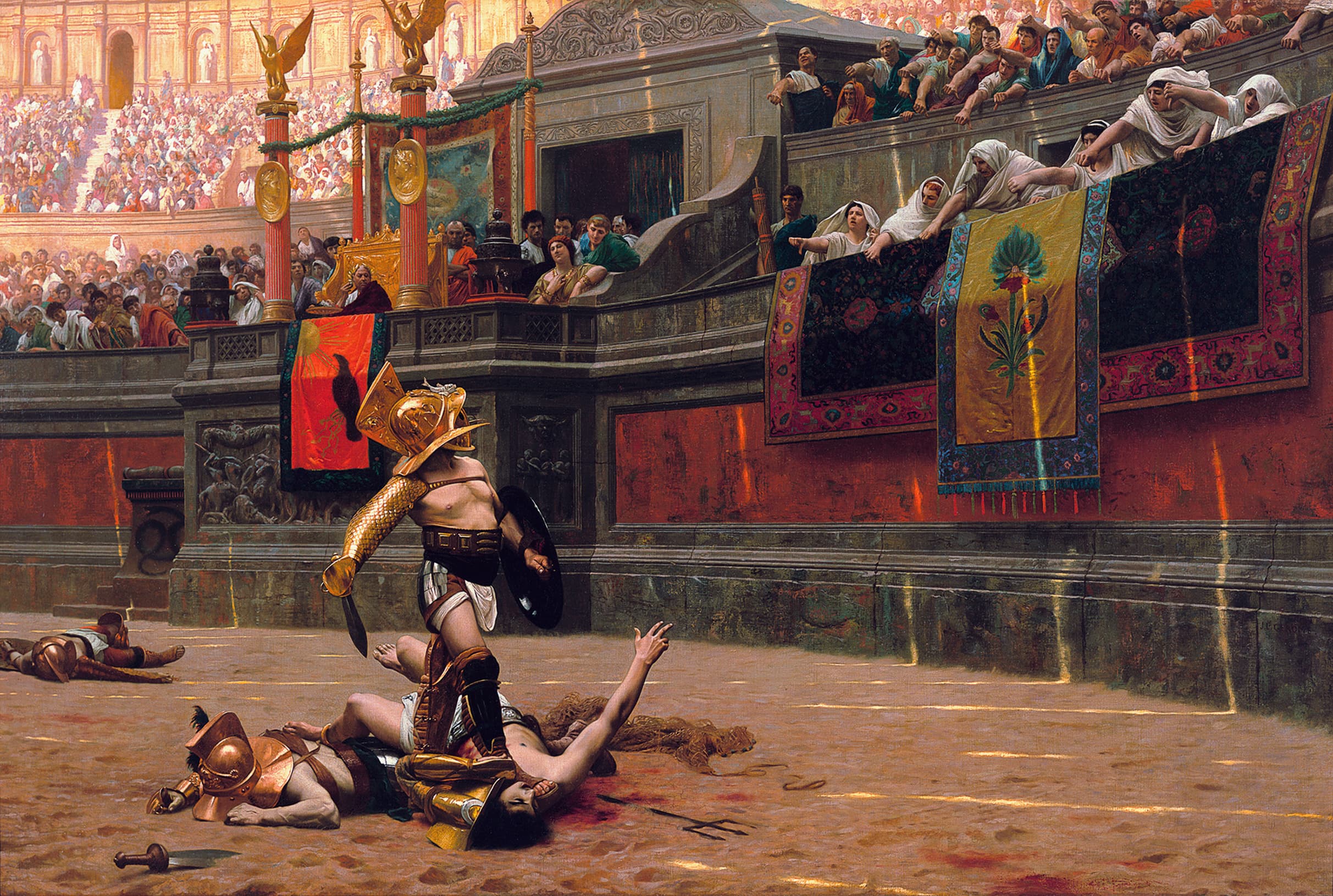
The winning gladiator is seen from behind in a crested helmet, with a gold scaled sleeve on his sword arm. A curved blade is still in his fist, and one bare foot rests on the man he beat. He is a murmillo, and Gérôme copied his armour from pieces dug up at Pompeii.
When the Colosseum opened in the summer of 80, the emperor Titus marked it with a hundred days of games. Cassius Dio says 9,000 animals died in them, hunted and killed in the sand. He also says Titus threw small wooden balls into the crowd from his box, each stamped with the name of a prize: so much grain, a horse, a slave. Whoever caught one took it to an attendant and collected. An awning the size of a small sea, the velarium, stretched over the top of the seats. A detachment of sailors brought up from the fleet at Misenum worked it. Rigging that much canvas against the wind was a sailor’s trade and no one else’s. Dio also says Titus wept at the dedication. He was dead a little over a year later, taken by a fever at a country posting station on the road north. The part everyone thinks they know, the crowd’s thumb deciding whether a beaten gladiator lived or died, is real in outline and blurred in every detail. The Romans did use a thumb, pollice verso, a turned thumb, and words for pressing it. What the gesture actually looked like, up, down, sideways, or hidden in a fist, no surviving source makes clear. The neat rule that thumb down means death was not handed down from Rome. It was mostly settled in the public mind by a painting. Jean-Léon Gérôme finished Pollice Verso in 1872. A murmillo in a crested helmet and scaled sleeve stands over the man he has beaten. The loser is a retiarius, a net fighter, flat in the sand with one hand thrown open above his head, begging. The winner does not look at him but up at the stands, waiting to be told. In the front row the Vestal Virgins lean over the marble and jab their thumbs down, and the whole tiered arena behind them does the same, a wall of thumbs. The scholarship was thin and the drama total, and the image simply won. Alexander Turney Stewart paid 80,000 francs for it, a record price for Gérôme, and it set the picture of the arena for everyone who came after. More than a century on, two producers walked into Ridley Scott’s office with a reproduction of the Gérôme and laid it on the desk before he had read a word of any script. Scott looked at the painting and said he would make the film. That film was Gladiator. The canvas that decided a modern blockbuster now hangs in the Phoenix Art Museum in Arizona, a long way from the sand. It is still turning its thumbs down at a man on his back with one hand up.