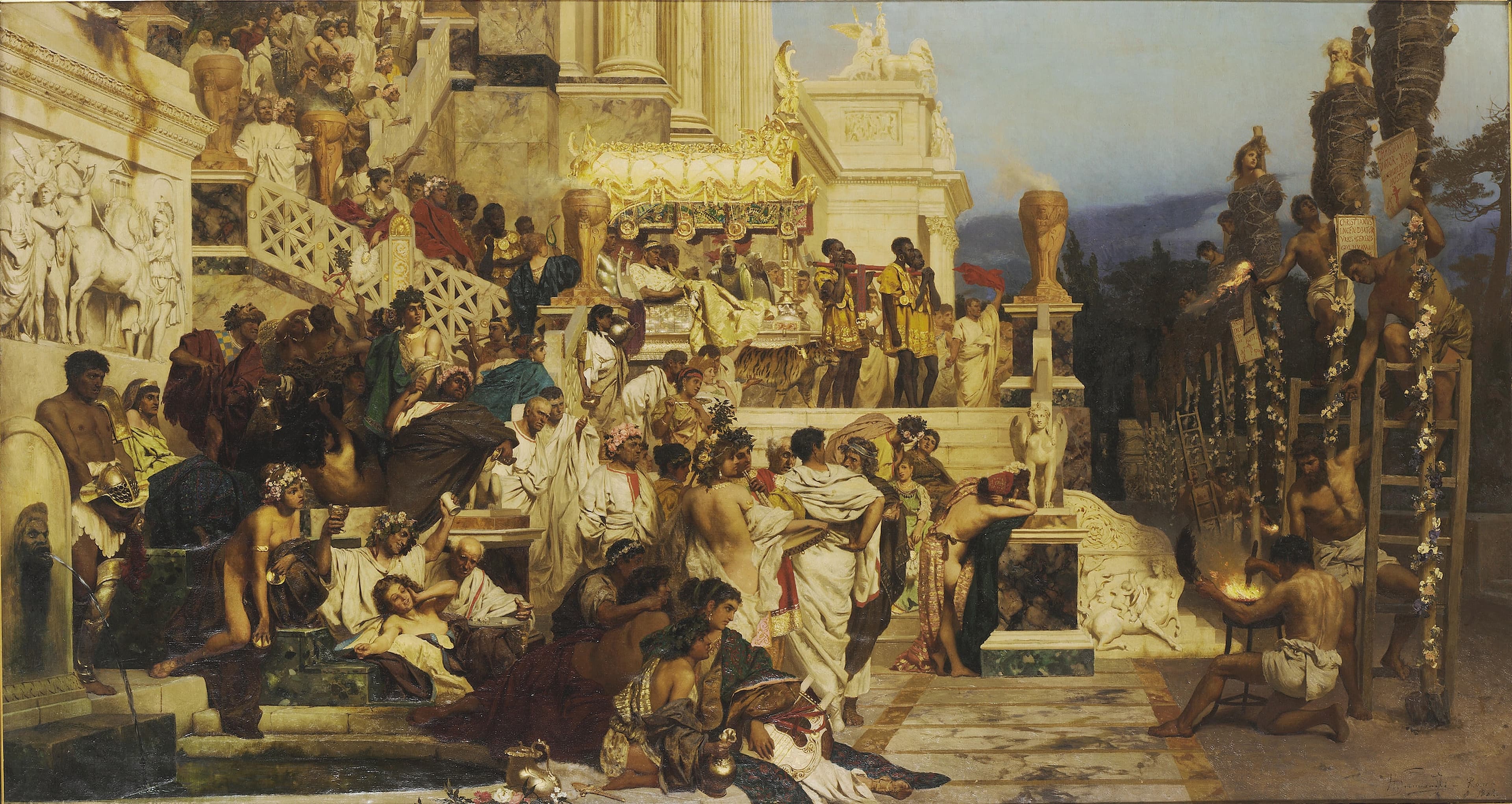
Ancient Rome · July, AD 64
Torches in the Garden
After the fire, an emperor needs someone for the crowd to blame
look closer
A woman is bound in straw at the top of her post. A man below holds up a board with the charge on it: CHRISTIANVS INCENDIATOR VRBIS, Christian, burner of the city. The posts are being dressed with flowers, and the torch at the left is already lit.
The fire started in the shops around the Circus Maximus on the night of the eighteenth of July, 64, and the wind took it. It ran for six days through the packed wooden districts, was checked, then broke out again and burned more. Of Rome’s 14 districts, only 4 came through untouched. Nero was 30 miles away at Antium when it began. Tacitus, who was a boy at the time and wrote from records decades later, says he hurried back and opened his gardens and public buildings to the homeless and brought in food. Tacitus also records the rumor that would not die: that while the city burned the emperor had sung of the fall of Troy, in costume, on a private stage. He does not say it happened. He reports that people believed it, which for a ruler is nearly as bad. Relief did not buy back the story. To kill the rumor Nero needed other arsonists, and he found them in a small, disliked sect the crowd already suspected of everything. Tacitus names them plainly, a rare early mention of Christians in a Roman source, and then describes what was done in a sentence colder than any accusation. They were covered in the skins of beasts and torn apart by dogs, or nailed to crosses, or made into torches to be lit after dark for light when day had gone. The emperor gave over his own gardens for the show and mixed with the crowd dressed as a charioteer. Even people with no love for the sect, Tacitus adds, began to pity them, sensing the killings served one man’s cruelty and not the public good. Henryk Siemiradzki painted that night in 1876, an enormous canvas he called Nero’s Torches, and staged it as a piece of cruel theatre. On the left the court settles onto a marble stair in gold and flower crowns, and in the middle Nero is carried down the steps on a litter under a canopy of gilded victories. On the right stand the tall posts. The condemned are bound to them in straw and hung with garlands like festival columns, with charge boards fixed up beside them naming them arsonists of the city. A man crouches at the foot of the posts over a fire pan, getting the first flame going. Across the front of the picture runs a strip of bare marble pavement, empty, the ground between the couches and the stakes. Siemiradzki gave the picture to the city of Kraków, and it became the founding work of its National Museum, a gift that started a collection. The garden where it happened sat on the far side of the Tiber, on the Vatican hill. A racing track ran through it, and near its center stood an Egyptian obelisk Caligula had shipped from Heliopolis. That obelisk still stands in Rome. It was dragged a few hundred yards in 1586 to the middle of a new piazza. There it watches the front of St Peter’s, on the ground where the sect Nero lit for a night eventually buried its capital.