Feudal Japan · 1274 and 1281
The Divine Wind
A samurai charges the largest fleet on earth, twice, and the weather saves him
look closer
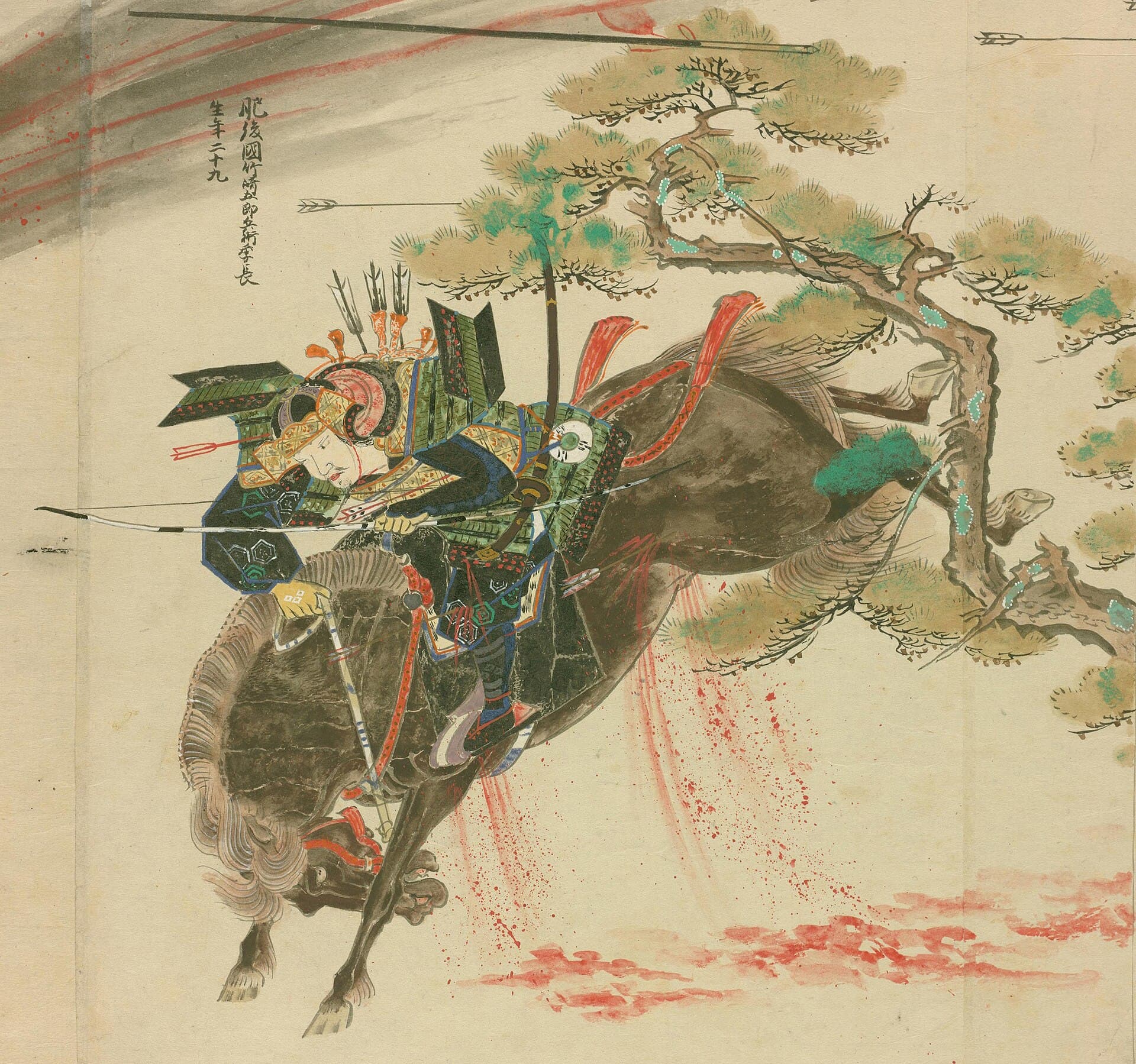
Takezaki Suenaga bends low in green-laced armor. The wide side plates of his helmet are flung back, and his own arrows stand in the quiver behind his head. A red-shafted arrow crosses toward his face from the left.
In 1274 the ships come out of the west toward Hakata Bay, and nothing in Japan has prepared anyone for them. Kublai Khan, having taken China, has sent a fleet from Korea, perhaps 900 ships and 40,000 men, against a country he expects to fold. The Mongols fight in disciplined units behind massed archery. They also throw the tetsuhau, a ceramic ball packed with powder, and it bursts with a noise and a spray of iron no one there has met before. The samurai ride out one at a time, calling their names and lineage to invite a worthy opponent, and are cut down in the open by volleys. Then, with the Japanese barely holding, a storm comes up in the night and wrecks a third of the fleet at anchor. The survivors sail home. One of the men in that fight was Takezaki Suenaga, a minor warrior from Higo with a complaint. He had fought hard and received nothing. Reward in this system went to whoever could prove his deeds to the officials, and Suenaga had no proof. So he did something almost no medieval soldier did. He rode the length of Japan to Kamakura to argue his own case in person, and won a horse and an estate out of it. Then he commissioned a set of illustrated scrolls to record exactly what he had done, with captions, so it could never be disputed again. The scrolls survive. They are the reason we can see this war from inside it. The painting here is from those scrolls, made around 1293. Suenaga is on his wounded horse, an arrow standing in its side and the blood coming down bright onto the sand, riding into arrows that are still in the air. His name and his age are written on the paper beside him; the whole point of the commission was that he, personally, was here. A calm green pine reaches over the violence, drawn with the same brush that drew the blood. Between the invasions, the Japanese did the sensible thing and built a wall. Along the likeliest landing beaches around Hakata they raised a stone barrier, roughly 2 meters high and running for kilometers, and they organized the coast to expect a return. It came in 1281, and this time the fleet was enormous, by the sources several thousand ships and well over 100,000 men, the largest seaborne invasion assembled anywhere before the twentieth century. The wall held the landings up. The defenders raided the anchored ships by night in small boats. And in the middle of August a typhoon came in off the sea and destroyed the fleet again, drowning a huge part of the army in the shallows. Twice the weather had arrived exactly when the country could not save itself, and the Japanese named it: kamikaze, the divine wind, the gods breathing on the water. It became a national conviction that Japan could not be conquered from the sea. That conviction was still doing work in another war, six and a half centuries later, when young men were told the wind had a name and were asked to become it.