Feudal Japan · July 1333
The Regent and the Goblins
The last man to rule Kamakura is remembered dancing while it ends
look closer
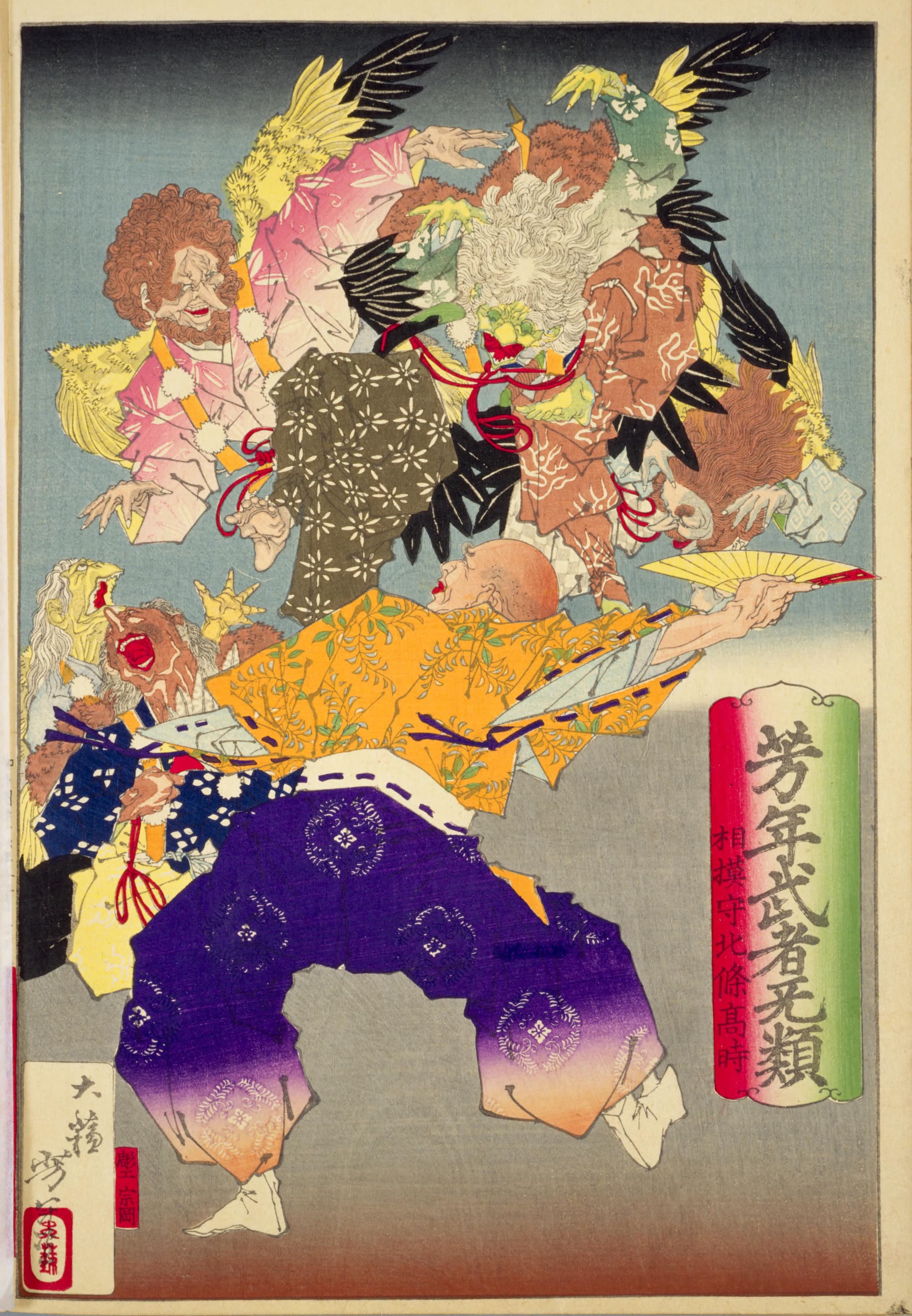
A man tips back under a black wing with his head shaved and his mouth open. This is Hōjō Takatoki, who took Buddhist vows in 1326 and shaved his head for them. He gave up the office of regent that year and kept the real power anyway.
By the 1320s the men who actually ran Japan were not the emperor and not even the shogun, but the Hōjō regents behind the shogun, and the last of them was Hōjō Takatoki. He was made regent in 1316, still a boy, and left the governing to others. What the chronicle remembers him for is dogs and dancing. He is said to have kept packs of fighting dogs, hundreds of them, fed on fish and birds and carried about in litters. He is also said to have lost himself for nights on end in dengaku, the wild temple dance, while the country’s business went unread. The painting is Yoshitoshi’s, from an 1883 series on famous warriors, and it takes the strangest story in Takatoki’s file at face value. The Taiheiki says a troupe of dengaku performers came one night to dance for him, and Takatoki, drunk and delighted, rose to join them. He did not see that they were tengu, the beaked mountain goblins, wearing the performers’ robes. They spun him through the steps and chanted a line about a devil star rising over the temple, an omen that his house was finished, and vanished. In the print he is caught mid-lurch in a bright yellow robe, mouth open, warding the black-winged goblins off with a fan while they crowd the air around his bald head. The end came in the summer of 1333. Two of the regime’s own commanders had turned: one seized Kyoto for the emperor, and another, Nitta Yoshisada, drove south on Kamakura itself. The story told of Nitta at the shore is that the beach approach was blocked and the tide was against him. So he threw his gold-mounted sword into the sea and prayed to the dragon-gods for a road. The tide is supposed to have gone out far enough to let his army around the headland. However it happened, the defenses broke, and Kamakura burned. Takatoki set fire to the government buildings and withdrew to Tōshō-ji, his family’s temple. There, on 4 July, he and the men of his clan killed themselves, more than 800 by the count that came down, some records saying nearer 900 with the townspeople who followed them. The regency that had held real power in Japan for over a century ended in one burning temple in one afternoon. Yoshitoshi drew the goblin dance five and a half centuries later, and he drew it as comedy and doom at once, which is about right for a man history could not decide whether to pity. The tengu got the last word they had chanted: the star came up over the temple, and the house came down.