Medieval Europe · 1302
The Exile With the Book
The city that sentenced him to burn puts him on the cathedral wall
look closer
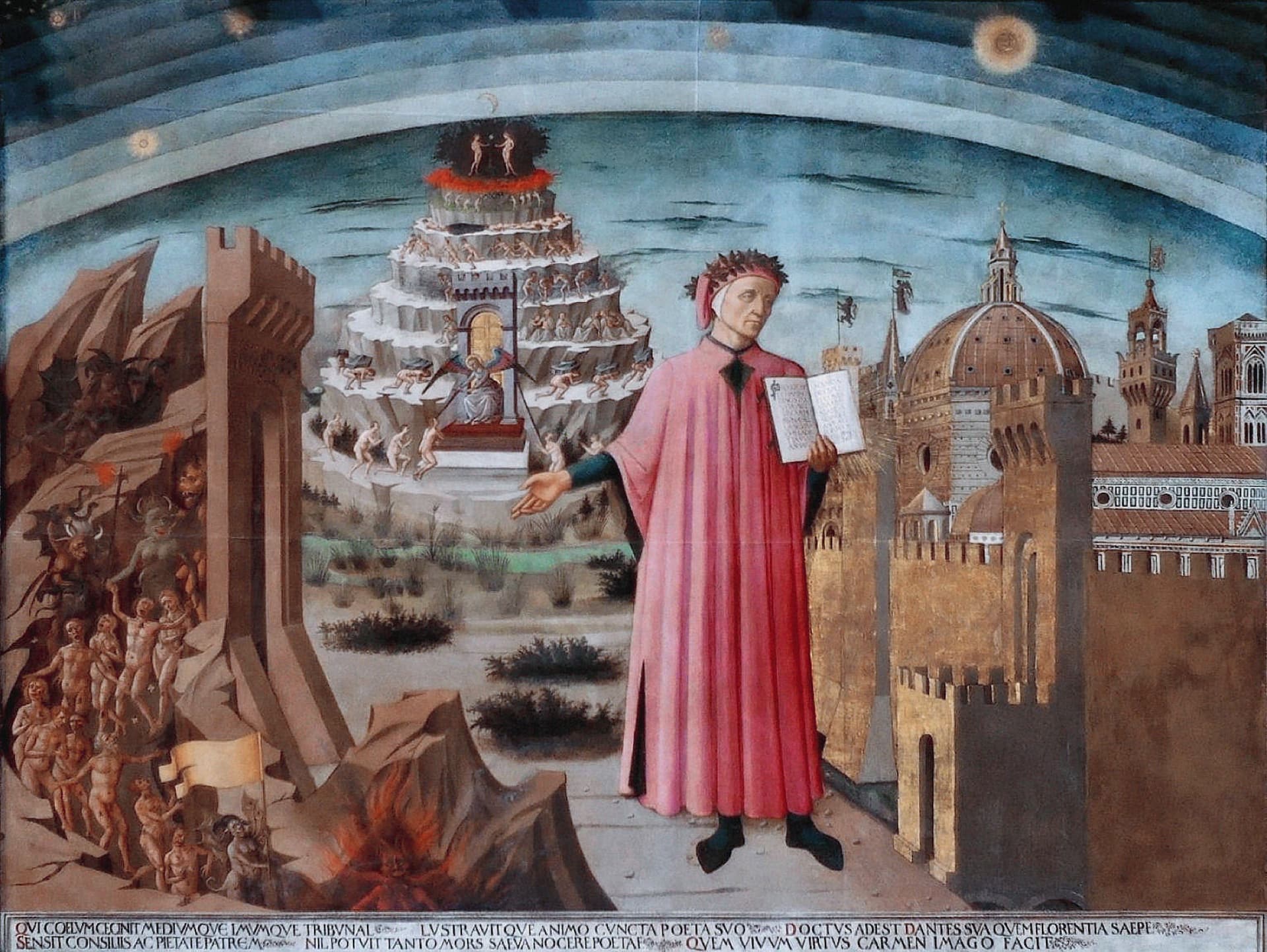
Dante holds the Comedy open, in a laurel wreath and a red hood. He wrote the poem in the Tuscan of his own street instead of Latin, which is why standard Italian is Tuscan.
Dante Alighieri was a Florentine politician on the losing side. In 1301, while he was away in Rome on an embassy, a rival faction took the city with French help. In January 1302 he was convicted of corruption without being there, and sentenced to a fine and 2 years' exile. He did not appear, so the sentence was raised to death by fire if he was ever caught inside Florentine territory. He never went back. He spent the remaining 19 years of his life moving between Verona, Bologna and Ravenna. He wrote the line every exile has borrowed since: how salt the taste of another man's bread, how hard the going up and down another man's stairs. He wrote the Comedy in that condition, and he wrote it in Italian. That was the decision with consequences. Serious work was written in Latin. Everyday Italian was for love songs and shopping lists. Dante wrote 100 cantos on the structure of the universe in the Tuscan of his own street. That Tuscan became the language a country was eventually assembled around. He also settled scores in it. Hell is full of people he knew, named out loud, including three popes. His Florentine readers were expected to recognize the local politicians. He died in Ravenna in 1321 of malaria caught on a diplomatic trip, and Florence has been trying to get the body back ever since. Ravenna has consistently declined. In 1519 the pope granted a Florentine petition for the remains. The tomb was opened and found empty. The Franciscans had cut a hole in the wall and taken the bones out. They stayed hidden until 1865, when workmen doing repairs found a wooden box with an inscription explaining who was inside. Domenico di Michelino painted this in 1465, for the wall of Florence cathedral, on commission from the city that had condemned him, and he worked to a design by Alesso Baldovinetti. Dante stands in red with the book open. Hell goes down on the left, purgatory rises behind him as a terraced mountain, and on the right are the walls of Florence with Brunelleschi's dome above them. The dome was finished in 1436, so the poet never saw it. The gate he is standing outside is the city's, and he is on the wrong side of it.