Medieval Europe · 18 March 1314
The Order Dissolved
A bankrupt king arrests his bankers on a Friday
look closer
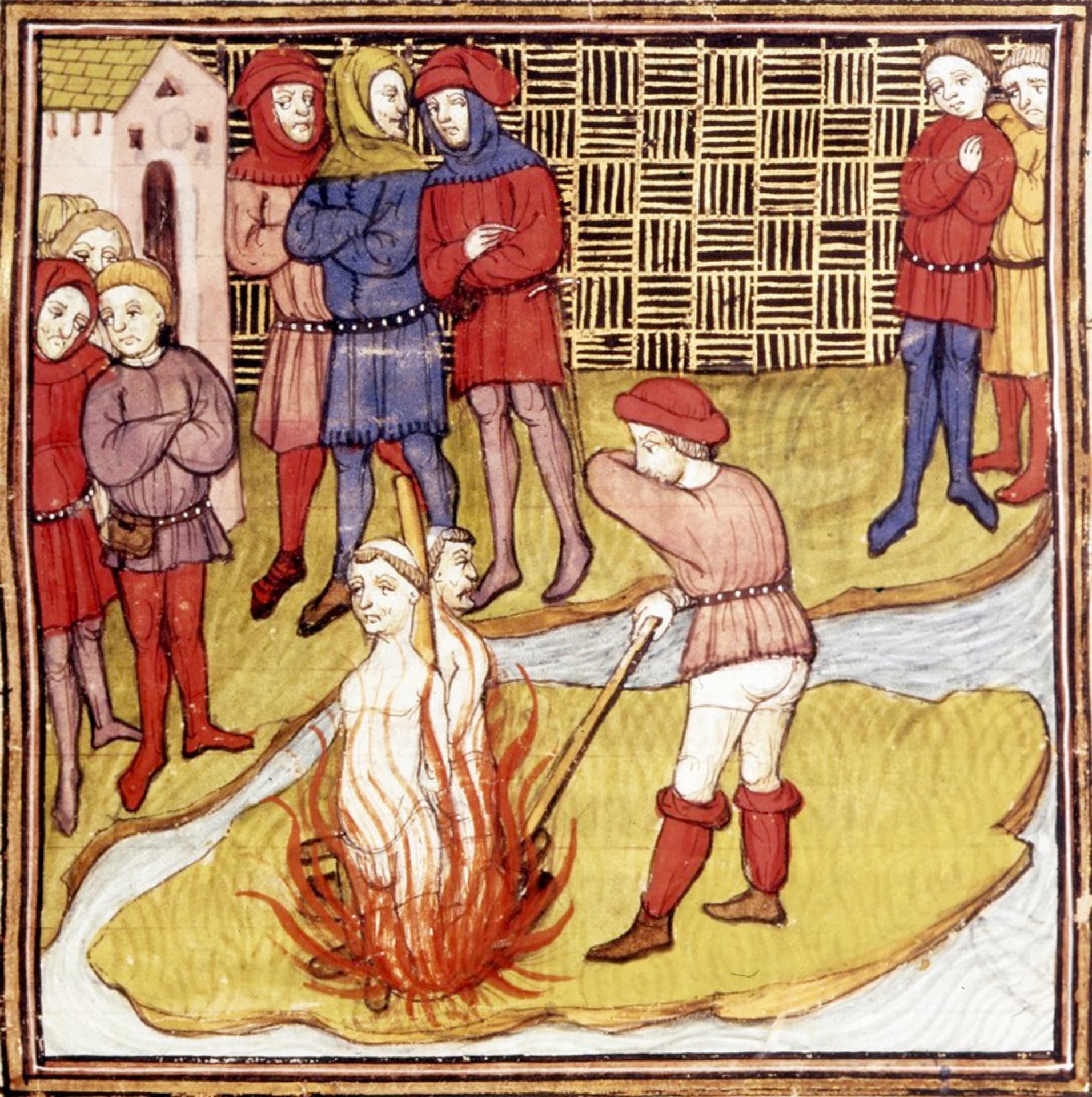
Two men burn on an island in the Seine. They are Jacques de Molay and Geoffroi de Charney, and de Molay was the last Grand Master of the Templars. Both had confessed under torture and then taken it back, and that made them relapsed heretics.
At dawn on Friday 13 October 1307, sealed orders that had gone out weeks earlier were opened across France simultaneously, and royal officers arrested every Knight Templar they could find. The order had been founded in 1119 to protect pilgrims on the roads of the Holy Land and had become something nobody planned: a multinational bank. Templars held deposits, moved money between kingdoms on paper so travellers did not carry gold, managed estates, and lent to monarchs. One of the monarchs was Philip IV of France. He had already expelled the Jews and taken their property, debased his coinage, and taxed the clergy. He owed the Templars a great deal of money. The charges were spectacular and impossible to disprove: denying Christ, spitting on the cross, obscene initiation rites, worshipping an idol called Baphomet that nobody could ever produce. Confessions arrived quickly, because the men were tortured. In England and Aragon, where torture was not used at first, the Templars largely confessed to nothing. Many who confessed later took it back. Under the rules of the day that made a man a relapsed heretic, and relapsed heretics were burned. In 1310, 54 of them were burned outside Paris. Pope Clement V lived at Avignon and depended on French support. In 1312 he dissolved the order without formally condemning it, and handed most of its property to the Knights Hospitaller. France took its cut in expenses. The last Grand Master, Jacques de Molay, had been in a cell for 7 years. In March 1314 he was brought out onto an island in the Seine, retracted everything, and was burned that evening with one of his officers. The story that he summoned pope and king to meet him before God within the year is a later embroidery, but both were dead within eight months, which is why the story exists. A document found in the Vatican archives in 2001, the Chinon parchment, shows Clement had absolved the leadership of heresy in 1308 while dissolving the order anyway on grounds of scandal. The illumination here was painted in Paris about 1380, for a copy of the Chroniques de France ou de Saint-Denis, some 66 years after the fire. Two men stand in the flames. The executioner leans on his rake, and a row of spectators watches with folded arms.