The Age of Sail · 25 April 1607
The Flagship Went First
The Dutch catch a fleet at anchor and the sky fills with rigging
look closer
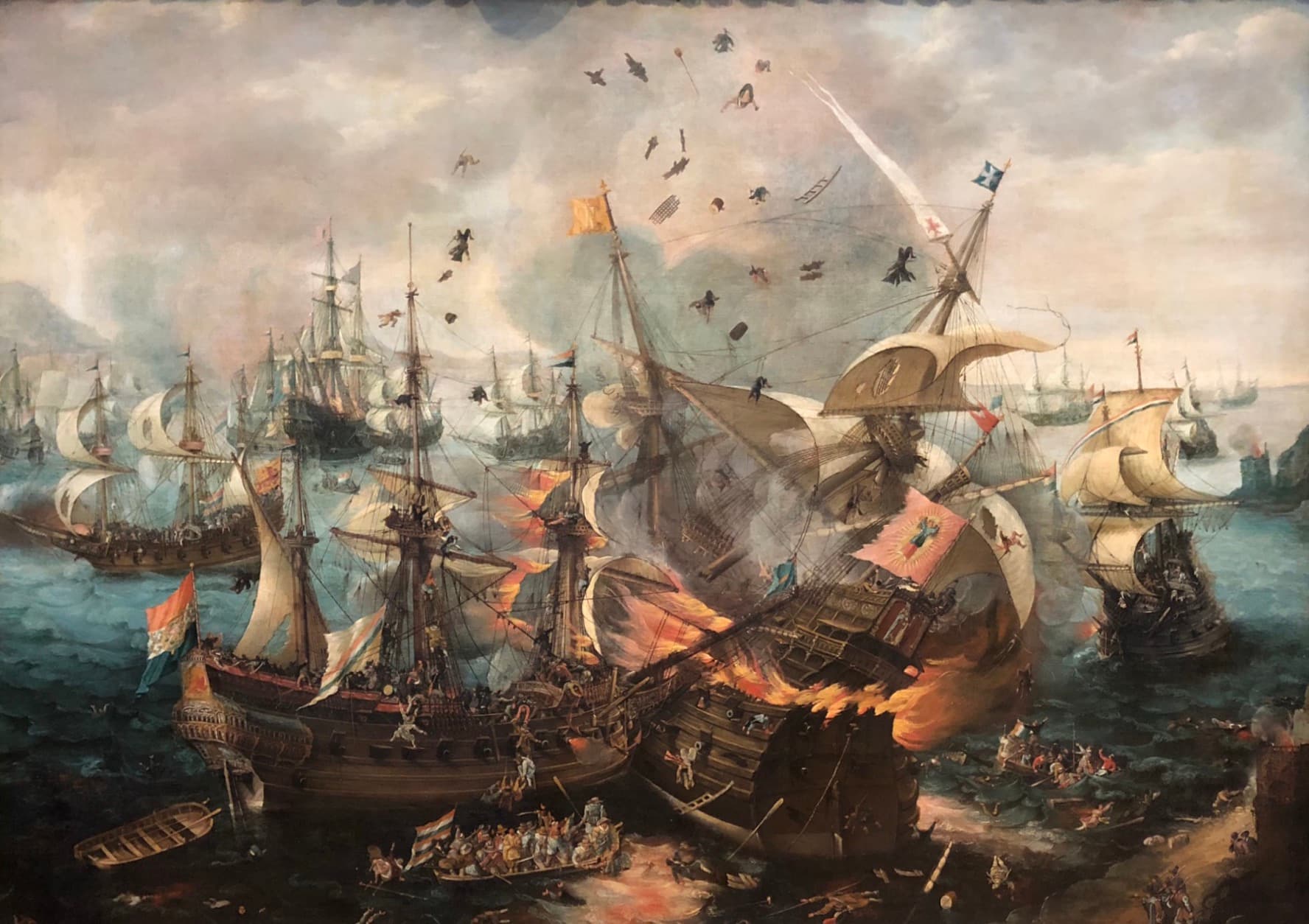
Sailors, a ladder and a wooden deck grating are up in the sky and still rising. The Spanish flagship's powder store caught fire in the middle of the afternoon. This is what came off her top deck.
The Spanish fleet lay at anchor under the guns of Gibraltar on 25 April 1607, in its own harbor, in its own war. Then 26 Dutch ships came around the point flying every flag they owned. The Dutch Republic was 39 years into its rebellion against Spain and had decided to make a point where it would be most educational: at home. Admiral Jacob van Heemskerck had already survived a winter frozen into the Arctic on Nova Zembla, with nothing but ship's biscuit and polar bears for company. He gave his captains a plan with no second act: sail straight in, lay alongside, and destroy everything afloat. Heemskerck did not live to see much of it work. A cannonball took off his leg in the first exchange, alongside the Spanish flagship, and he bled out on his own deck; his officers kept the news moving slowly while the battle moved fast. The Dutch doubled up on the anchored galleons, two to one. In the middle of the afternoon the fight produced the image the whole war had been waiting for: the Spanish flagship took fire in her powder magazine and went up whole. Van Wieringen painted the moment with an accountant's literalness. Sailors, ladders and gratings hang against the smoke at the top of their arc, over a jet of flame and cordage where a galleon had been standing a second before. By evening the Spanish fleet at Gibraltar had ceased to exist: every ship burned, sunk, or shattered, thousands of men dead against about a hundred Dutch. The victory shocked both capitals into speeding up truce talks. Two years later Spain signed the Twelve Years' Truce, which treated the rebel provinces, for the first time, as a country you make treaties with. That is the polite version. The painting also records the other one. In the foreground boats, Dutch sailors are beating the swimmers with oars, and van Wieringen put it in because everyone knew it had happened and nobody yet thought it needed hiding. The canvas was made around 1621, the year the truce expired, commissioned as a reminder of what the last round had cost Spain. It hangs in the Rijksmuseum with the falling men mid-air, four centuries into a descent that the painter, deliberately, never lets end.