The Age of Sail · 22 November 1718
The Head on the Bowsprit
Blackbeard’s two-year career ends in a boarding trap in a Carolina inlet
look closer
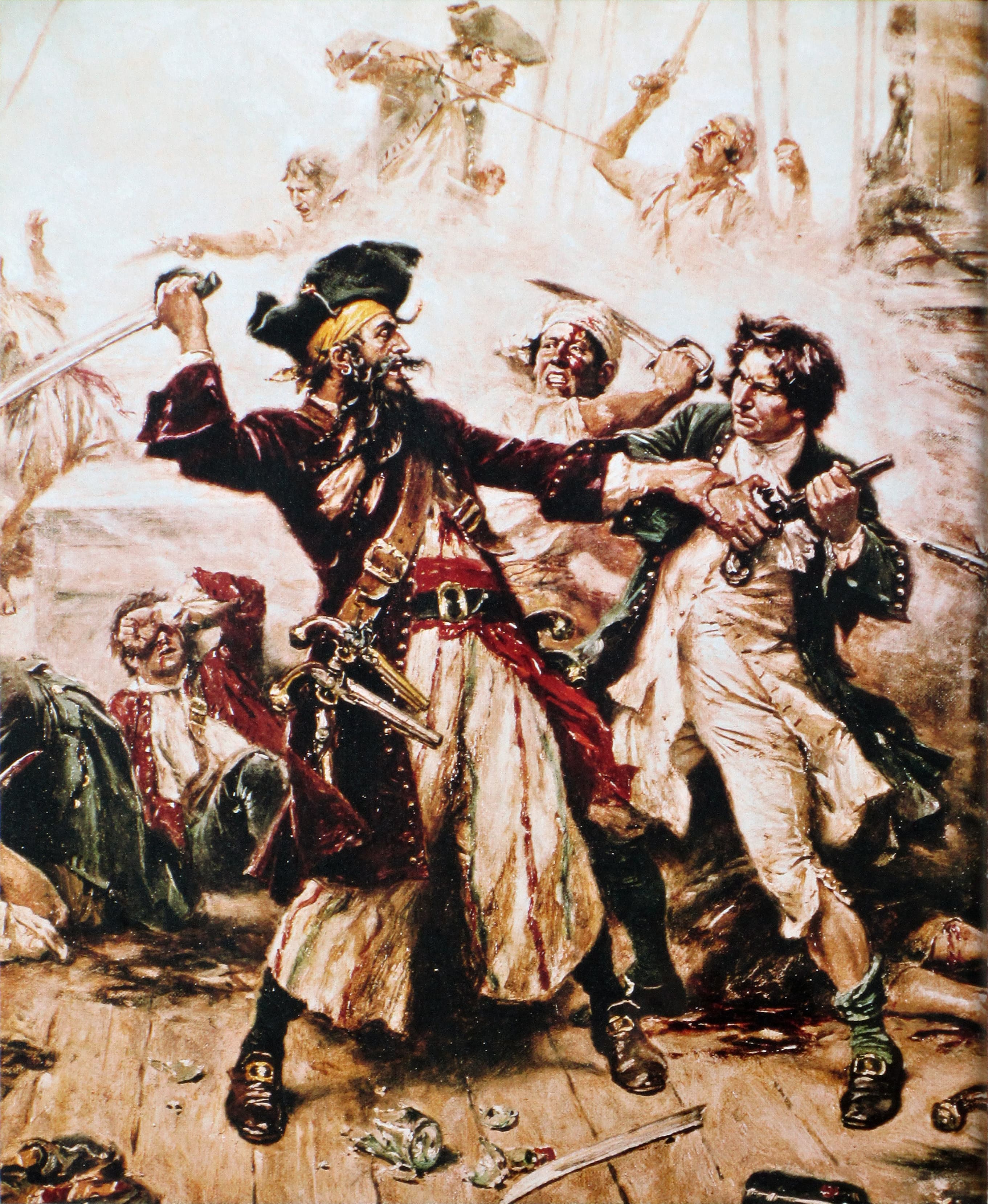
Teach is in profile under a black three-cornered hat, and his beard hangs in tied strands. A gold hoop is in his ear and his fist is closed around a cutlass. Ferris left out the one thing everyone remembers, the lit fuses Teach is said to have tucked under his hat until his whole face smoked.
Edward Teach anchored for the night in Ocracoke Inlet on the North Carolina coast, and by first light on 22 November 1718 two small sloops had crept in after him. He was an Englishman, most likely out of Bristol, better known by the beard he had made into a brand. By the accounts, he wore it long and black down his chest, tied off in little pigtails. In a fight he tucked lengths of smouldering cannon fuse under the brim of his hat, so that his whole face smoked. Men who met him swore he looked like the devil come up out of the sea. He had been a pirate for barely two years. In that time he had taken dozens of ships and run a captured French slaver of 40 guns, which he renamed the Queen Anne’s Revenge. He blockaded the whole port of Charleston until the city sent him a chest of medicine to make him go away. The man hunting him was not even from his colony. Lieutenant Robert Maynard of the Royal Navy had been sent by the governor of Virginia, who had no legal say over North Carolina and did it anyway, with two hired sloops and no cannon. Maynard set a trap using his own weakness. When Teach’s crew fired a broadside that swept his decks, Maynard hid most of his men below and left the deck looking nearly empty. The pirates grappled on and swarmed aboard, expecting to finish a beaten ship. Then the hatches came up. The fight that followed was hand to hand across a few yards of deck. Teach and Maynard shot at each other, then went at it with swords. Teach’s cutlass shattered the officer’s blade, and a Highlander in Maynard’s crew came in from the side and cut the pirate across the throat. He was hard to kill. The sailors who stripped the body afterward counted 5 gunshot wounds and about 20 cuts, and said he had gone on fighting through most of them. Maynard had Teach’s head hacked off and lashed to the end of his sloop’s bowsprit, partly as proof to collect the reward and partly to be sure the thing was really dead. The body went over the side. The story that the headless corpse swam three times around the ship before it sank was already being told within a few years, and no amount of arithmetic has ever quite killed it. As for the treasure, Teach is supposed to have said that only he and the devil knew where it was, and neither has said. His flagship sat lost on the sea floor off Beaufort Inlet until divers found the wreck in 1996. Almost everything colourful about Blackbeard comes from one book: the smoking beard, the devil talk, the swimming body. A General History of the Pyrates was published in London in 1724, six years after his death. The writer called himself Captain Charles Johnson, and nobody has ever pinned down who he was. The painting is later still and honest about being a legend. Jean Leon Gerome Ferris made it around 1920, for a series of American history scenes meant for schoolrooms and prints. He freezes the fight at its peak. Teach is in a dark red coat and a yellow headscarf, a cutlass up in one fist and the other hand locked on Maynard’s arm, a brace of flintlocks swinging at his hip. Maynard is braced against him with a pistol out. It is two centuries of storytelling painted as one frozen second, on a deck the painter never saw, of a fight nobody sketched.