The Age of Sail · 26 November 1703
Winstanley’s Wish
A showman builds the first sea lighthouse and asks to be inside it in the worst storm
look closer
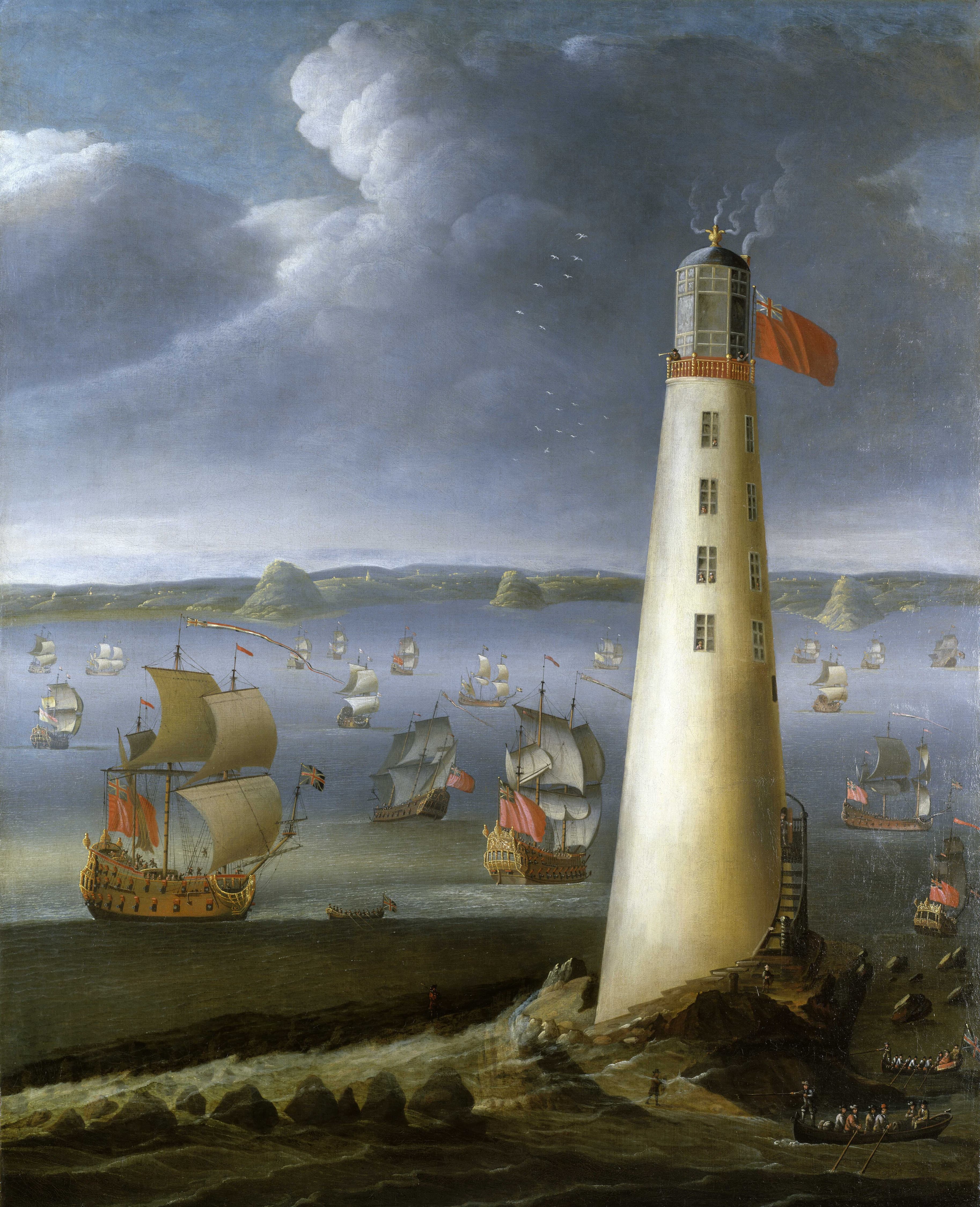
The lantern room stands under a black dome with a gilded ornament on top, and smoke goes up off the light. One keeper is out on the red gallery with a glass to his eye, and another stands beside the ensign. This is not Winstanley’s tower but John Rudyerd’s replacement, which was lit on the same rock in 1708.
Henry Winstanley was not a sailor. He was a showman, an Essex gentleman who engraved playing cards and ran a Mathematical Water Theatre in Piccadilly full of fountains and clockwork tricks. He filled his own house with practical jokes: a chair that grabbed anyone who sat in it, a floor that dropped a visitor into the garden. He came to the sea by losing money on it. He had put his savings into a few merchant ships, and two of them broke apart on the Eddystone. That is a low reef of rock 12 miles out from Plymouth Sound, and it had been sinking ships for as long as anyone kept count. When he asked why nobody warned ships off it, he was told that no one could build anything out there that the sea would not take. He took that as a dare. Between 1696 and 1699 he built the first lighthouse ever raised on a rock in the open ocean. He worked only in the short calm weeks of summer, drilling the reef by hand. A French privateer once carried him off in the middle of the job, in the middle of a war, and the king ordered him released because a lighthouse helped everyone. What he finished looked less like a lighthouse than like something from his theatre: an ornate wooden tower, candlelit, hung with carved scrolls and Latin mottoes and iron flourishes, a folly standing in the Atlantic. Sailors could not quite believe it. It worked. For five winters the Eddystone light burned and ships stopped dying on the reef. Winstanley was so proud of the thing that he said out loud the wish that would kill him: that he might be inside his lighthouse during the greatest storm that ever blew. He got the greatest storm that ever blew. On the night of 26 November 1703 a hurricane came up the Channel that people still measure other storms against, the worst in English history before or since. Winstanley happened to be out at the Eddystone that day making repairs, and chose to stay the night in his tower to see it hold. It did not. By dawn on the 27th the lighthouse was simply gone, swept off the rock down to the iron stumps. Winstanley and five other men were gone with it, no bodies, no wreckage anyone could name. The same night the storm tore the fleet apart. The Royal Navy lost 13 warships in a few hours and around 1,500 sailors drowned; a rear-admiral died with them. On land 2,000 chimney stacks fell in London alone, and the lead was peeled off Westminster Abbey. The Bishop of Bath and Wells was crushed in his bed when his own palace chimneys came through the roof. A hack writer just out of the pillory for debt and libel saw a subject in it. Daniel Defoe put advertisements in the papers asking survivors to send him their accounts. He gathered the letters and published The Storm the next year, stitching hundreds of ordinary voices into what people now call one of the first real works of reporting. He wrote Robinson Crusoe 15 years later. Isaac Sailmaker painted the Eddystone a few years later, one of the first men in England to make a whole living painting ships. The tower in his picture is not Winstanley’s. Winstanley’s had been scoured off the rock down to the iron stumps. This smooth pale cone, plain as a candle, is the second Eddystone light. John Rudyerd raised it on the same reef and lit it in 1708, with no scrolls, no mottoes and nothing for a gale to take hold of. The red ensign flying beside its lantern carries the union canton adopted in 1707. Sailmaker painted the rock working again, warships filing past it in safety, and no sign at all of the showman who put the first light there.