The Age of Sail · 12 June 1667
The Royal Charles Carried Off
The Dutch sail up an English river and tow away England’s flagship
look closer
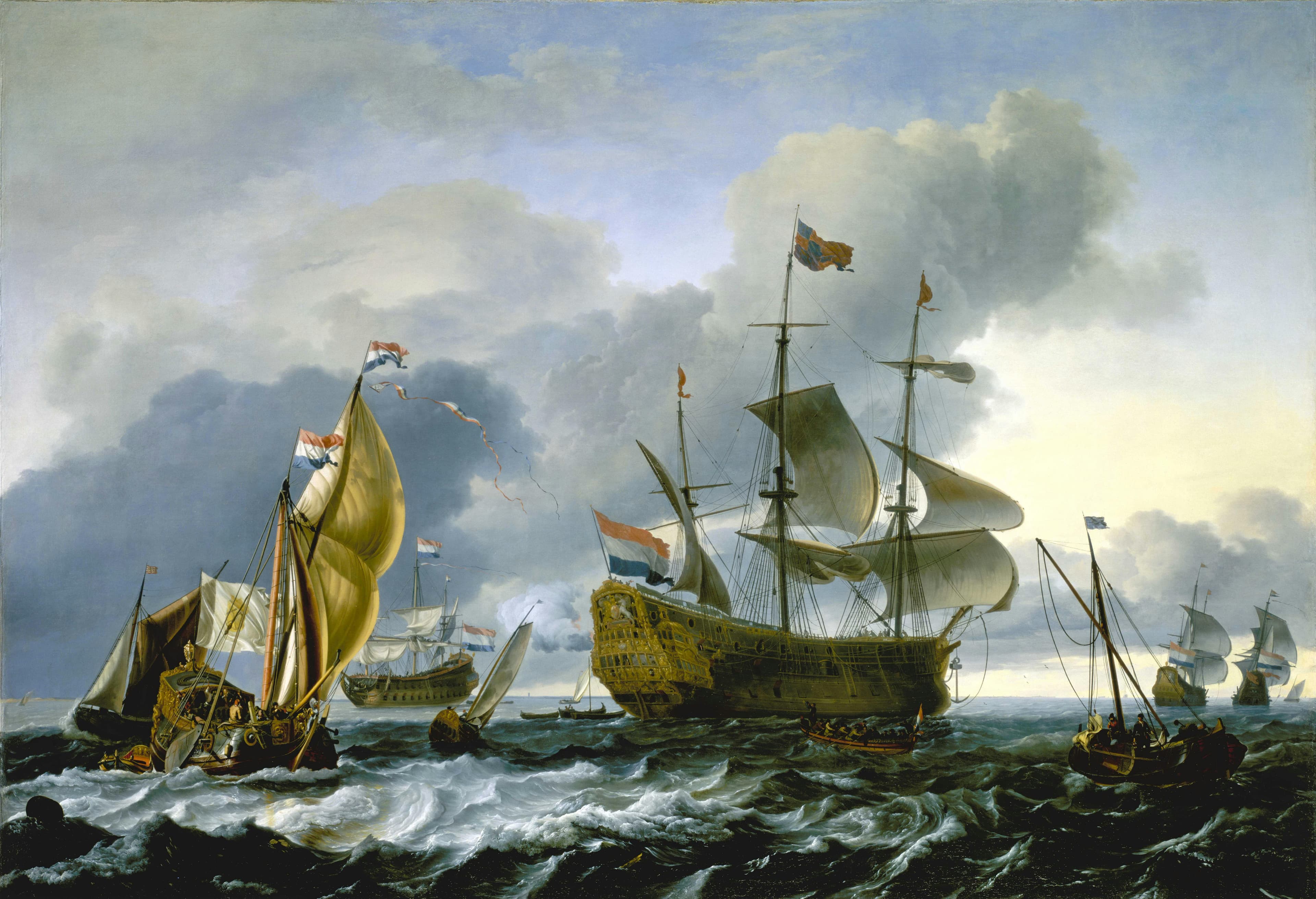
The Royal Charles moves with only a little sail set, and the Dutch flag flies from her rear mast. Her whole stern is one slab of gilt carving, and a puff of gun smoke stands off her side. She had been the Naseby until Charles II came aboard in 1660 and renamed her on the spot.
In June 1667 a Dutch fleet did something no enemy had done before or has done since. It sailed up an English river, past the forts, into the heart of the Royal Navy’s home dockyard, and came out towing the flagship. England had brought the disaster on itself. The Crown was broke after the plague and the Great Fire. The biggest warships had been laid up in the mud at Chatham to save money. The sailors were so far behind on their pay that some had rowed over to the Dutch side, and they were now piloting the attack. On 12 June the Dutch broke a great iron chain strung across the Medway at Gillingham. Then they put a boarding party onto the Royal Charles, 80 guns, pride of England, sitting there with almost no crew. The next day they burned three of the finest ships left in the fleet at their moorings. The insult was doubled by what that ship was. She had been built under Cromwell and named the Naseby, after the battle where Parliament broke the king’s army. Then in 1660, refitted and renamed, she was the very ship that carried Charles II home from exile to take back his throne. Now a handful of Dutch sailors walked her decks. They found her too deep to bring out easily and took her anyway, floating her downriver on the tide with the tricolor run up where the royal standard used to fly. Michiel de Ruyter commanded the operation from the estuary. Cornelis de Witt, brother of the man who ran the Dutch Republic, rode up the river with the raiding squadron to see it done, and signed the report. It was, in cold terms, the worst day in the history of the Royal Navy. Samuel Pepys, who ran the navy’s paperwork and heard the guns from London, wrote it all down in his diary with his hair standing on end. He sent his wife and his father out of the city with 1,300 pounds in gold sewn into a belt, half expecting the Dutch on the Thames next. He called the whole thing a dishonour never to be wiped off. He was not entirely wrong. The raid pushed England to make peace within weeks, on terms that let the Dutch keep the sugar colony of Suriname. In exchange England kept a swampy North American port it had grabbed and renamed New York. A week of gunpowder up one river had settled the ownership of a slice of two continents. Ludolf Bakhuizen painted the trophy at sea, and painted it the way the Dutch wanted to remember it. The captured ship rides high and gilded in a fresh Dutch wind, escorted in under the tricolor with boats of men pulling alongside her. He went out in open boats in bad weather to watch how the sea actually behaved, and the water here is his, choppy and specific and cold. After Willem van de Velde and his son left for England in 1672, he was the leading marine painter in Amsterdam. The real ship did not last. She was too big and too deep for Dutch harbors, so within a few years she was broken up for timber. One piece was sawn off and kept: the carving from her stern, the royal arms cut in oak and gilded. It hangs in the Rijksmuseum in Amsterdam today, a lion and a unicorn holding up a shield, taken as a souvenir and never given back. Bakhuizen’s picture of the day they took her hangs in Greenwich, in the losing navy’s own museum.