The Age of Sail · July 1620
The Speedwell at Delfshaven
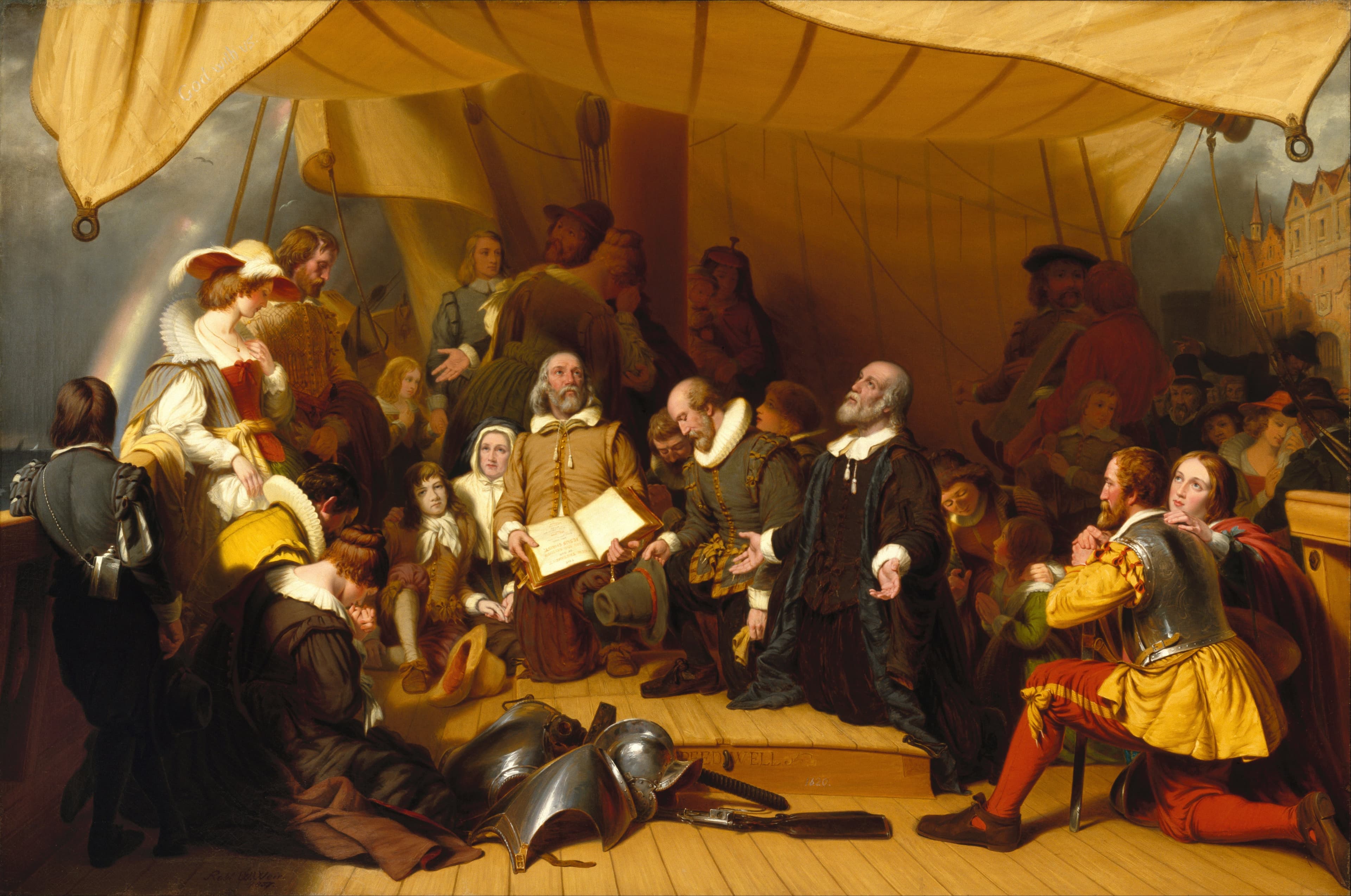
A congregation prays on a deck before crossing an ocean they have only read about
look closer
An open Bible lies across William Brewster’s knee, and an older man in a starched ruff leans in over it with his hat in his hand. This is the Geneva Bible, the English translation with footnotes that these Separatists read. The official church distrusted it because ordinary people could carry it and argue with it.
They had already left one country before they left for good. In 1608 a small congregation of English Separatists slipped across to Holland and settled in Leiden. They were in trouble at home for worshipping outside the official church. There they could pray as they liked, and work themselves grey in the cloth trade. After about 12 years they made a harder choice. Their children were growing up Dutch, the truce with Spain was ending, and they resolved to cross the Atlantic and build a settlement where they could be both English and free. In July 1620 the first of them boarded a small ship called the Speedwell at Delfshaven to sail to Southampton, meet a second, larger ship, and go. This painting is that morning: the deck at Delfshaven, the sails half set, the whole company on its knees while their pastor prays over them. The man who stayed behind is the one blessing them. John Robinson had led the Leiden congregation and meant to follow with the rest of the flock later. He never did. He died in Holland five years on, so the goodbye in the picture was the last time most of them saw him. William Brewster, the elder, would go. So would a stubborn young man named William Bradford. He lived to govern the colony for decades and to write its history in plain, aching prose. That book is where he calls the travelers pilgrims: they knew they were pilgrims, he wrote, and looked not much on those things but lifted their eyes to heaven. The Speedwell turned out to be a disaster. She leaked so badly on the way that she was abandoned in England. About 102 people crammed instead onto the one ship that held, the Mayflower. She left Plymouth in September, took 66 days, and made Cape Cod in November with the wrong latitude and winter coming. Weir loads the deck with small true weights. A breastplate, a backplate and a helmet lie on the planks in the foreground with a musket beside them, the soldier’s trade set down for the length of a prayer. The deck timber behind them is lettered SPEEDWELL. William Brewster holds the open Bible across his knee while an older man in a ruff leans in over it with his hat in his hand. These people read the Geneva Bible, the plain, heavily footnoted English translation the official church disliked precisely because ordinary readers could carry it and argue with it. On the left, under the hanging sail, Weir painted a rainbow. It is not weather. It is the sign God gave Noah, and he painted it red, white and blue, the colors of the flag these people were leaving. Robert Walter Weir painted this between 1837 and 1843, more than two centuries after the deck it shows. He painted it to hang in one specific room, the Rotunda of the United States Capitol. It is still there, 12 feet by 18, one of eight enormous history paintings ringing the walls. Weir taught drawing to army cadets at West Point for 40 years. One of the cadets who sat in his class was James McNeill Whistler, who went on to paint the most famous portrait of a mother in the world. One of Weir’s own sons, Julian Alden Weir, grew up to help bring French Impressionism to America. At the right edge of the picture, close enough to step onto, Weir put the stepped gables of Delfshaven. A knot of people stands on the quay, one of them with his arm out toward the ship.