The Age of Sail · 8 August 1588
God Blew and They Scattered
Eight burning ships and a north wind undo the greatest fleet in Christendom
look closer
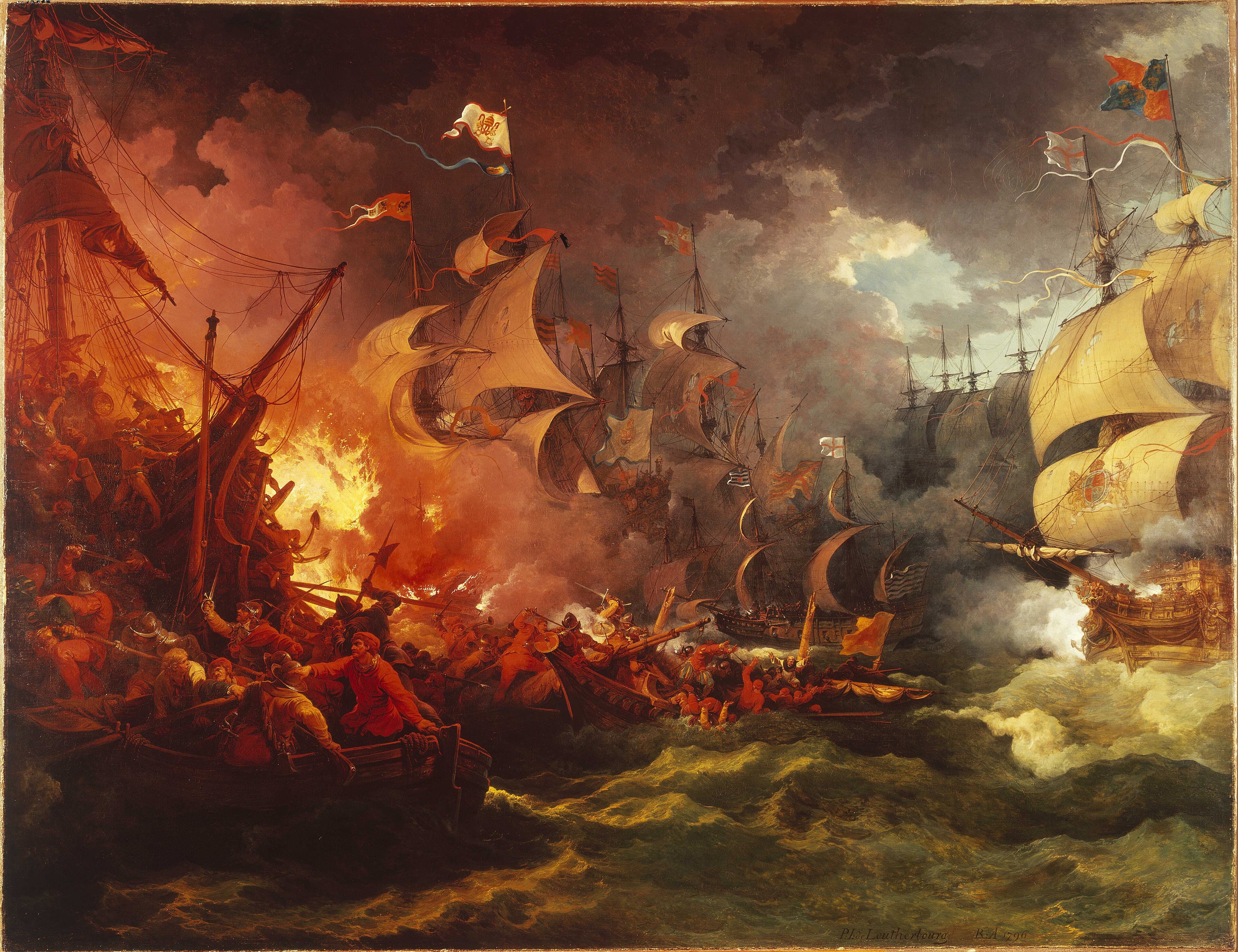
A Spanish ship heels over with her rigging cut loose, and men are packed along the tilted deck under masts that stand black against the fire. No Spanish ship actually caught fire at Calais. The crews cut their cables in the dark and the formation came apart.
The plan was enormous and it half worked. In the summer of 1588 Philip II of Spain sent about 130 ships up the English Channel. Some 30,000 men were aboard, and their orders were to meet his army in the Netherlands, ferry it across, and put an end to Elizabeth I and Protestant England. The fleet sailed in a crescent miles wide, and for a week the English ran alongside it firing and could not break it. The Spanish commander was the Duke of Medina Sidonia, a careful landed nobleman who got seasick and had never wanted the job. He had written to the king begging to be excused, on the honest grounds that he knew nothing of the sea. Philip gave it to him anyway. He held the crescent together all the way up the Channel, which was harder than winning a battle and less remembered. The break came at anchor. On the night of 7 August the Armada lay off Calais, waiting for the army that was not ready. The English filled eight old ships with pitch and tar and set them alight. The tide carried them down into the packed fleet in the dark. Not one Spanish ship caught fire. It did not matter. Captains who had spent a week in disciplined formation cut their anchor cables rather than burn, and ran for open water. By morning the crescent was gone, the ships scattered across the sea in ones and twos. The next day, off Gravelines, the English closed at last and fought the one real gun battle of the campaign. They fired low into the hulls until the Spanish were driven north, with the wind behind them and no way back down the Channel. And then the weather took over, and the weather was English. The Armada had to escape the only way left, up around the top of Scotland and down the wild Atlantic coast of Ireland, and the autumn gales caught it there. Ships that had survived every English broadside broke up on the rocks of Donegal and Kerry; men who reached shore were often killed on the beaches. Perhaps half the fleet never came home, most of it drowned rather than shot. Elizabeth had ridden to Tilbury to address her troops. She told them she had the body of a weak and feeble woman, but the heart and stomach of a king, and of a king of England too. When it was over, England struck a medal that gave the credit to the weather and to God together, in four Latin words: he blew, and they were scattered. The painting is a late one, and it is a fireship’s idea of the fight. Philip James de Loutherbourg made it in 1796, more than two centuries after the event. He stages the Battle of Gravelines as pure theatre. A Spanish ship on the left heels over, black against a wall of flame, with sailors fighting from open boats in the smoke below her. The English flagship Ark Royal sails half out of the frame on the right, Elizabeth’s arms painted on her foresail. De Loutherbourg had actually run a theatre of a kind. In London he built a miniature mechanical stage he called the Eidophusikon, with tin sheets for thunder and colored lamps for fire and storms, moving pictures decades before the technology existed. The machine is still running behind this canvas. The light comes from where the drama needs it, and every ship is lit like a set.