The Age of Sail · 7 October 1571
The Arrows of Lepanto
The last great battle of oared galleys, decided hand to hand across joined hulls
look closer
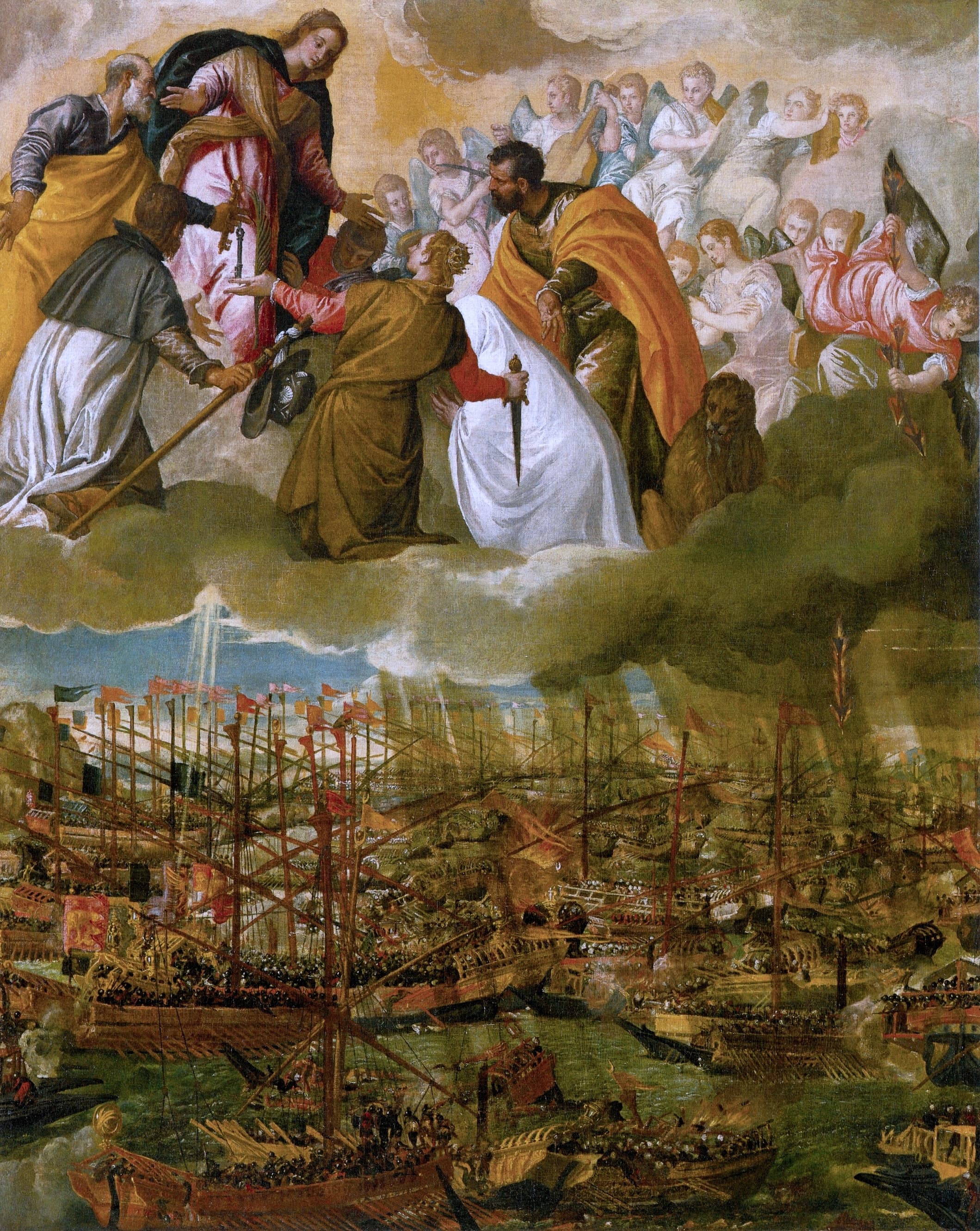
A hat with a scallop shell and a pilgrim’s staff mark Saint James at the left. Beside him a crowned head bows and a figure in white grips a dagger point-down. Veronese put four patron saints of the Holy League up here to present Venice to the Virgin of the Rosary.
On the morning of 7 October 1571 two fleets rowed toward each other in the Gulf of Patras, off the town the Italians called Lepanto, and neither could run. Galleys fight by closing: oars against oars, then boarding planks, then a foot of blood-slick deck at a time. On the Christian side some 208 galleys carried the flags of Spain, Venice, the Pope, Genoa, Malta and Savoy. The alliance had spent months not trusting one another. Now it was lashed into a single line under a young man of 24. Don John of Austria was the illegitimate half-brother of Philip II of Spain. Before the fight he had himself rowed down the line in a fast boat, holding up a crucifix and letting the whole line look at it. Across the water waited a roughly equal Ottoman fleet under Ali Pasha, who had his own son aboard and the Sultan’s orders to attack. The Venetians had a surprise. Six galleasses, fat oared hulks bristling with far more cannon than a galley could carry, were towed out ahead of the line and let the Ottoman front row in close before firing into it. The heavy guns broke up the attack before it properly began. Then the lines met, and the battle became what galley battles always became. For four hours men fought hand to hand across joined hulls, a floating infantry brawl, while both fleets drifted downwind together. Ali Pasha’s own flagship and Don John’s ground against each other twice; Spanish infantry were thrown back twice and boarded the third time. Ali Pasha was killed in the press. A soldier cut off his head and raised it on a pike, and the sight of it going up is often given as the moment the Ottoman center lost heart. Among the Spanish soldiers was a 24-year-old with a fever who had been told to stay below and refused, saying he would rather die for God and king than keep to his bed. His name was Miguel de Cervantes. He took two gunshots in the chest and a third that wrecked his left hand for life; he wore the ruined hand as a badge afterward and called himself, without complaint, the cripple of Lepanto. Decades later, defending the book that had made him famous, he wrote that Lepanto was the greatest occasion the past or present had seen or the future could hope to see. He was there. He got to say so. When the smoke cleared, perhaps 117 Ottoman galleys had been captured and dozens more sunk. Tens of thousands were dead in a few square miles of water. Something like 12,000 Christian galley slaves had been unchained from the Ottoman benches and set loose. Pope Pius V, who had pushed the alliance together, credited the victory to the rosary and fixed a feast for the day. Paolo Veronese painted the whole thing about a year later for Venice, and split the canvas honestly in two. The bottom half is the sea: a forest of red banners and broken masts and galleys jammed prow to prow, painted small, the way a real fleet looks from a hill. The top half is a bank of cloud. Four patron saints of the Holy League kneel there and present Venice to the Virgin of the Rosary, while an angel leans out and throws arrows down into the Turkish ships. Veronese knew which half his city believed had done the work.