The Age of Sail · 20 October 1827
An Untoward Event
Three navies sail into a bay to keep the peace and destroy a fleet by nightfall
look closer
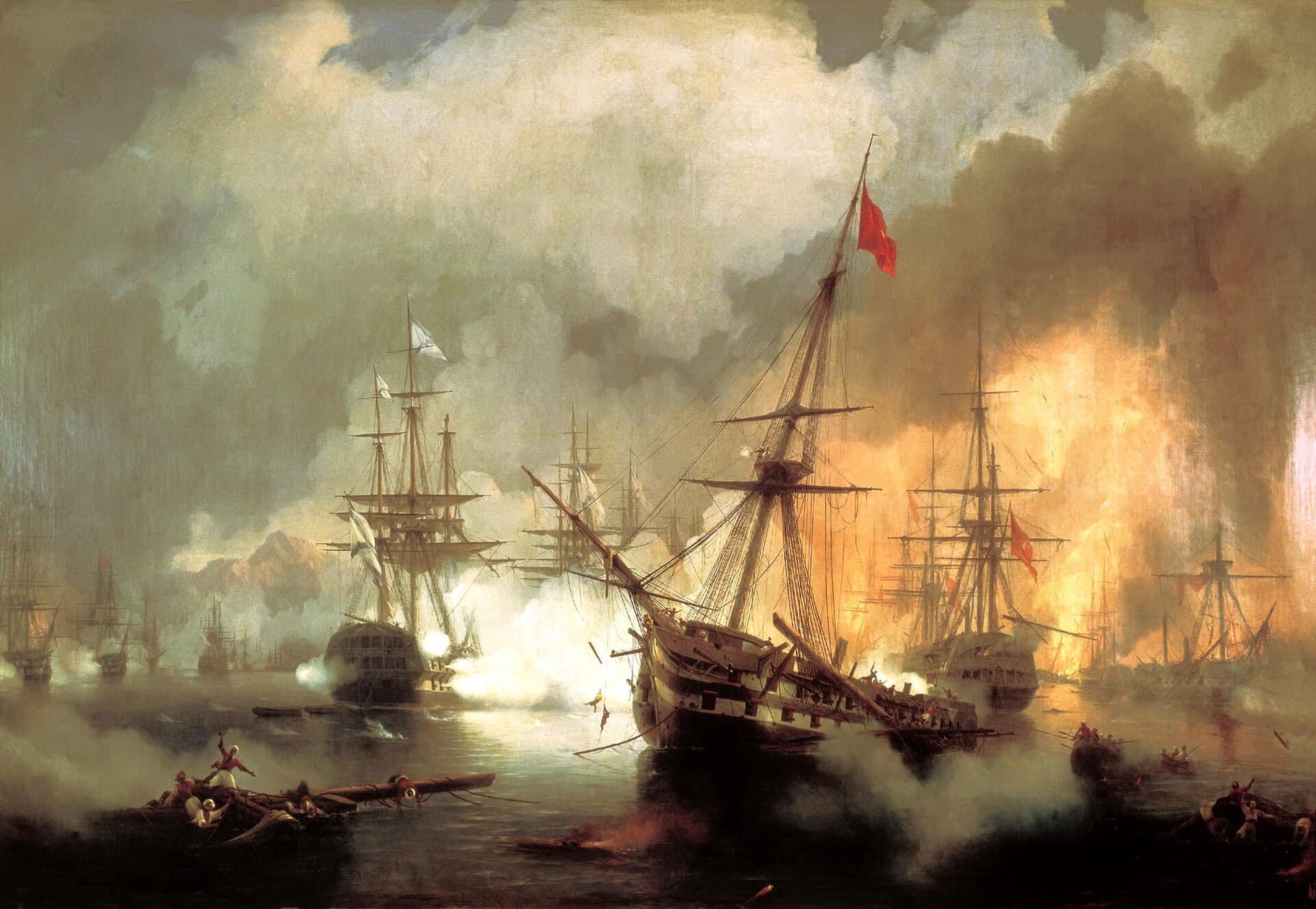
A battered warship heels over. Gunports run along her lit side and men in red crowd the rail. The ships at Navarino fought at anchor a few dozen yards apart, with no room to turn.
Nobody in charge wanted this battle, which is part of why it was so complete. In the autumn of 1827 the Greeks were six years into a war of independence against the Ottoman Empire. The Sultan’s Egyptian ally, Ibrahim Pasha, was grinding the revolt out of the Peloponnese, his large fleet anchored in the wide harbour at Navarino. Britain, France and Russia had signed a treaty to force a ceasefire. They sent a combined squadron under the British admiral Edward Codrington to lean on Ibrahim without firing a shot, if that could be helped. On 20 October the allied ships sailed straight into the crowded bay and dropped anchor among the Ottoman fleet, close enough to talk, close enough to touch. The two forces sat wedged together in the water for hours, gun to gun, waiting on nerves. Then the allies sent a boat across toward a Turkish fireship, and it was fired on, and a man in it killed. One musket shot somewhere in that packed harbour, and the whole bay went up at once. There was no room to manoeuvre and no need. Anchored ships simply hammered each other at ranges of a few dozen yards until one of them caught fire, drifted, and set the next alight. By the time the smoke cleared the Ottoman and Egyptian fleet had effectively ceased to exist: of 78 ships, about 55 were sunk, burned, or blown up by their own crews. The allies lost 181 men killed and not one ship. It was the last great sea battle fought entirely under sail. Within a few years steam would begin to appear in the world’s navies, and no fleet of this size would ever again decide a day with wind and canvas alone. In London the victory was an embarrassment: Britain had wanted the Ottoman navy leaned on, not annihilated, for fear of what a weakened Turkey would let Russia do. When Parliament opened, the government put into the King’s mouth a description of Navarino as an untoward event, and the phrase stuck to it. Codrington was recalled and left to defend himself. Ivan Aivazovsky painted the bay 19 years later, in 1846, as the official artist of the Russian navy, whose ships had fought in the allied line that day. He was Armenian, from the Crimean coast, and he worked seascapes largely from memory and at speed, laying in whole storms in a single sitting. Here he gives Navarino the light he loved best. A burning fleet on the right throws orange across the water, and a battered ship of the line heels in the centre with a red flag still up her mast. Down in the corner, small, men in red caps cling to the wreckage in the water. Ibrahim held on ashore for another year. The Greeks got their country.