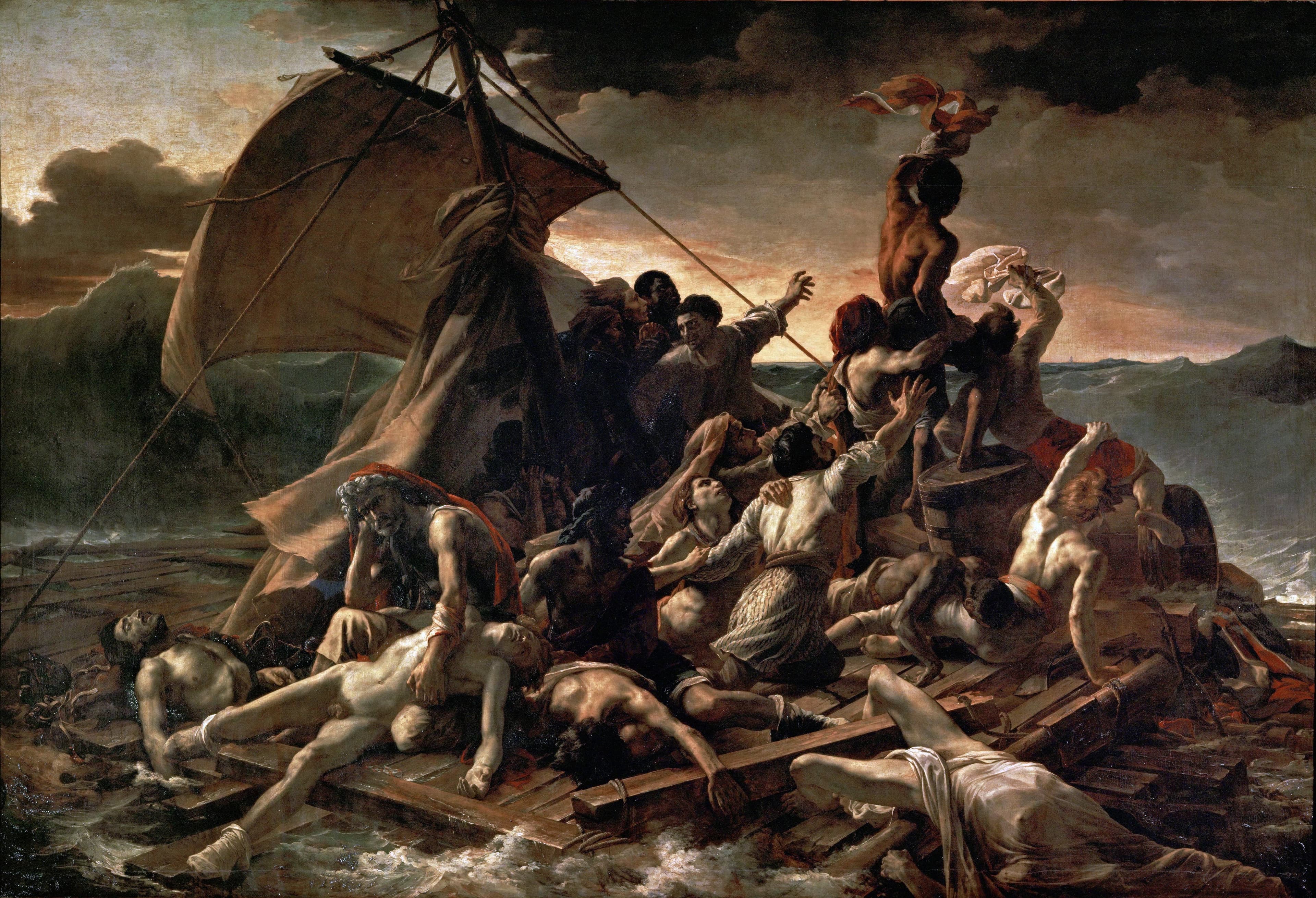
The Age of Sail · 2 July 1816
The Raft
A raft with 147 people is towed out to sea, then the rope is cut
look closer
Jean Charles stands at the top of the human pyramid with his back turned. He waves a scrap of cloth at the horizon. Géricault posed him from Joseph, a Haitian model who worked in the Paris studios.
On 2 July 1816 the French frigate Méduse drove hard onto a sandbank off the coast of West Africa, in daylight, in calm weather, because the man in command could not do his job. Hugues de Chaumareys had spent most of the previous 20 years ashore as a royalist émigré and had been given a frigate for his politics, not his seamanship. When the ship could not be floated off, there were not enough boats for the 400 aboard. So the crew lashed together a raft from masts and planks, about 60 feet by 23, and put 147 people onto it, meaning to tow them to the African shore behind the boats. Within a few miles the tow lines were slipped. Whether they parted or were cut with an axe, the boats rowed away. The raft was left in the open Atlantic with almost no food, a few casks of wine, and no way to steer. The brig Argus found it by accident 13 days later, with 15 men still alive on it. What had happened in between came out because two survivors wrote it down: the surgeon Henri Savigny and the geographer Alexandre Corréard. They published it against the wishes of a government that would much rather they had not. The first night men were swept off or drowned themselves. There were fights over the wine and over the middle of the raft, where the footing was best; the stronger killed the weaker; the living ate the dead. By the end those 15 had thrown the sick and the wounded into the sea to make the water last. The captain who caused it was court-martialled and got three years. Théodore Géricault was 27 and looking for a subject enormous enough to make his name. He found it in the scandal and went at it like an investigator. He read the survivors’ book, then met the men themselves. He had the ship’s carpenter, who had lived through it, build him a scale model of the raft. He brought severed limbs and heads from hospitals and the guillotine into his studio, to study how dead flesh actually looks, until the room stank and his friends stopped visiting. He shaved his head so he would be too embarrassed to go out, and worked. The body lying face down in the foreground, one arm flung out over a beam, was posed for by a friend of his, a young painter named Eugène Delacroix. The canvas is about 16 feet by 23, and Géricault chose the cruellest possible instant to paint. Not the rescue, but the moment the survivors first spot a sail on the horizon, pile themselves into a pyramid, and wave. The Argus sails on out of sight without seeing them. It came back hours later. At the top of the pyramid he put Jean Charles, a soldier and one of the few Black men on the raft. He waves a scrap of cloth at a ship the size of a splinter, far off to the right. When it went on show at the Salon of 1819 the authorities let it in under the flat title Scene of Shipwreck, as if that would keep anyone from knowing which one.