The Age of Sail · 1 August 1798
The Night L’Orient Burned
A 120-gun flagship goes up so loud the firing stops on both sides
look closer
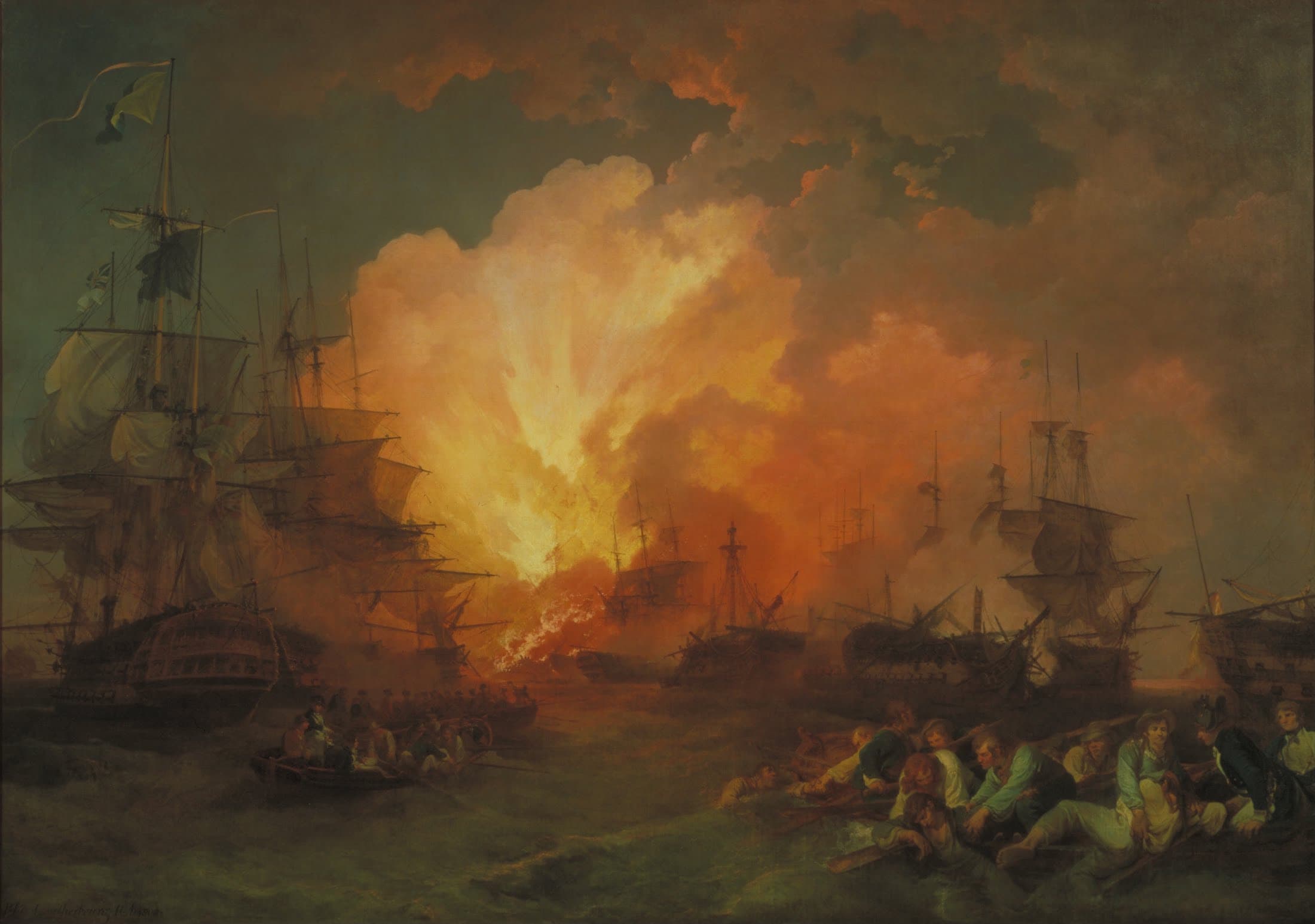
A white core of fire throws debris flat across the bay. This is L’Orient’s powder store going up. The blast was heard in Alexandria, more than 10 miles off.
The French fleet lay at anchor in Aboukir Bay, off the mouth of the Nile, in a long line close to the shoals. Admiral Brueys thought no attacker would dare pass between his ships and the shore. On the evening of 1 August 1798 Nelson dared. His captains closed in the last of the light and worked out for themselves that where a French ship could swing at anchor, there was water enough to sail. Some of the British ships slid down the inshore side of the enemy line while the rest engaged from seaward. The French were caught between two fires, in the dark, many of their landward guns not even cleared for action. Nelson took a splinter across the forehead early on, a flap of skin dropping over his good eye, and was carried below sure he was dying. The centre of the French line was L’Orient, a floating fortress of 120 guns, Brueys’s flagship, bigger than anything in Nelson’s line. Sometime after nine at night she caught fire, probably from paint and oil left on her decks, and the flames climbed her rigging faster than any crew could fight them. Every ship in the bay, French and British alike, understood what was coming and hauled away from her as far as their anchor cables allowed. Around ten o’clock the fire reached her magazine and L’Orient blew up. The blast was heard in Alexandria, more than 10 miles off. For a few minutes after it the guns simply stopped, by more than one account on both sides. Men on every deck were stunned into silence by the size of what they had just seen. Then someone somewhere fired again, and the battle went on. Brueys was already dead, cut nearly in two by a cannonball and propped up to keep giving orders until he bled out. Aboard the flagship was her captain, Casabianca, and his son, a boy of 12 who had come to sea with his father; both died in the ship. An English poet, Felicia Hemans, would put that boy on the burning deck in a poem schoolchildren recited for a century without knowing his name. Of 13 French ships of the line, 11 were taken or destroyed by morning. Napoleon’s army, landed in Egypt to march on the British in India, was now stranded there with no fleet to carry it home. The man who painted the explosion had spent his life making light do tricks. Philip James de Loutherbourg was a stage designer before he was a battle painter, famous in London for the Eidophusikon, a little theatre of moving painted scenes lit from behind to mimic fire and storm. He finished this canvas in 1800 and gave the blast the full apparatus of the stage: the fountain of flame, the rays shooting up, the burning ships gone almost to shadow around it. Down in the right corner he set a knot of exhausted men sprawled on wreckage in the firelight, close enough to touch. The bay was so choked with sunken hulls that some of them still lie there.