The Renaissance · 23 May 1498
The Friar in the Square
The preacher who burned Florence’s luxuries is burned in the same square
look closer
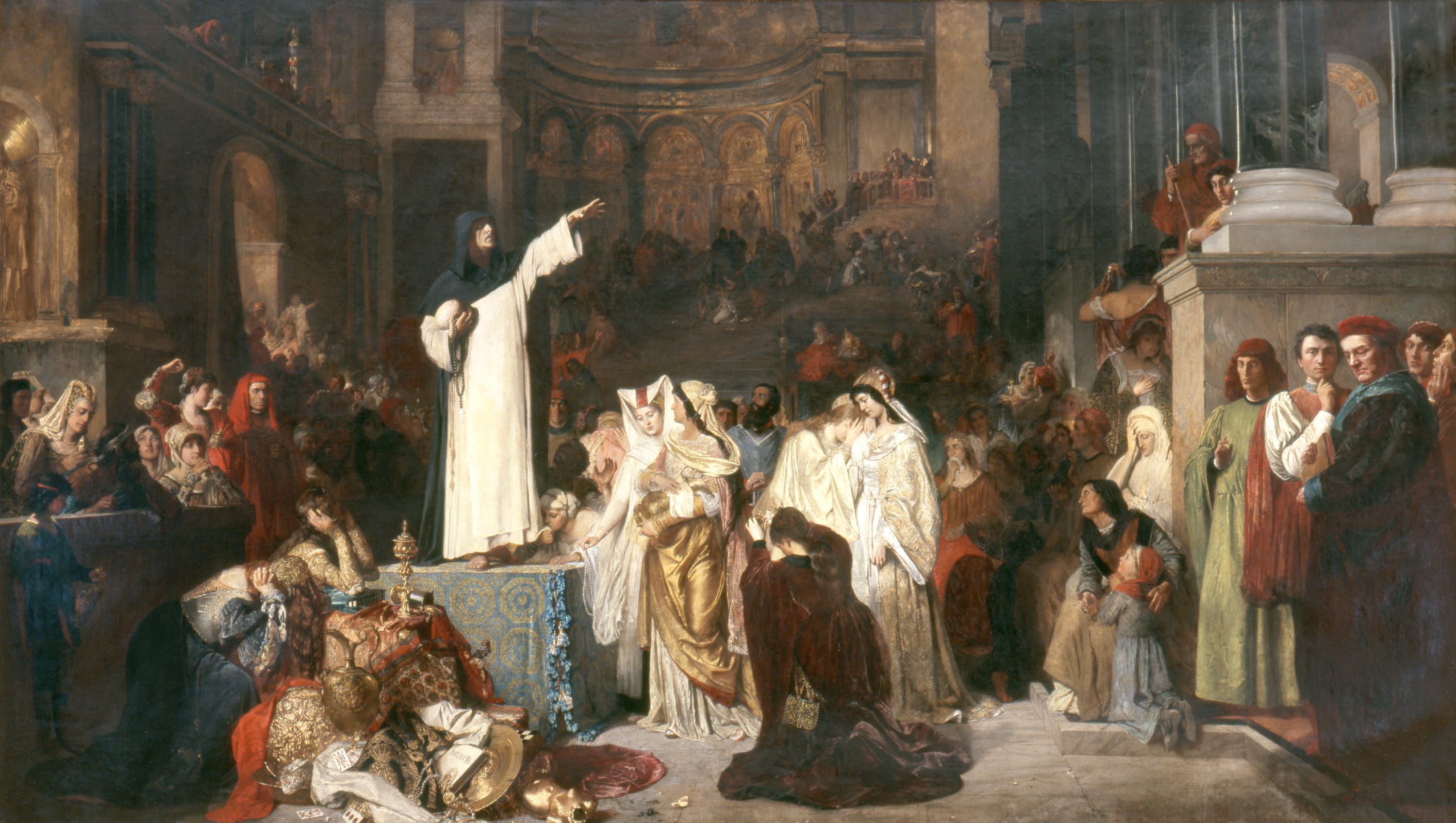
Savonarola preaches in the black cloak and white robe of a Dominican friar. He has one arm flung out, and a rosary swings from his other fist. He held no office in Florence, and for four years the government did what he told it.
For four years Florence was run by a monk who owned nothing. Girolamo Savonarola was a Dominican friar with a heavy jaw and a huge voice. Since the late 1480s he had been preaching in the city that a punishment was coming from God. Then the French army marched into Italy in 1494 and the ruling Medici fled, and it looked as if he had called it. The friar stepped into the gap. He never held an office. He preached, and the government of Florence bent to what he preached. For a while the most sophisticated city in Europe took its orders from a man in a coarse robe who told it that God was disgusted with its vanity. He organized the disgust. Bands of boys went house to house collecting the objects Savonarola named as snares: mirrors, cosmetics, fine dresses, playing cards, lutes, wigs, and the paintings and books that he judged lewd or pagan. In February of 1497, and again the year after, the collected goods were heaped on a scaffold in the Piazza della Signoria and set alight. This was the bonfire of the vanities. By some accounts the painter Botticelli, then turning devout, carried work of his own to the flames. Merchants who wanted to buy the pyre whole were refused. It had to burn. The enemies stacked up as fast as the vanities. The friar had denounced the Borgia pope, Alexander the Sixth, as corrupt, which was true and unwise; the pope excommunicated him, and the powerful Florentine families he had lectured wanted their city back. A rival order challenged him to prove his mission by walking through fire. The ordeal was arranged in the Piazza in April 1498, and crowds packed in to watch a friar step into flame. Then it rained, and the two sides argued over the terms until the whole thing was called off. The crowd had come for a miracle and gone home wet and cheated, and their mood turned. Within weeks he was arrested, tortured until he signed a confession, and condemned. On 23 May 1498 Savonarola and two fellow friars were hanged on a high scaffold in the Piazza della Signoria, on the same spot where the vanities had burned. A fire was lit beneath the bodies so that nothing would be left to keep as a relic. The ashes were carted to the Arno and thrown in. The painting here is a later imagining, made in 1879 by Ludwig von Langenmantel. It shows the friar in mid-sermon, with women laying their finery in a heap below him. Richer men in velvet caps watch from the side. They are the ones who would still be standing in the square when it was his turn.