Medieval Europe · 7 May 1429
The Girl at the Tower
A farmer’s daughter in armor lifts the siege that was starving Orléans
look closer
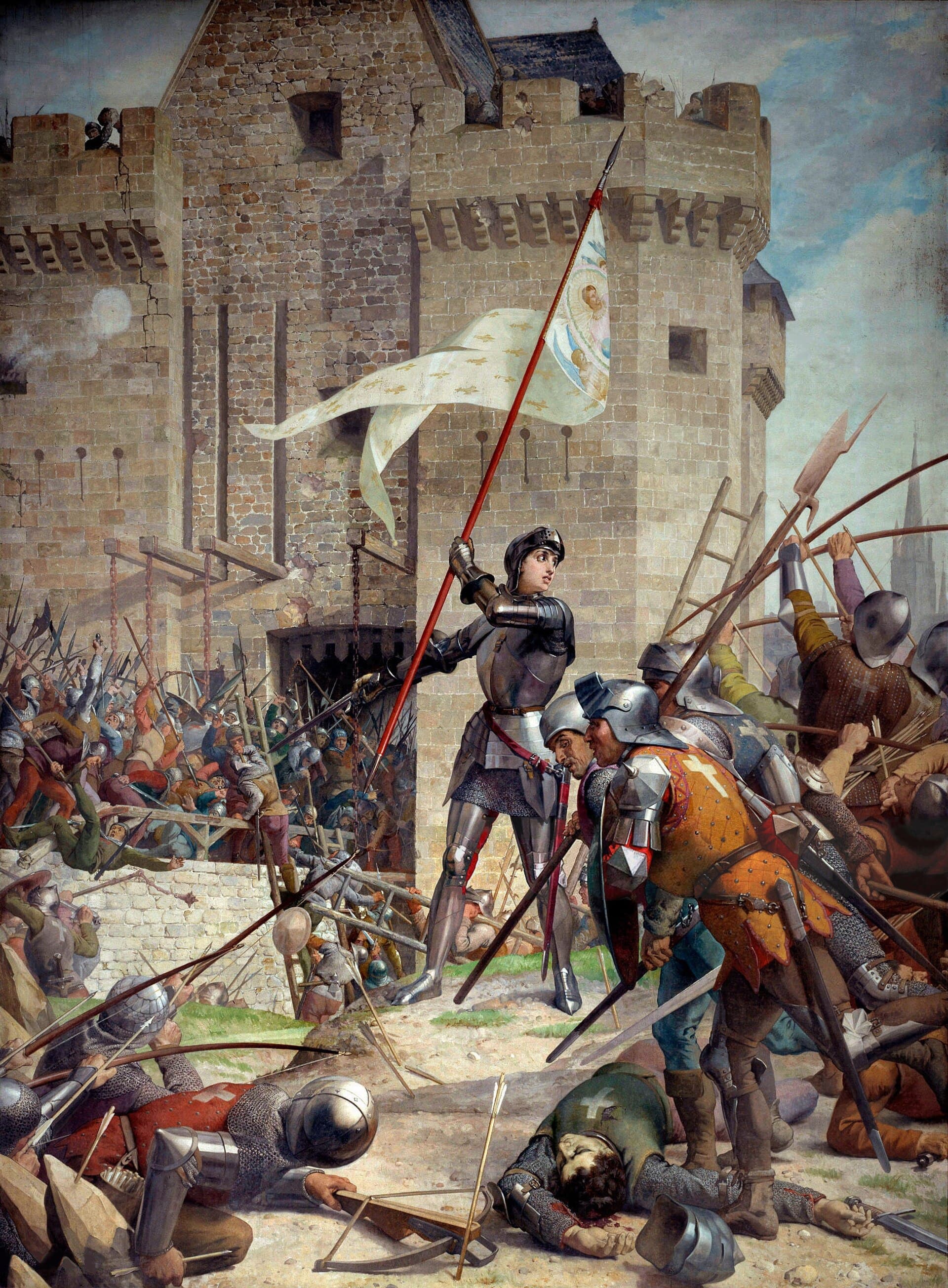
Jeanne stands in plate armor and a mail hood. She grips the red staff of her banner, and the white cloth with its gold lilies is over her head. She said she loved that banner more than her sword, and an arrow went through her shoulder here.
A girl of about 17 stood in the ditch below an English fort at Orléans with an arrow through her shoulder and told the soldiers to keep going. It was the seventh of May, 1429. Her name was Jeanne, a farmer’s daughter from the village of Domrémy on the eastern edge of France. She said God had sent her to drive the English out and see the disinherited French prince crowned. The war was 90 years old by then and going badly for the French. Orléans, the key to the south, had been under English siege for half a year and was close to falling. A few months earlier Jeanne had talked her way to the prince and convinced a panel of churchmen she was not a fraud. She put on armor and rode to the city with a relief force, carrying a white banner she said she liked better than her sword. The fighting that broke the siege came at the Tourelles, the stone fort guarding the bridge into the town. Jeanne was hit early, an arrow between neck and shoulder, and was carried out of the press. She wept, had the arrowhead pulled out, and went back. Late in the day, with the assault stalling, she took up her banner again at the edge of the ditch, and when its tip touched the wall she called that the fort was theirs. The French went over. The Tourelles fell on the seventh, and on the eighth of May the English burned their siege works and marched away. Orléans had held. Within weeks the momentum she had started carried the prince to Reims, where in July he was crowned Charles the Seventh, with Jeanne standing near him in the cathedral. The painting is by Jules-Eugène Lenepveu, one of four panels on Jeanne’s life made for the Panthéon in Paris between 1886 and 1890. It puts her exactly where the day turned: in full armor at the foot of the Tourelles, the banner up in her hands. Below her the storming party is packed against the wall, and a dead soldier lies in the dirt in front of her. This is nineteenth-century France painting its patron saint, unbloodied and shining in the middle of a real slaughter, and it knows what it is doing. What the siege bought her was two more years. In 1430 she was captured at Compiègne, sold to the English, and put on trial for heresy by a French bishop working for them. On the thirtieth of May, 1431, they burned her in the market square at Rouen. She was about 19. An English soldier who had helped build her pyre is supposed to have said afterward that they had burned a saint. A second trial 25 years later, ordered by the king she had crowned, went back over the record and cleared her name.