Medieval Europe · 25 October 1415
The Morning in the Mud
A small, sick English army meets the French host on a ploughed field
look closer
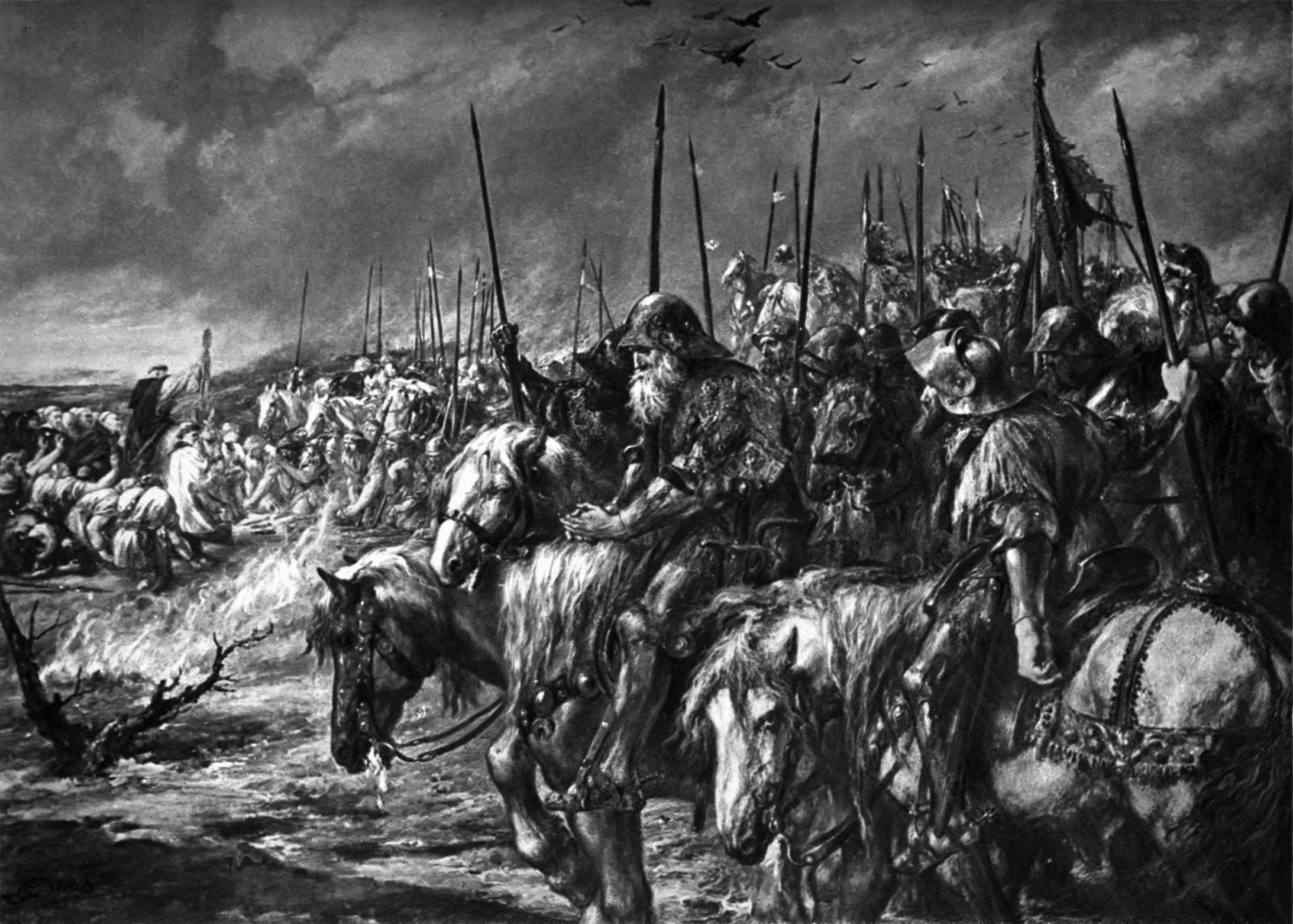
A bearded man-at-arms slumped forward over his horse’s neck, hands folded on the mane. Henry’s army had marched for weeks with dysentery in the ranks before it reached this field.
It was the morning of the twenty-fifth of October, 1415, Saint Crispin’s Day. A small English army stood cold and hungry at one end of a newly ploughed field in northern France. At the other end was a French army several times its size. Henry the Fifth had landed in the summer to press his claim to the French crown, and spent five weeks taking the port of Harfleur. Then he marched his men toward Calais, with dysentery thinning the ranks the whole way. The French had caught up and blocked the road near a village called Agincourt. Henry had perhaps 6,000 men, most of them archers. Across the field the French had many more, and most of theirs were armored men-at-arms, the nobility of a kingdom, sure of the outcome. The ground was the third army on the field, and it fought for England. Rain had fallen for days on the fresh-turned clay. Between the two woods that funneled the battle, the French had to cross deep, sucking mud in heavy plate, on foot, packed too tight to swing their arms. The English archers planted sharpened stakes in front of them and poured arrows into the crush from the wings. Men went down and could not get up and were smothered or trampled under the ones behind. The French attack, so much larger, arrived exhausted and jammed and was butchered where it stuck. It is one of the lopsided days of the age, a few hundred English dead against thousands of French. There is a dark passage in it. Partway through, with prisoners already taken and his rear thinly held, Henry heard an alarm that a fresh enemy force was coming at his baggage. He was afraid his captives would pick up weapons and take him from behind, so he ordered the French prisoners killed. The threat turned out to be little more than local men after the baggage. How many were cut down no one knows for certain. It may have been well over a thousand. It was a killing of unarmed men, and the men who did it were uneasy about it even then. The painting is by John Gilbert, made in 1884 and titled The Morning at Agincourt, and it does not show the slaughter. It shows the waiting: English horse and men-at-arms crowded in the half-light before the battle, lances up, crows already circling, a bearded rider slumped forward on a worn-out animal. The picture here is the black-and-white plate from Cassell’s History of England, which is why the morning has no color in it. When it was over Henry summoned the heralds, whose trade was to watch battles and keep the score, and who by custom had stood together through this one, French and English side by side. He asked them the name of the nearest castle. Agincourt, they told him. Then that, he said, is what the battle will be called.