The Viking Age · 29 July 1030
The King Who Came Back
The exiled king comes home over the mountains, and Norway raises an army to meet him
look closer
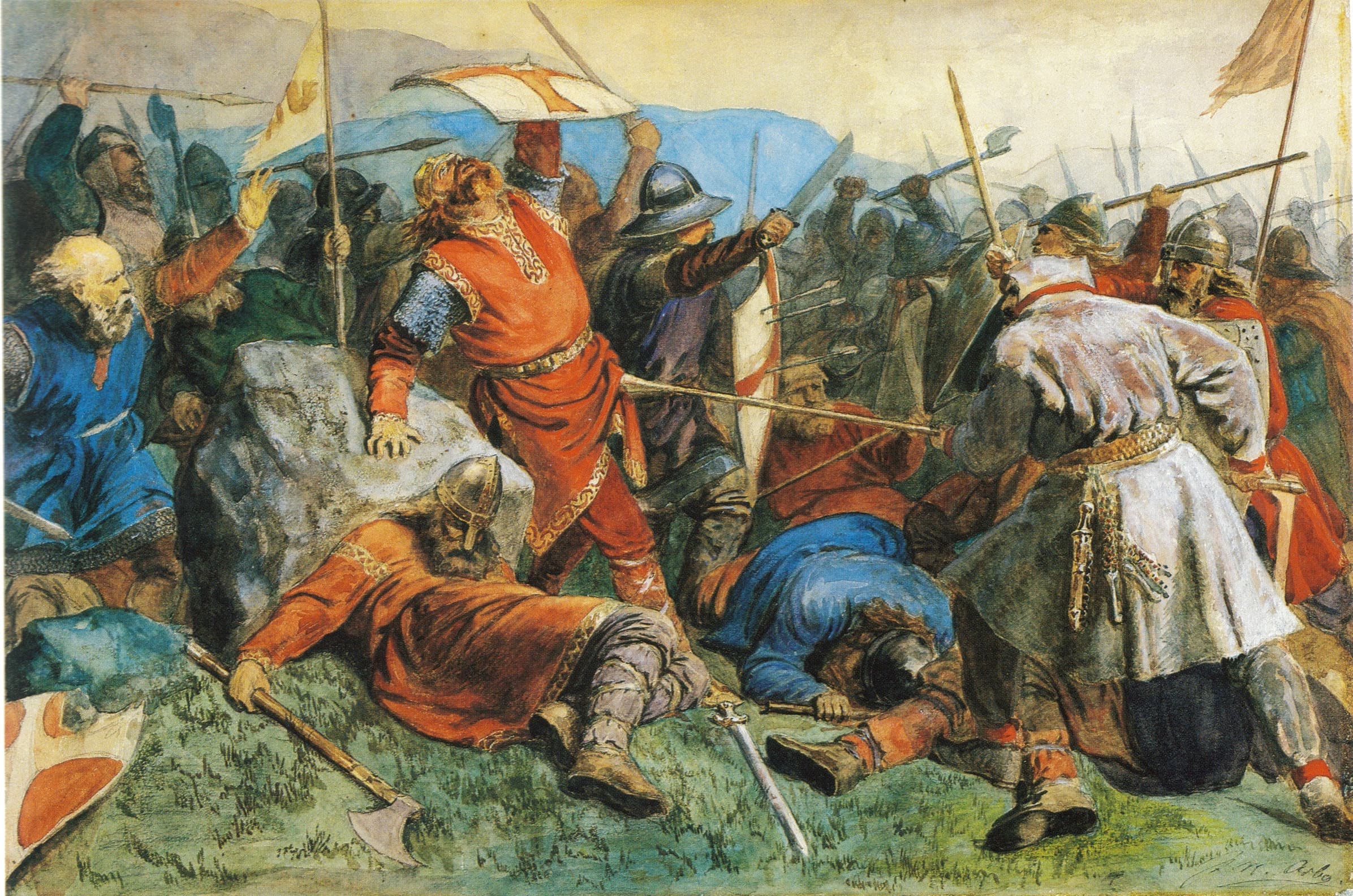
The king braces on the stone with his head thrown back. He wears a red tunic bordered with gold. The pale shaft across his waist is the spear Thorir Hund drove up under his mail.
The king’s army was woken with a poem. Before first light on 29 July 1030, at a farm called Stiklestad in the Verdal valley, the Icelandic poet Thormod stood up and recited Bjarkamál. It is an old poem about a lord’s household guard dying around him. The men called it the whetting of the housecarls, and the saga says the king paid for it with a gold ring off his own arm. Olaf Haraldsson had ruled Norway for 15 years and been out of it for two, his chiefs bought out from under him by the silver of Cnut, king of Denmark and England. Now he had come back over the mountains from Sweden with a scraped-together army and his half-brother Harald, aged 15, in the line beside him. The answer stood across the valley: an army of farmers raised by the local lords, the biggest force Snorri says anyone had ever seen gathered in Norway. The two sides named themselves at the top of their lungs. Forward, forward, Christ’s men, cross men, king’s men, was the king’s cry. Forward, forward, farmer men, was the other. The farmers had the numbers. The battle was short. Thorstein the Shipwright, who owed the king a grudge over a trading ship the king had taken from him, put an axe into Olaf’s knee. The king dropped his sword and leaned against a stone. Thorir Hund drove a spear up under his mail, and a man named Kalv cut into his neck. There were two Kalvs within reach, and Snorri admits he cannot say which one struck. Thormod, the poet of the dawn recital, walked out of the fighting with an arrow in his chest. In the healing hut he pulled it out with tongs, looked at the white fat clinging to the barbs, and said the king had fed his men well. Then he died on his feet. The famous darkness is a problem of dates. Sigvat, the king’s own poet, missed the battle. He was on pilgrimage to Rome. His memorial verses report what survivors told him: clear weather, and the sun refusing its light while men fell. An eclipse did cross Trøndelag that summer, total over Stiklestad, but on 31 August, 33 days after the church’s date for the battle. Either the battle is misdated or the memory of one darkness slid into the other. The tradition kept both the date and the eclipse and let them disagree. What happened next made the winners irrelevant. A farmer named Thorgils hid the body, ferried it downriver by night, and buried it in a sandbank by the river Nid. Word of healings started moving within the year. A year and five days after the battle, Grimkell, the English bishop who had come north with Olaf’s missionaries, had the coffin opened. Witnesses said the cheeks still had color, and the hair and nails had grown. He declared Olaf holy on the spot. Four years later Kalv Arnesson himself sailed east with Einar Thambarskelfir, the same Einar whose bow had burst at Svolder, and fetched the dead man’s son Magnus, 11 years old, home to be king. Thorir Hund went the other way, south on pilgrimage, and the sagas lose him on the road to Jerusalem. A later king formally dedicated the kingdom of Norway to the man who died at the stone: rex perpetuus Norvegiae, the eternal king. Peter Nicolai Arbo painted the fall in 1859, at 28, fresh out of the academy at Düsseldorf. He put the king red and gold against the stone. On the right he put a broad pale back: Thorir Hund in the reindeer coat that Snorri says shed sword strokes like dust off a hide. Arbo painted the boy who survived this field 11 years later: Harald, under an English arrow, at a bridge called Stamford.