The Viking Age · 23 April 1014
Between Two Tides
An old king waits out the fight in his tent while the tide decides it
look closer
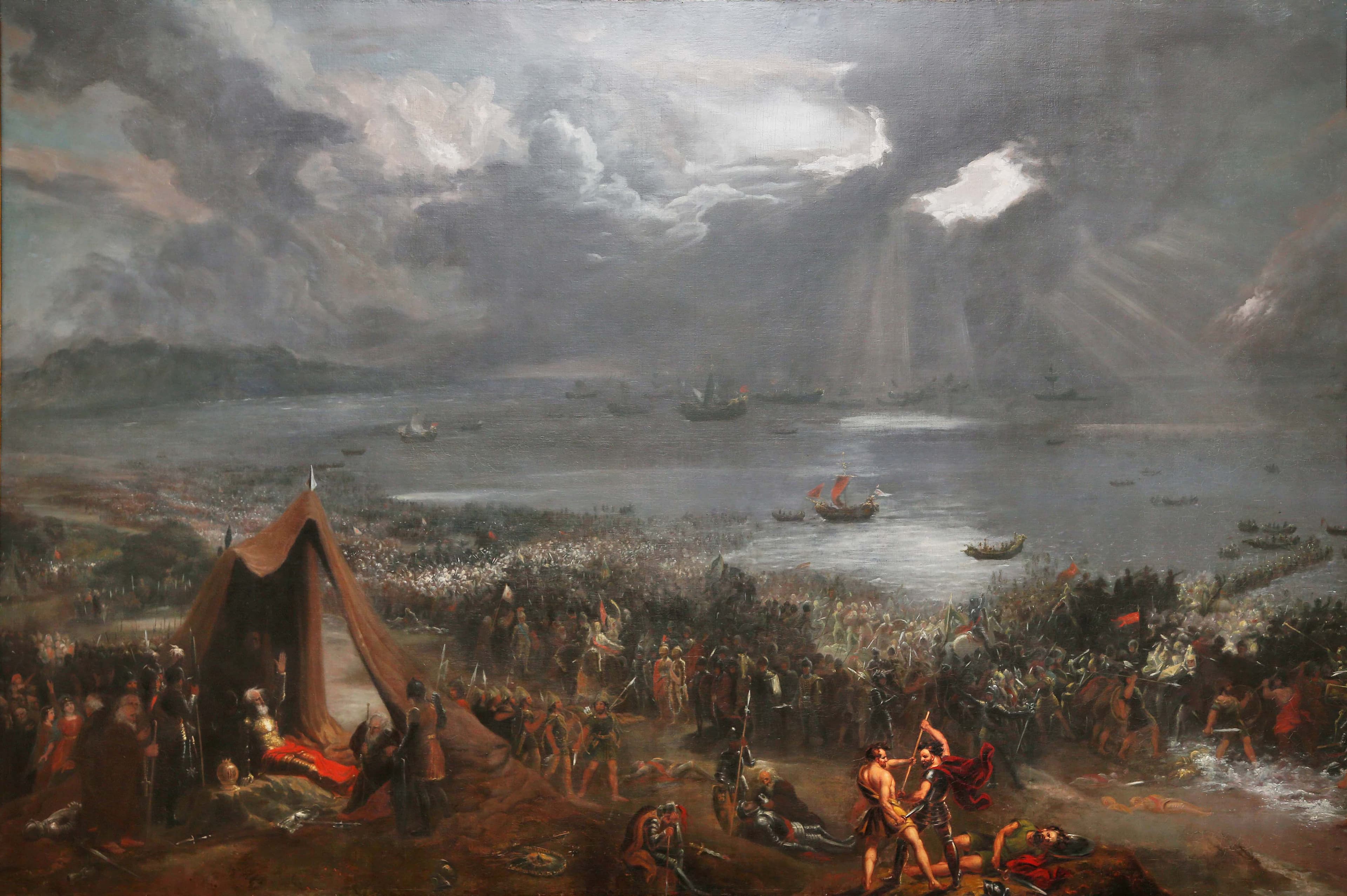
Under the open tent an old man in gilded armor lifts one hand. A red cloak is spread beneath him. This is Brian Boru at 73, and he is waiting out Good Friday with a book of psalms instead of a sword.
The high king would not fight on Good Friday. Brian Boru was 73, if the annals have his birth year right. He had spent half his life making himself master of Ireland from Kincora on the Shannon. On the morning of 23 April 1014 he sent his army down to the shore north of Dublin and stayed behind it in his tent with a book of psalms. The battle he could hear beginning was partly his own household’s work. Gormflaith, the wife he had put away, had turned her brother Máel Mórda, king of Leinster, against him. Her son Sigtrygg Silkbeard, the Norse king of Dublin, had spent the winter recruiting overseas. Njáls saga records his method. He promised the kingdom of Ireland, and his mother’s hand with it, to Sigurd the Stout, earl of Orkney. Then he promised the same kingdom and the same mother, separately and in secret, to Brodir of Man, a deacon who had thrown off his faith and gone to sea. Brodir’s brother Ospak wanted no war against so good a king. He sailed his ships to Brian instead, took baptism, and stood in the Irish line. It began at the morning high tide and ran to the evening one. The Orkney men carried a raven banner Sigurd’s mother had woven for him, with its terms attached: victory for the army it flew over, death for the man who carried it. It performed as specified. Bearer after bearer went down. When no one else would touch the staff, Sigurd said it was fittest that the beggar carry his own bag. He tucked the banner under his cloak and was dead soon after. On the walls of Dublin, Sigtrygg watched the day turn with his wife, Brian’s daughter, beside him. The Irish account preserves her review: the foreigners were taking to the sea, their true inheritance, like cattle off a hot field. Her husband struck her in the mouth. The sea did the last of the killing. The returning tide had floated the longships off the strand, and the beaten army drowned reaching for them. The king’s grandson Toirdelbach was 15. They found him drowned at the salmon weir of the Tolka, his hands still knotted in a foreigner’s hair. Brodir had spent the rout in the wood behind the lines. He came out on the one tent nobody was guarding and killed the old man at his prayers with an axe. Njáls saga hunts him down a page later, into the hands of a champion it calls Wolf the Quarrelsome, and gives him the worst death in the book. The king’s body went north to Armagh, and the clergy of Patrick waked it for 12 nights. Clontarf broke the last Viking bid for Ireland without removing a single Norseman from it. Sigtrygg kept Dublin and reigned 22 more years, made a pilgrimage to Rome, and on his return gave the city its first cathedral, Christ Church. The men of the longships stayed on as the traders they had mostly become. What ended on the strand was the idea that the sea road led to an Irish crown. Hugh Frazer painted the day in 1826. The tent stands at the left edge with the old king inside it, one hand raised. Two armies dissolve into weather, and light breaks through the storm cloud onto a bay full of ships. It is an Irish painter’s guess from eight centuries out. He dressed the fighters in armor from the wrong centuries and got the shape of the bay right. The canvas has gone further from home than any man in it ever sailed. It hung for years in a school art museum in Hawaii, then came back to Dublin in 2014 for the thousandth anniversary of the battle.