The Viking Age · September, 1000
The Long Serpent
Two kings and a jarl wait behind an island for the finest ship in the north
look closer
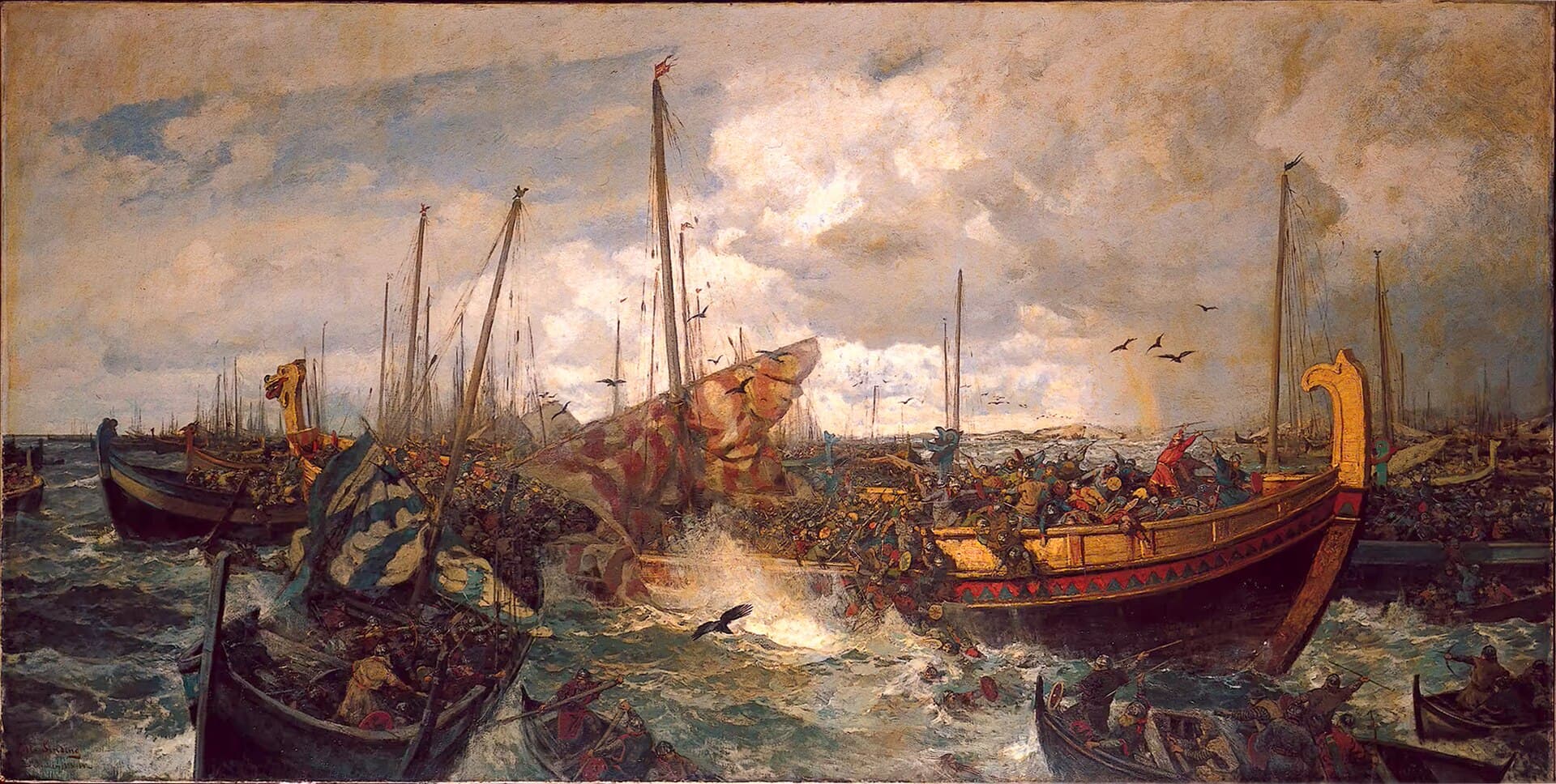
The man in red stands above the shields with his arm raised, near the stern of the gilded ship. Snorri dressed Olaf to be seen. He gave him a short red tunic over his mail and a gilded helmet, so the whole fleet could find him.
Three commanders had a tent pitched on an island called Svolder so they could watch the strait in comfort. Svein Forkbeard was king of Denmark, Olof was king of Sweden, and Eirik Hakonarson was a Norwegian jarl with a dead father to avenge. At the end of summer in the year 1000, Olaf Tryggvason, king of Norway, sailed home past them, his fleet strung out and easy after a season in Wendland. Snorri Sturluson stages the wait as theater. Every time a big ship rounded the point, Svein announced the Long Serpent and called for the boats. Every time, Eirik, who knew Norwegians, said the king of Norway had more fine ships than one. When the Serpent finally came, nobody argued. Snorri says all of them knew. The silence was earned. The Long Serpent had been built on the beach below Nidaros the winter before, the biggest ship ever made in Norway. She was built for 34 pairs of oars, her head and tail were gilded, and her sides stood as high as an ocean trader’s. Even her flaws were legend. One morning, with the hull nearly finished, the new planks were found slashed full of axe notches, and King Olaf promised death for whoever had done it. The master builder Thorberg confessed on the spot. Told to make it good, he shaved the damaged plank down until the notches were gone and the line of the ship was better than before. The crew was picked by rule: no man older than 60, none younger than 20. The rule was bent once for Einar, who was 18, because nobody in Norway shot a bow like him. Most of the fleet had already passed out of sight when the trap closed on the 11 ships nearest the king. Sigvaldi, the Jomsviking jarl who had steered Olaf into the strait, rowed out of the line as it began. Olaf would not run. Strike the sails, Snorri has him say. My men shall not think of flight. I have never fled from a fight. God rules my life, and flight I shall never take. He lashed the 11 together with the Serpent in the middle. Then he stood on her afterdeck in a short red silk tunic over his mail, with a gilded helmet, so every man on the water could see where the king was. The Danes and the Swedes bloodied themselves at the prows and fell away. Eirik was patient instead. He laid his ship the Iron Beard against the outermost Norwegian hull, cleared it, cut it loose, and worked inward one ship at a time until the Serpent stood alone. Her sides were too high to storm, so it became a fight with arrows. Einar loosed twice at Eirik and missed by a hand. Then an arrow split Einar’s bow. What broke there so loudly, asked the king. Norway from your hand, king, said Einar. He took the king’s own bow, drew it past the arrowhead, and said, too weak, too weak is the king’s bow. Then he fought on with sword and shield. Toward evening the boarders came over the rail in numbers, and the crew went into the sea. Kolbjörn the marshal, dressed like his king, jumped and was hauled into a boat by men certain they had Olaf. The king raised his shield over his head and went down under it. Otto Sinding painted the last hour in 1883 and 1884, on a canvas wide enough to hold a fleet. The Serpent runs gold across it, crowded to the rail, with small boats pressing in below and a single raven low over the water. The picture belongs to the Norwegian royal collection. His brothers were the composer Christian Sinding and the sculptor Stephan Sinding, so the national revival was a family trade. The death itself never quite took. Within a lifetime men swore the king had been seen in Rome, then in Jerusalem, a monk who would not give his name. Snorri weighs the rumors and settles nothing: however that may be, he writes, King Olaf Tryggvason never came back again to his kingdom in Norway.