The Viking Age · July, 971
The Prince at the Oar
A prince who lives like his oarsmen rows out to meet the emperor of the Romans
look closer
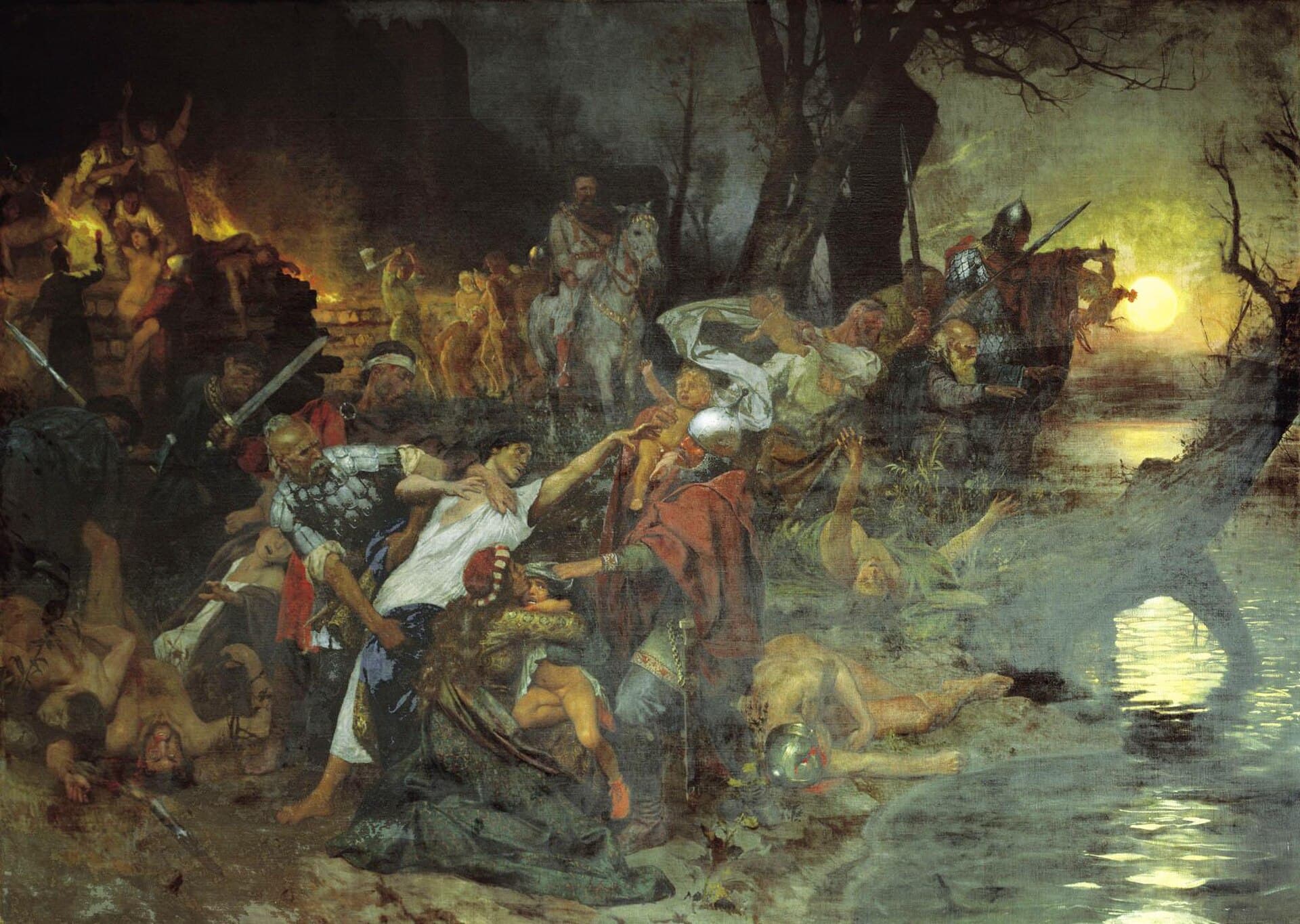
A body lies across the burning log stack and arms go up all around it. At the right, a man swings an axe. Leo the Deacon records the night from the Byzantine side. The Rus came out under the walls and burned their dead.
On one of the last nights of the siege of Dorostolon, the Byzantine army looked up from its camp and watched fires climb the sky in front of the fortress. Leo the Deacon, the historian of this war, explains what burned. When darkness fell and the moon rose full, the Rus came out under the walls. They gathered their dead from the day’s fighting and burned them on pyres. Over the bodies they killed captives, men and women both, after the custom of their ancestors. Then they lowered suckling infants and roosters into the Danube and drowned them. It was July of 971, the third month of the siege. The man keeping the old customs was Svyatoslav, prince of Kyiv, the son Olga had never managed to baptize. He had taken Bulgaria in a single season three years earlier, and now he could not get out of it. The tallest pyre that night had a name. In the day’s battle the emperor’s bodyguard Anemas had cut down Ikmor, second in command of the Rus army. Anemas was the son of the deposed emir of Crete, and he took off Ikmor’s head and right arm with one stroke. A few days later, in the last charge out of the town, Anemas broke through to Svyatoslav himself and struck him on the collarbone. The prince’s mail held. Anemas was killed where his horse stopped. A storm blew up during that battle and drove dust into the Rus faces, and afterward the Byzantines swore a rider on a white horse had gone before their line. They gave the credit to Saint Theodore. That evening Svyatoslav asked for terms. The treaty was businesslike. The Rus gave up Bulgaria and swore never to come against the empire again. The empire fed them for the road, two measures of grain a man. Leo says the measures were counted out for 22,000 men, of the 60,000 he claims had come. Then the prince asked to see the emperor, and Leo preserves the meeting. John Tzimiskes came down to the bank of the Danube on horseback, in gilded armor, with a squadron of riders shining behind him. Svyatoslav crossed in a boat, rowing with his own hands, pulling an oar like the rest of the crew. He was of middling height, Leo writes, blue-eyed under heavy brows, flat-nosed, beardless, with a thick mustache. His head was shaved but for one lock of hair on the side, the mark of his nobility. His neck was thick, his shoulders broad, his expression sullen and wild. In one ear he wore a gold earring, a red stone set between two pearls. His white clothes differed from his oarsmen’s in one thing only, that they were clean. He talked with the emperor a little about the peace, sitting on the rowing bench of his own boat, and pushed off. Henryk Siemiradzki painted the funeral night in 1884, the second of two huge canvases on the pagan Rus he made for the new Historical Museum in Moscow. The first staged the ship burning Ibn Fadlan saw on the Volga. He read his Leo closely, down to the full moon over the river and the rooster held up against it. But the leader he put on the white horse has a full head of hair, and the shaved skull with its one lock stayed on the page. The peace held exactly as long as the voyage home needed it to. Svyatoslav wintered at the Dnieper rapids, short of food, and in spring the Pechenegs were waiting at the portage. The Primary Chronicle says their khan, Kurya, had the prince’s skull sheathed in gold and drank from it. The earring is mentioned once, on the riverbank, and never again.