The Viking Age · c. 1000
The Sweet Dew of Vinland
Leif buys the ship that saw a coastline and goes to stand on it
look closer
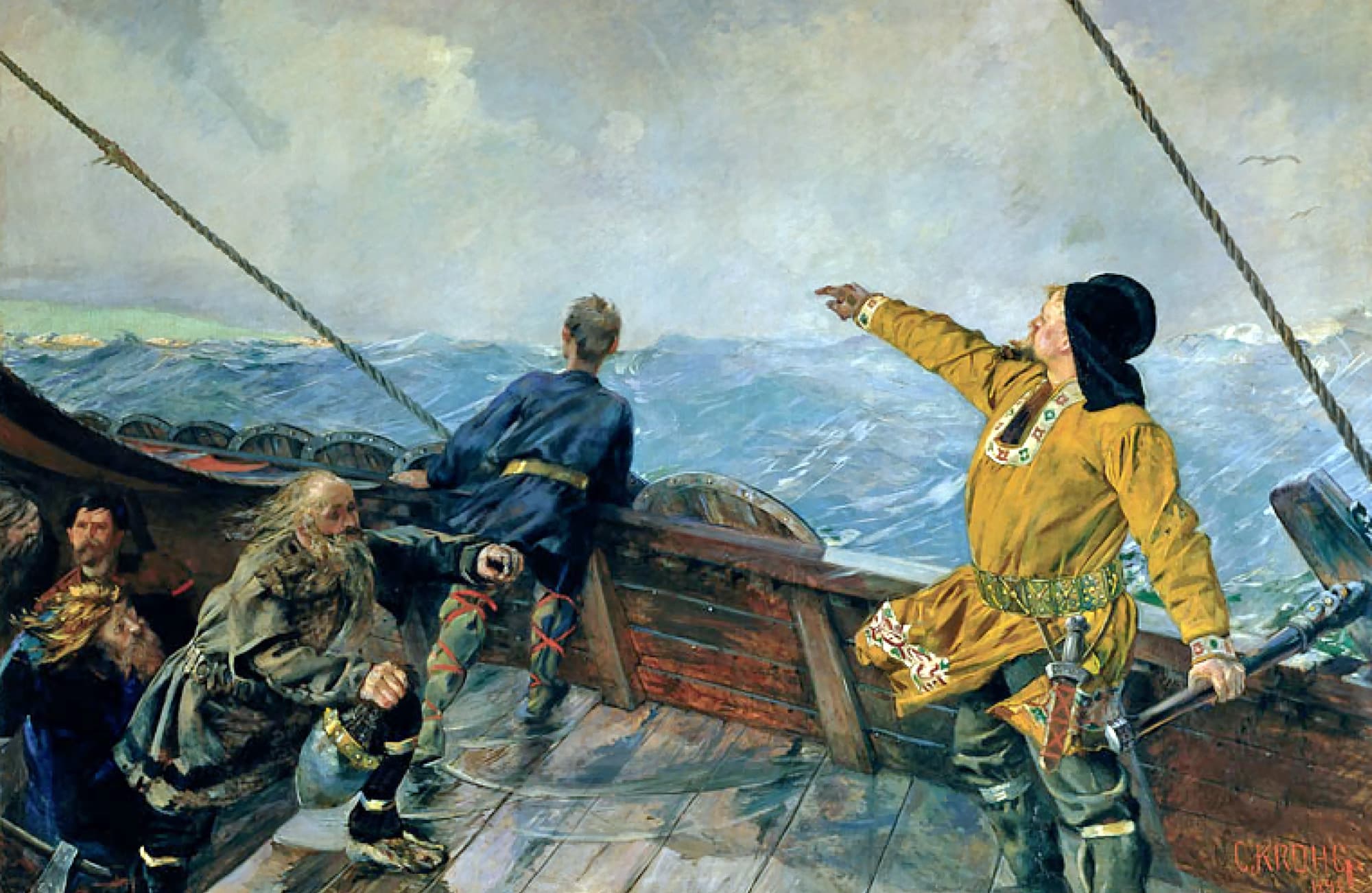
Leif throws his arm out over the bow with his head back. He wears a yellow tunic with an embroidered collar and a black hood. Krohg painted him in 1893, the year Norway sailed a copy of the Gokstad ship to the world’s fair in Chicago.
The first European on record to see America refused to step onto it. In 986 Bjarni Herjólfsson sailed from Iceland to join his father in the brand-new Greenland colony, and fog blew him past his mark. When the sky cleared he was coasting a low wooded shore that matched nothing in the sailing directions. His crew wanted to land. Bjarni said no, this was not Greenland, and held course until it was. At the earl’s court in Norway years later, men said openly that he had shown no curiosity, and the verdict followed him home. Around the year 1000 Leif Eiriksson bought Bjarni’s ship, gathered 35 men, and asked his father Erik the Red to lead the voyage. Erik’s horse stumbled on the ride down to the shore, and he took the fall as an omen. He was not meant, he said, to find more countries than the one he lived in. Leif sailed without him, ran Bjarni’s sightings in reverse, and named as he went, in the flat style of a man labeling crates: Helluland, slab land; Markland, forest land. At the third landfall the Saga of the Greenlanders drops its guard: the crew touched the dew on the grass and put it to their lips, and thought they had never known anything so sweet. The winter camp turned up one wonder after another. The rivers ran with salmon bigger than any of them had seen. On the shortest day of the year the sun was still up in mid-afternoon, which a Greenlander thought worth writing down. Then Tyrkir, the German foster-father Leif had brought along, went missing from the party. He came back talking German and rolling his eyes, too pleased to get it out in Norse for a while. What he had found was vines and grapes, in a country he had thought too far north for either. Leif named the land for them, Vinland, and in spring the ship went home loaded with timber and grapes. When he took 15 shipwrecked sailors off a reef on the way, the trip had gone so entirely right that he was Leif the Lucky ever after. Christian Krohg painted the landfall in 1893. He was a realist and a working journalist, and he put weather where the myth usually goes. The deck heels, the sea runs cold green, and a green shore shows on the horizon past the shields. The date was an argument. Chicago’s world fair that year was a jubilee for Columbus. Norway answered by sailing Viking, a copy of the excavated Gokstad ship, across the Atlantic to the fairground to show what an open Norse hull could do. The sagas held their half of the story for nine centuries before the ground supplied the rest. In 1960 a local man, George Decker, led the Norwegian explorer Helge Ingstad and the archaeologist Anne Stine Ingstad to grassed-over ridges at L’Anse aux Meadows, on the northern tip of Newfoundland. The ridges turned out to be 8 turf buildings, and with them came a smithy with slag from bog iron, boat rivets, a bronze cloak-pin and a spindle whorl. There were also butternut shells, from a tree that has never grown in Newfoundland. In 2021 tree-ring dating fixed the year one of the cut logs was felled, and the answer was 1021 exactly. The rings carry the scar of the solar storm of 993, and the tree grew 28 more of them before the axe.