Ancient Egypt · c. 1470 BC
The King Who Was a Woman
Twenty years of prosperity, then a campaign to erase her
look closer
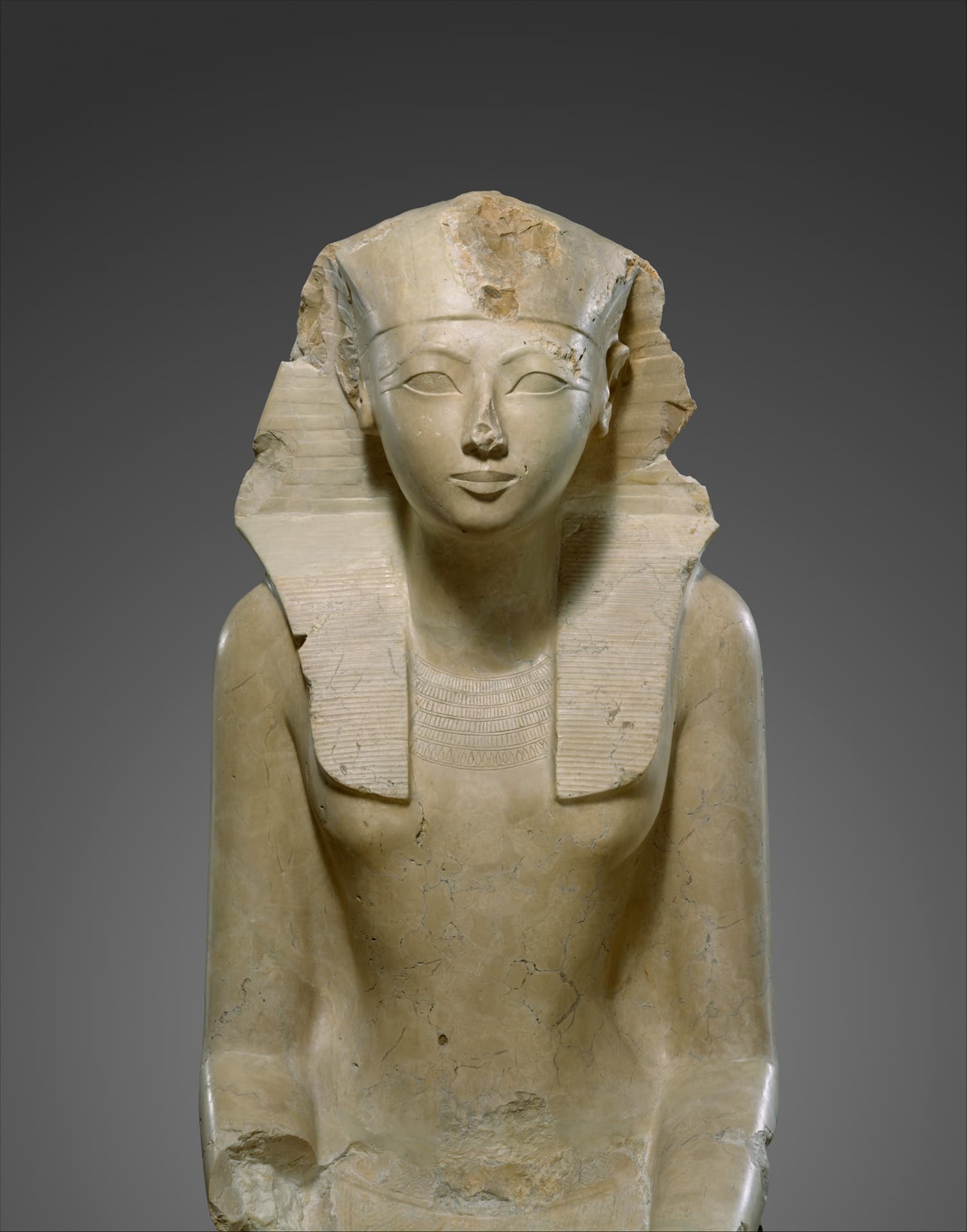
A king's headcloth sits over a woman's face. Her inscriptions switch between masculine and feminine forms in the same line. They are inventing grammar as they go.
Hatshepsut was the daughter of one king, the wife of another, and the regent for a third, her stepson Thutmose III, who was a small child when his father died around 1479 BC. Regency was normal. What she did next was not: within a few years she was crowned as king in her own right, with the full titulary, and ruled for two decades as the senior partner in a co-reign. Egypt had a word for a female king only in the sense that it had to invent grammar on the spot. Her inscriptions do exactly that, switching between feminine and masculine forms in the same sentence. Her reign was, by every surviving measure, a good one. She sent a trading fleet down the Red Sea to Punt and had the whole expedition carved on her temple walls at Deir el-Bahari. The carving includes the incense trees brought back with their root balls wrapped, and a memorably unflattering portrait of the queen of Punt. She quarried two granite obelisks at Aswan, one of which still stands at Karnak as the tallest in Egypt. She built one of the most beautiful buildings in the ancient world, the terraced temple under the cliffs where this statue once stood. Roughly 20 years after she died, the erasure began. Her images were chiselled out, her cartouches replaced with those of her father and husband and stepson, her obelisks walled up. The statues were dragged out to a pit near the temple causeway, smashed, and used as fill. For a long time the story was told as revenge, a resentful stepson getting even. The current reading is colder and more interesting. The timing points to a dynastic problem rather than a grudge. It looks like an attempt, late in Thutmose III's reign, to make the succession read as an unbroken line of men, and to remove the precedent of a woman who had done it. It failed by being thorough. Between 1922 and 1928 the Metropolitan Museum's excavators dug out the pit, recovered thousands of fragments, and spent decades fitting them back together, and Hatshepsut now has more surviving statues than most pharaohs. This one is hardened limestone, life size, wearing the nemes headcloth of a king over a narrow female body. The royal titles cut into the throne are put in the feminine: Perfect Goddess, Lady of the Two Lands. The stone reads as bare now. A patch on the back of the head kept its paint, and the pleats of the headcloth were blue and yellow, alternating.