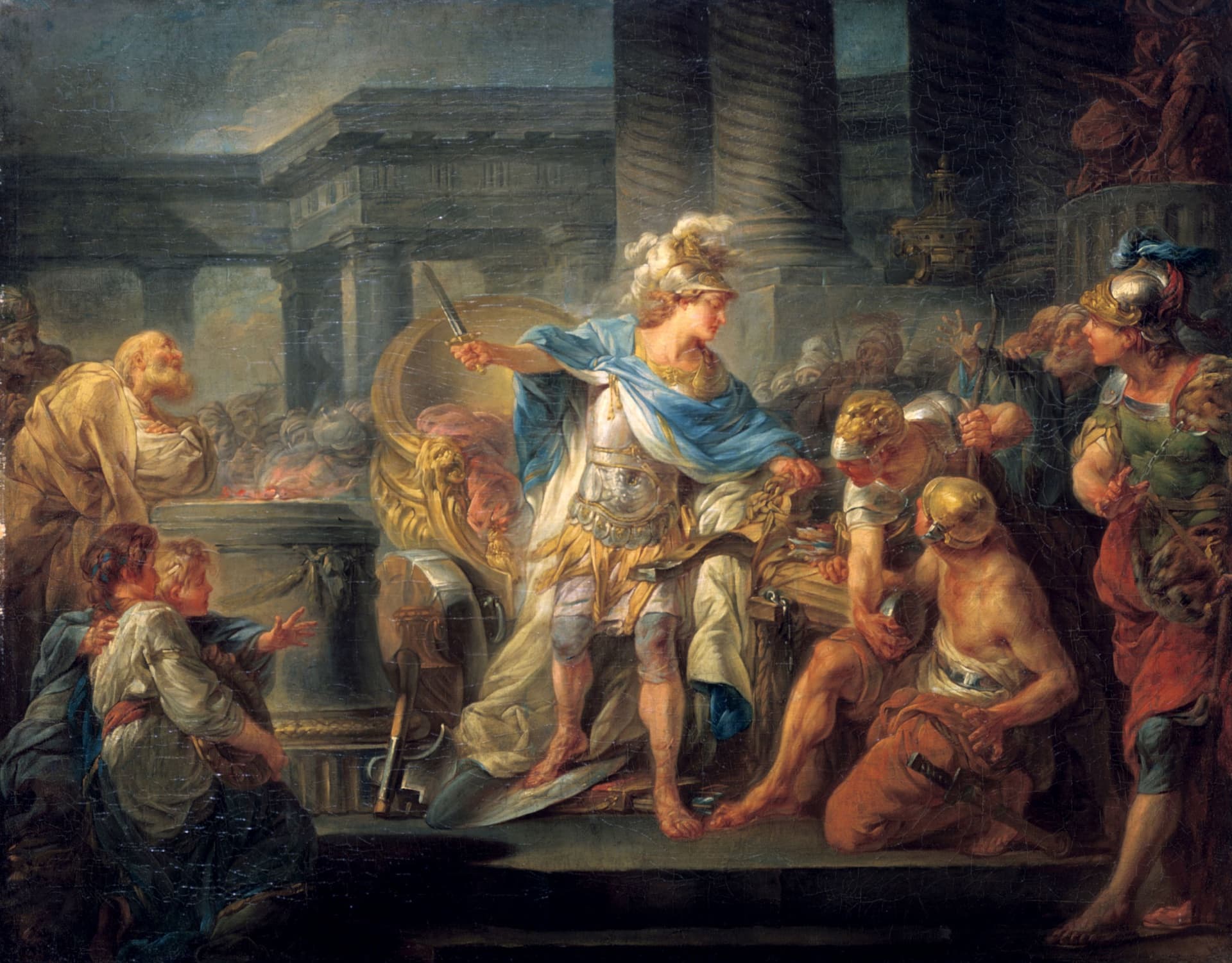
Classical Greece · 333 BC
The Knot and the Sword
At 22, Alexander finds the shortcut and keeps walking east
look closer
Alexander already has the sword up. Aristobulus was an engineer on the campaign, and he said Alexander pulled the pin out of the cart pole instead. Almost nobody repeats that version.
In the spring of 333 BC the Macedonian army came through Gordium, the old Phrygian capital in the middle of Anatolia, and Alexander went to look at the wagon. The local story said it had belonged to Gordias, a peasant whose ox cart rolled into the city on the day an oracle promised the next king. His son Midas gave the cart to the gods. Its yoke was lashed to the pole with a knot of cornel bark, tied so tightly into itself that nobody could find the ends. The prophecy attached to it said whoever undid the knot would rule Asia. He was 22, had crossed into Asia the previous year with an army he could not afford, and had just recovered from an illness at Tarsus that nearly killed him. He worked at the knot for a while. Then, in the version everybody knows, he drew his sword and cut it, and Alexander cutting the Gordian knot has meant impatience with false problems in every European language since. There is a second version, and its source is better. Aristobulus, an engineer who was on the campaign, said Alexander pulled the wooden pin out of the pole. That released the yoke and let the whole thing come apart with the knot still tied. The dull explanation comes from the man who was there, and the memorable one comes from writers who were not, which is the usual arrangement. Either way the oracle paid out. He beat Darius at Issus that November and spent the next two years taking the Persian coast. By 330 BC the empire was his. He died at 32 ruling from Greece to the Punjab. His generals then fought over the wreck, and what they carved out of it set the shape of the eastern Mediterranean for 300 years. Berthélemy painted it in 1767 in the full French academic manner: torchlight, a temple interior, priests recoiling, Alexander in a blue cloak with the blade already up. He won the Prix de Rome the same year, the state prize that paid for French painters to study in Rome. The canvas hangs at the École des Beaux-Arts in Paris. The detail he gets right is the audience. Alexander's own officers are watching, and their faces are the faces of men who have just realized what kind of career they have joined.