Classical Greece · c. 343 BC
The Tutor and the Blind Man
A philosopher weighs a gold chain against a stone head
look closer
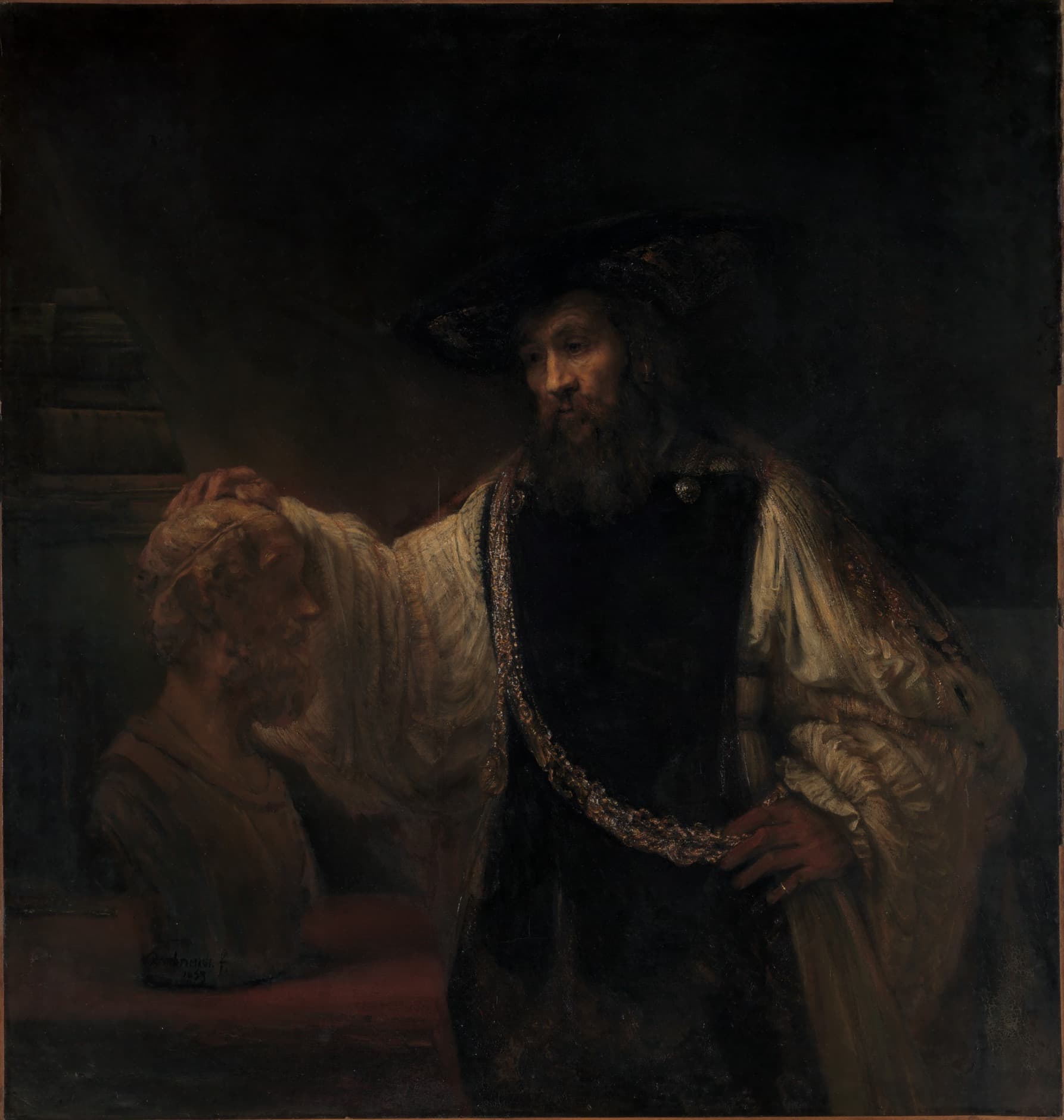
His hand rests on the head of Homer, the poet who was blind and poor and left nothing but words. The light catches the stone brow and the white sleeve.
Aristotle spent three years as tutor to the teenage son of Philip of Macedon, and the pupil turned into Alexander. The relationship stayed useful in both directions. Alexander sent back animal and plant specimens from Asia. Aristotle's nephew Callisthenes travelled with the expedition as its official historian, until he objected to the king's new Persian court ritual, and was arrested and died in custody. Being the great man's teacher was not a safe posting. Rembrandt's painting sets the whole arrangement out as an argument between two objects. The philosopher rests his right hand on a bust of Homer, the poet who was blind and poor and left nothing but words. His left hand touches the heavy gold chain across his chest, and the medallion hanging from it carries a portrait of Alexander: the honor a patron gives, the reward for teaching a king. The face between them is doing arithmetic that the picture declines to finish. The light falls on the sleeve, the chain and the stone forehead, and everything else in the room stays in the dark. The commission has its own comedy. It came from Don Antonio Ruffo, a Sicilian nobleman in Messina who had never met Rembrandt. He ordered a philosopher sight unseen from a painter at the other end of Europe. When it arrived in 1654 he was pleased enough to order two more. Rembrandt was already sliding toward the collapse that came three years later, when his possessions were inventoried and his house and his collection were sold off. He had spent much of his life buying exactly the kind of costume the sitter is wearing. The painting came up at auction in New York in 1961, and the Metropolitan Museum bought it for $2.3 million. That was the highest price anyone had ever paid for a picture, and the news ran on front pages. The museum hung it alone in a gallery, and people queued around the block to look at a picture about whether worldly reward is worth anything. The queue was itself an answer.