Ancient Rome · c. 750 BC
The Women Between the Spears
Rome stole its wives at a festival, then the wives stopped the war
look closer
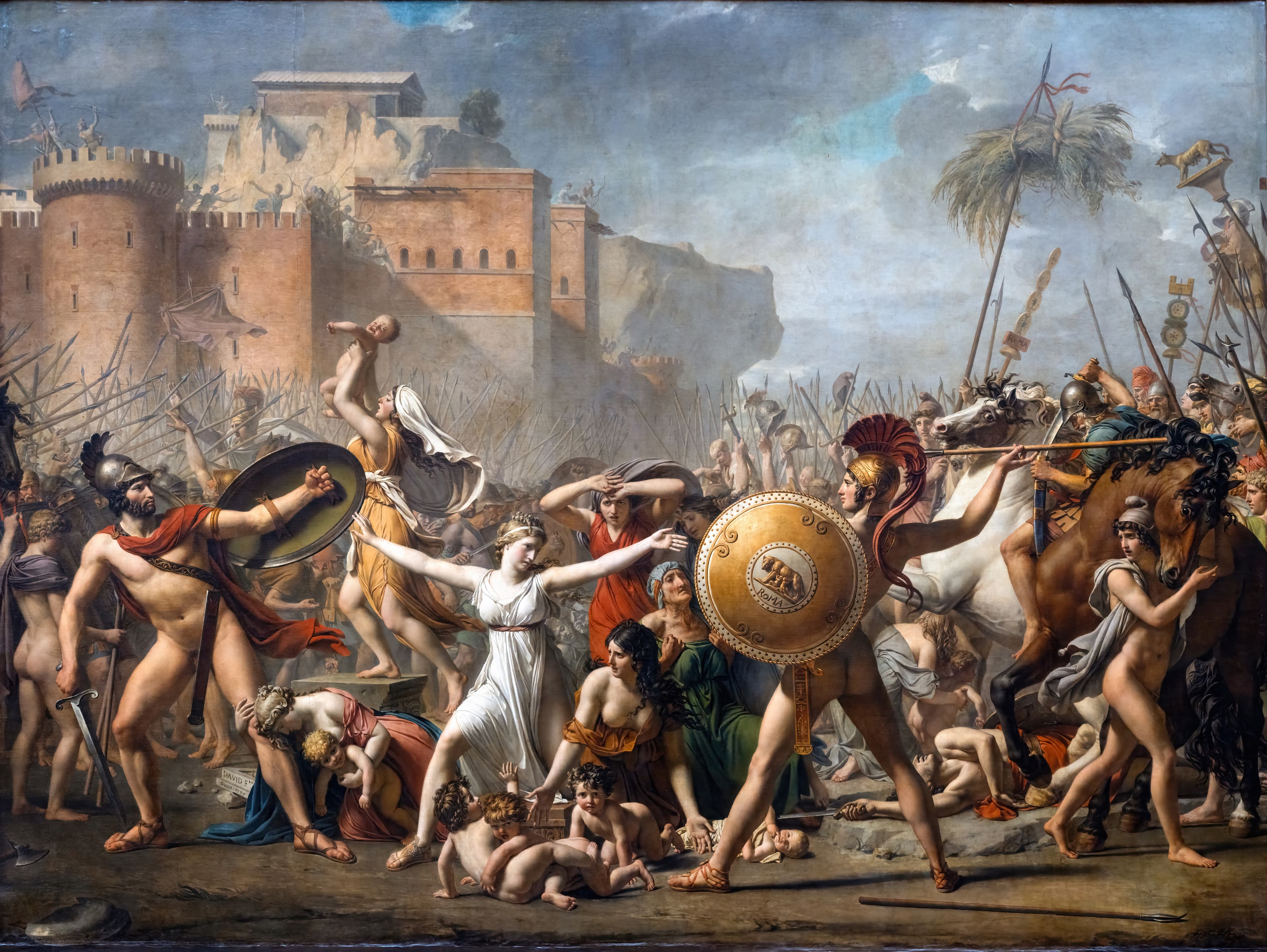
A woman stands in the gap with both arms flung wide. This is Hersilia, and one arm reaches toward her Sabine father and the other toward her husband Romulus. Her face is the face of Aurore de Bellegarde, a Paris society woman who sat for David.
Rome is barely a year old and short of women. Romulus has walled a hill and filled it with runaways and landless men, and the neighboring towns will not marry their daughters into a settlement of thieves. So he lays a trap dressed as a party. He announces games in honor of the god Consus, spreads the invitation up and down the valley, and the Sabines come in whole families to watch, curious about the new city. At a signal the young Romans draw their daggers, seize the unmarried girls out of the crowd, and drive the fathers off empty-handed. Livy counts the abduction as the first crime of the state and, in the same breath, its first marriage rush. The fathers do not forget. The Sabine king Titus Tatius is the last and largest of the wronged neighbors to bring an army to the walls. He takes the citadel by treason first. A Roman girl named Tarpeia opens the gate in exchange for what the Sabines wear on their left arms, meaning their gold bracelets. They crush her to death under their shields instead, since a shield is also carried on the left arm. The two sides finally meet in the low ground that will become the Roman Forum. This is the moment the picture holds. The stolen women are married now, with small children. They walk out of the city and stand in the open dirt between their fathers and their husbands, close enough to catch a thrown spear. Livy says they begged both sides to make widows and orphans of them rather than fight over them. The lines lowered their weapons. Rome and the Sabines agreed to become one people under two kings, and the women who had been the cause of the war wrote its peace. Jacques-Louis David painted the reconciliation, not the theft, and he had reasons close to the bone. He had voted to execute the king, sat in the Convention through the Terror, and been jailed twice after Robespierre fell. He thought of the picture in a cell in the Luxembourg palace and started painting after he got out. When it was finished in 1799 he charged admission to see it, which scandalized Paris, and lived on the money. About 50,000 people paid. In the center stands Hersilia in white, arms flung wide, one hand toward her Sabine father and one toward Romulus her husband, the exact posture of a country asking itself to stop. David has painted his soldiers stark naked in the Greek manner, which the critics mocked, and given Romulus a gold shield with the wolf of Rome on it. Down at the women’s feet the babies crawl in the dirt, ignored by everyone holding a weapon. David put them at the very bottom of the picture, directly under the spears.