The Viking Age · c. 862
The Land Without Order
Quarreling tribes send overseas for a king, and get a dynasty
look closer
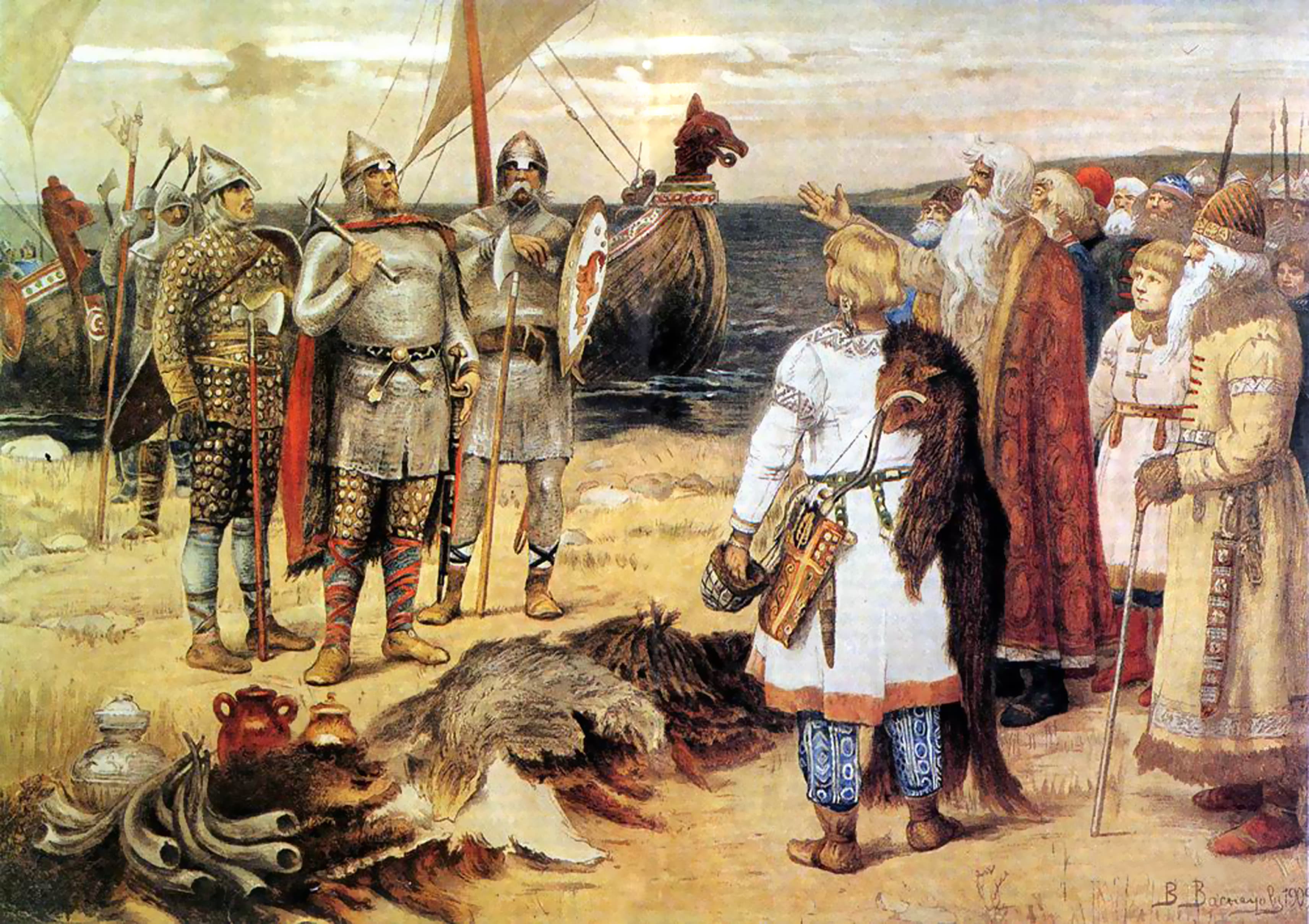
The men off the ships stand in mail and scale armor, and one of them rests a long axe on his shoulder. The chronicle names 3 brothers. Vasnetsov gives them a whole warband.
The tribes of the lake country east of the Baltic had driven their Varangian overlords back across the sea and refused them any more tribute. Then, the Primary Chronicle admits, they found they could not govern themselves. There was no law among them. Tribe rose against tribe, and they began to make war on their own kin. Under the year 6370 from the creation of the world, 862 in ours, the chronicle records what they did about it. They sent a delegation back over the water, to a people called the Rus. It carried the most quoted invitation in Russian history: our land is great and rich, but there is no order in it. Come rule and reign over us. Three brothers accepted. Rurik, the eldest, took Novgorod. Sineus sat down at Beloozero and Truvor at Izborsk. Within two years the younger two were dead, the chronicle does not say how, and Rurik held the river roads alone. His kinsman Oleg pushed south to take Kyiv in 882 and called it the mother of Rus cities. The family stayed. When Tsar Fyodor died childless in Moscow in 1598, the dynasty that ended at his deathbed still traced itself to Rurik, 736 years back. Whether any of it happened is a fair question. The chronicle was compiled by monks in Kyiv around 1113, two and a half centuries after the invitation, the same distance that separates us from the American Revolution. Archaeology muddies the clean date: at Staraya Ladoga, on the river below Novgorod, Scandinavian combs and glass beads lie in layers from the 750s, a century before anyone was supposedly called in. The very name Rus is probably Finnish before it is Slavic, from Ruotsi, the Finns’ word for Swedes, which likely began as a word for rowing. Scholars once argued that Sineus and Truvor never existed at all, and that a scribe turned two Norse phrases, his own household and his loyal troop, into two extra brothers. Most linguists have abandoned the idea. It survives anyway, being too good to kill. Viktor Vasnetsov painted the arrival around 1909, for a set of wall pictures the Moscow publisher Iosif Knebel sold to schools. It was never meant for a gallery. He divided the beach honestly. On the left the brothers stand in mail and scale armor, hands near their weapons. On the right the elders of the land wait in linen and fur, arms spread wide. Between the two groups, on the sand, sit drinking horns and a jar that nobody has picked up. The empire took the scene at face value. Its Millennium of Russia monument went up in Novgorod in 1862, dating the whole country from this meeting. The bronze Rurik at its base carries a shield stamped 6370.