The Viking Age · c. 874
Smoke Bay
A settler lets the sea choose his farm and the search takes three years
look closer
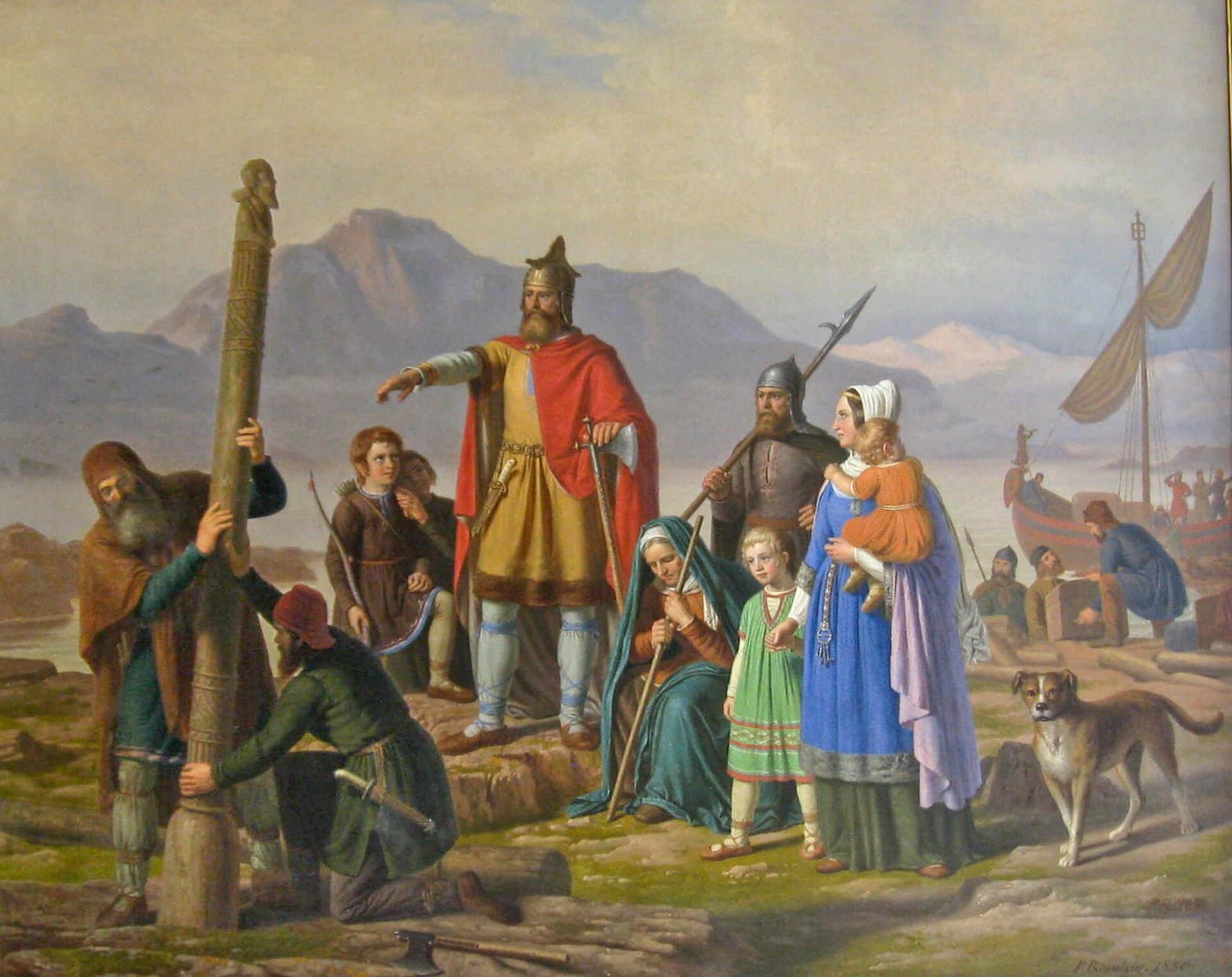
The pillar goes up with a bearded face cut at the top. At home a pair of these stood on either side of the owner’s seat, and Ingólfr threw them into the sea to let them pick his farm for him.
Land is already in sight when Ingólfr Arnarson carries his high-seat pillars to the rail and lets the North Atlantic have them. The carved posts stood on either side of the owner’s seat at home, and a household’s luck was held to live in them. Ingólfr has sworn to build wherever the gods float them ashore. Landnámabók, the Icelanders’ book of settlements, gives him plain reasons for the crossing. A feud with an earl’s sons had cost him his Norwegian estates. The island, sighted by storm-blown sailors a few years earlier, was the one country on offer with nobody in it. Nobody, or nearly. Ari the Learned, writing in the 1120s, says the first Norsemen found bells, books and bishops’ staffs left behind by Irish hermits. Those men had rowed to the edge of the world to pray alone, and they left rather than share the island with heathens. Ingólfr spent his first winter under the great south-coast headland that still carries his name, Ingólfshöfði, then sent two slaves, Vífill and Karli, west along the shore to look for the pillars. The search took three years. The bay where the posts finally lay steamed with hot springs, so it was named Reykjavík, smoke bay. Karli looked at the lava fields and said the line Landnámabók was honest enough to keep: we came past good country to settle on this bare headland. Ingólfr’s sworn brother Hjörleifr, who had crossed alongside him, never saw the bay. He would never sacrifice to the gods, the book notes. In the first spring his Irish slaves killed him, took the women and ran for the islands offshore. Ingólfr tracked them there and killed them in turn, and the islands are still Vestmannaeyjar, the west men’s isles. Standing over his brother’s body, he allowed himself one line about the gods: this, he said, is what comes of refusing the sacrifice. Johan Peter Raadsig painted the landing in Copenhagen in 1850, when the Danish crown had governed Iceland for centuries. Ingólfr’s men heave the pillar upright while he points out over the shore in a red cloak. His wife Hallveig, the children, the dog and the beached ship all wait on the stones. The carved head on the pillar top gets the first good look at the new country. It is a Danish academy picture, and it stands closer in time to us than to the landing. Tradition fixed the year as 874, and the ground nearly agrees. Under downtown Reykjavík lies a layer of volcanic ash that Greenland ice cores date to 871, give or take 2 years. The turf wall of the oldest house yet found in the city sits directly on it. The museum built around that wall took the geology for a name: The Settlement Exhibition, Reykjavík 871±2.