The Viking Age · 12 May 922
The Man from Baghdad
The caliph’s envoy reaches the Volga and writes down everything he sees
look closer
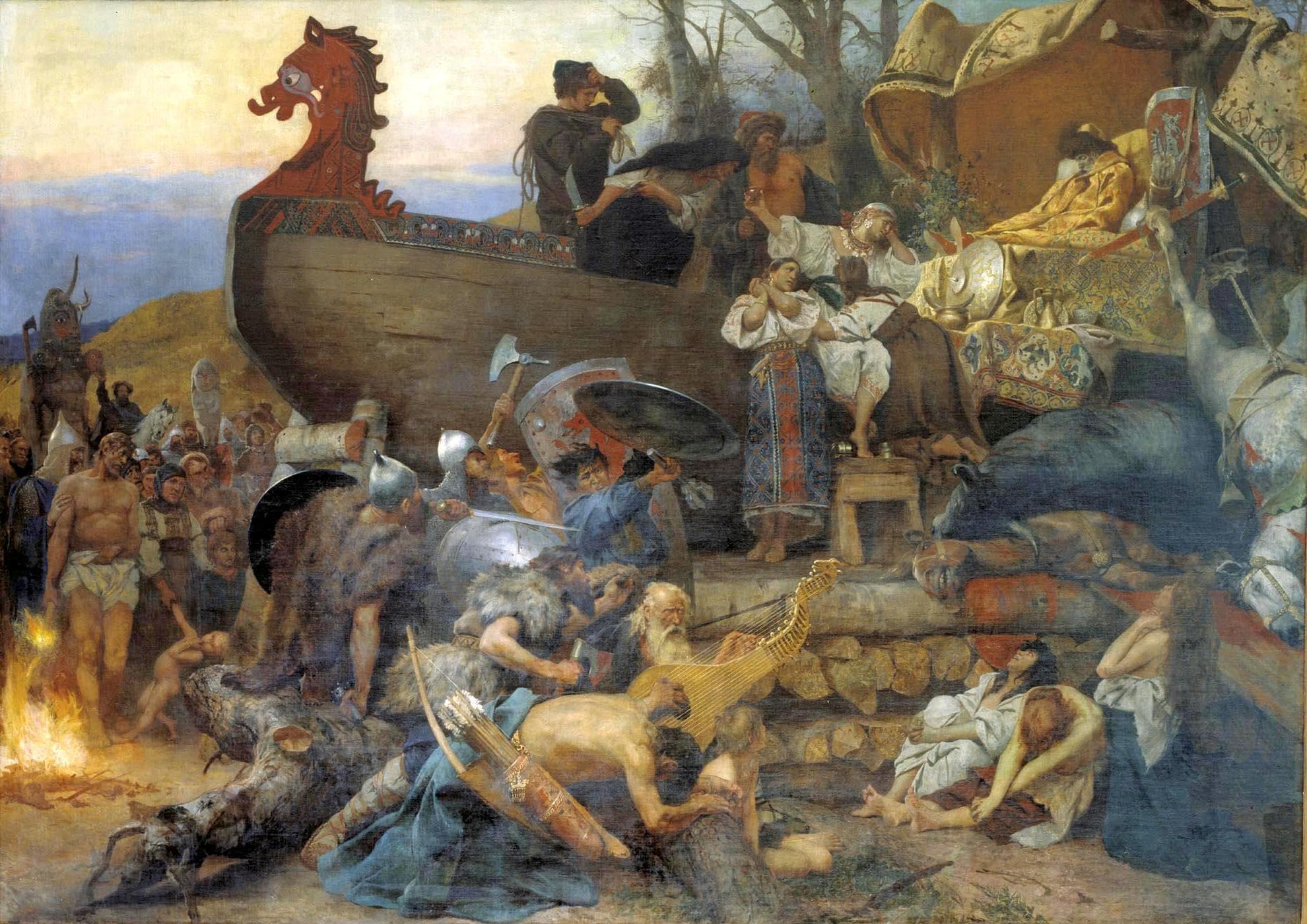
Three mourners in embroidered shirts stand at the foot of the bier. One raises a cup and presses a hand to her eye. The girl beside her steps barefoot onto a stool set with two small brass cups.
On 12 May 922 a caravan out of Baghdad reached the camp of the Volga Bulgars, and the king’s welcome party rode out to meet it. Ahmad ibn Fadlan, jurist to the embassy, records the date exactly. He had been traveling since the previous June. The mission wintered in Khwarazm, where he says the great river froze hard enough for carts to cross on the ice. Then it pushed north with 3,000 animals and 5,000 men. The cold made him think a door had opened onto Zamharir, the frozen wing of the Muslim hell. An awkward job waited at the far end. King Almış had asked the caliph for 4,000 dinars toward a fortress against the Khazars, and the money had fallen through. Ibn Fadlan was the man who had to read the caliph’s letter aloud, then answer for the coins that were not in the baggage. The king listened to the letter, then asked where the money was. Much of the report that follows was written by a man taking notes while in trouble. At the river he met the Rus, come downstream to trade furs and slaves. He had never seen bodies more perfect, he wrote: tall as date palms, blond and ruddy, every man inked dark green from fingernails to neck. He priced what he saw like an auditor. A woman wore one neck ring for every 10,000 dirhams her husband was worth. The green glass beads the men prized cost a dirham each, and went to their women as necklaces. Their piety was commercial: a trader would stand before a carved wooden post, list his cargo aloud, and ask for a rich buyer who would not haggle. Their washing undid him. One basin of water went from man to man each morning, and each blew his nose into it in turn. The same pen that admired the date palms calls them the filthiest of God’s creatures. That summer a great man of theirs died on the riverbank, and ibn Fadlan watched the whole rite through, from temporary grave to ash, an interpreter at his elbow the entire time. The beached ship, the goods, the animals, the slave girl who volunteered to follow her master: all of it is in the report, timed, counted and measured. His method was to ask the next question and write down the answer he got, not the one he expected. Henryk Siemiradzki painted that funeral in 1883 for the Historical Museum just opened on Red Square. He worked from the report itself: the dragon-prowed hull propped on timber, the dead man couched in brocade, the mourners on the steps. The museum had ordered two scenes of pre-Christian Rus the year before, and Count Alexei Uvarov, who planned the halls, picked the subjects. Siemiradzki was a Pole living in Rome who had made his name staging the spectacles of Nero, and he gave the Volga bank the warm light of his Roman canvases. Outside these pages, nothing is known about ibn Fadlan. The report nearly vanished with him. For centuries it survived only as quotations inside a 13th-century Arabic dictionary of places. Then in 1923 the Bashkir scholar Zeki Validi Togan opened a manuscript in the shrine library at Mashhad, in Iran, and found the embassy waiting inside.