The Viking Age · Midsummer, 930
The Law Rock
Farmers with no king invent a government that fits in a meadow
look closer
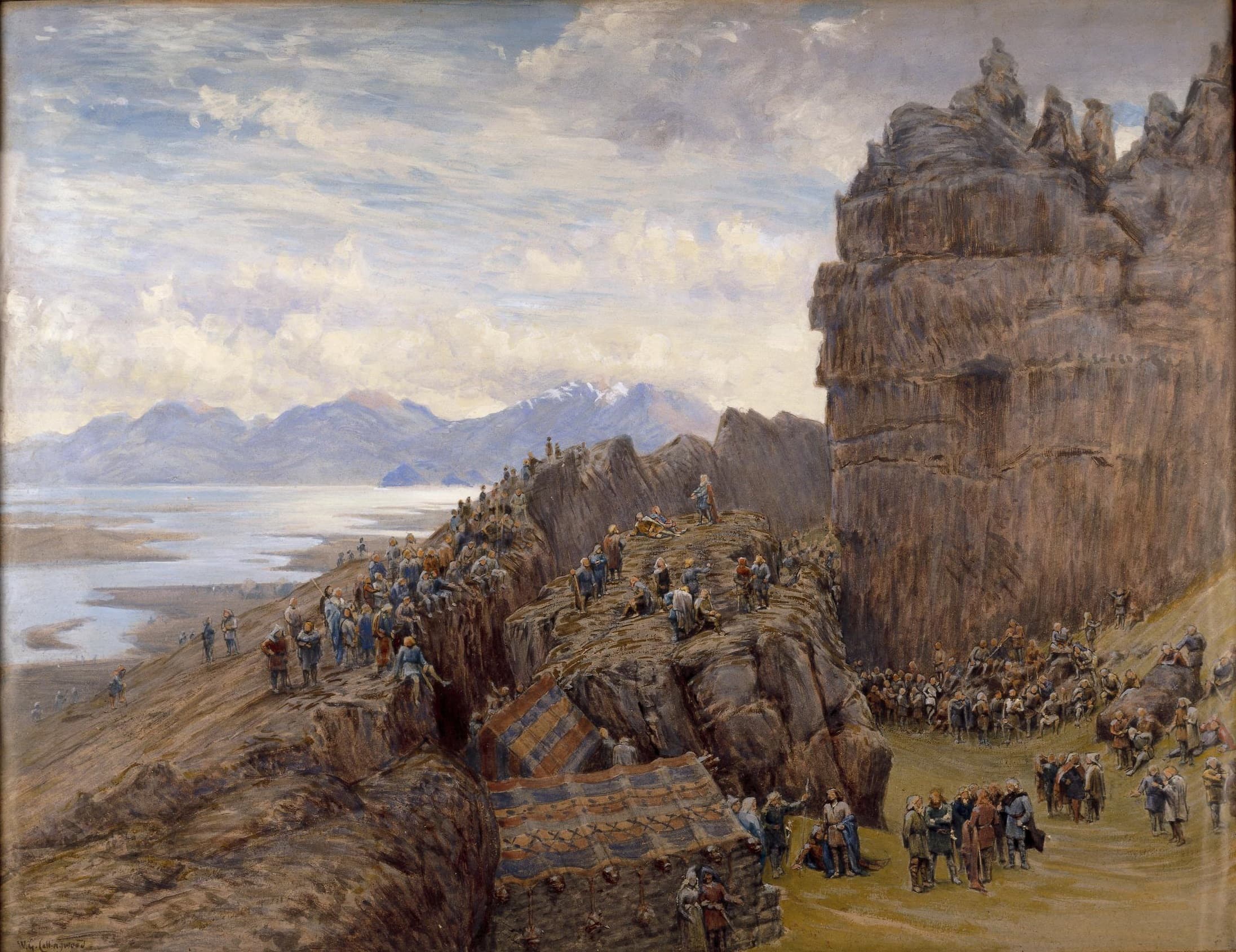
A man in a red cloak stands alone at the top of the rock and speaks. Two listeners wait at his feet, and the crowd is strung out along the ridge behind him. He is the Lawspeaker, who had to recite a third of Iceland’s law from memory each summer.
Every householder in Iceland owed a penny to a man called Grímr Goatbeard. Ari the Learned, writing the island’s first history around 1125, explains the fee. The settlers had decided their 60-year-old colony needed one law and one assembly. Grímr walked the country to find the meeting place, and the pennies were his wage. The spot sits where a lava plain meets a wall of cliff: Þingvellir, the assembly plains. It had grazing, trout water and a natural sounding board in the rock, and its previous owner had lately been outlawed for murder, so the land conveniently belonged to everyone. The law itself came back from Norway with a man named Úlfljótr, who had spent three winters there reshaping the west-coast Gulathing code for an island with no king to enforce it. Around midsummer 930 the first Althing met, and it met every summer after that, two weeks in June. The whole thing balanced on one elected man. The Lawspeaker stood on the Law Rock and recited a third of the law aloud each session, so the full code went through living memory every three years. The first of them, Hrafn Hængsson, kept the job for 20 summers. Nothing existed to check him against, because Iceland did not write its law down until the winter of 1117. For those two weeks the plain was the capital of the island. Booth walls of turf and stone, left standing all year, were roofed with striped homespun each summer. Goods, gossip, betrothals and lawsuits moved between them, and the sagas stage half their turning points in this crowd. What the assembly never had was any way to make people obey it. Courts could declare a man outlaw, full outlawry meaning anyone might kill him without penalty, and then the winning side rode home to enforce the sentence itself. The arrangement sounds unworkable. It ran for over three centuries before the Norwegian crown absorbed it. W. G. Collingwood, an English painter who had published John Ruskin’s biography in 1893, spent the summer of 1897 crossing Iceland on horseback with the scholar Jón Stefánsson. He painted the saga sites as he went, and the two of them printed the results in 1899 as A Pilgrimage to the Saga-Steads of Iceland. His Althing is a reconstruction: cloth roofs on the booths, chieftains’ parties strung along the rocks, the assembly crowd on the floor of the rift called Almannagjá. The rift is the one detail nobody present could have understood. It is the torn edge of the North American plate, pulling away from Europe at about 2 centimeters a year. The plain between the cliffs belongs to neither continent. Each summer the law was read out from the edge of one plate, to men camped in the gap between two. The assembly, moved to Reykjavík and interrupted once for 45 years, still sits. The pennies were never refunded.