Classical Greece · 416 BC
The Last Guest to Arrive
A poet throws a dinner, a drunk crashes it, and a student writes the night down forever
look closer
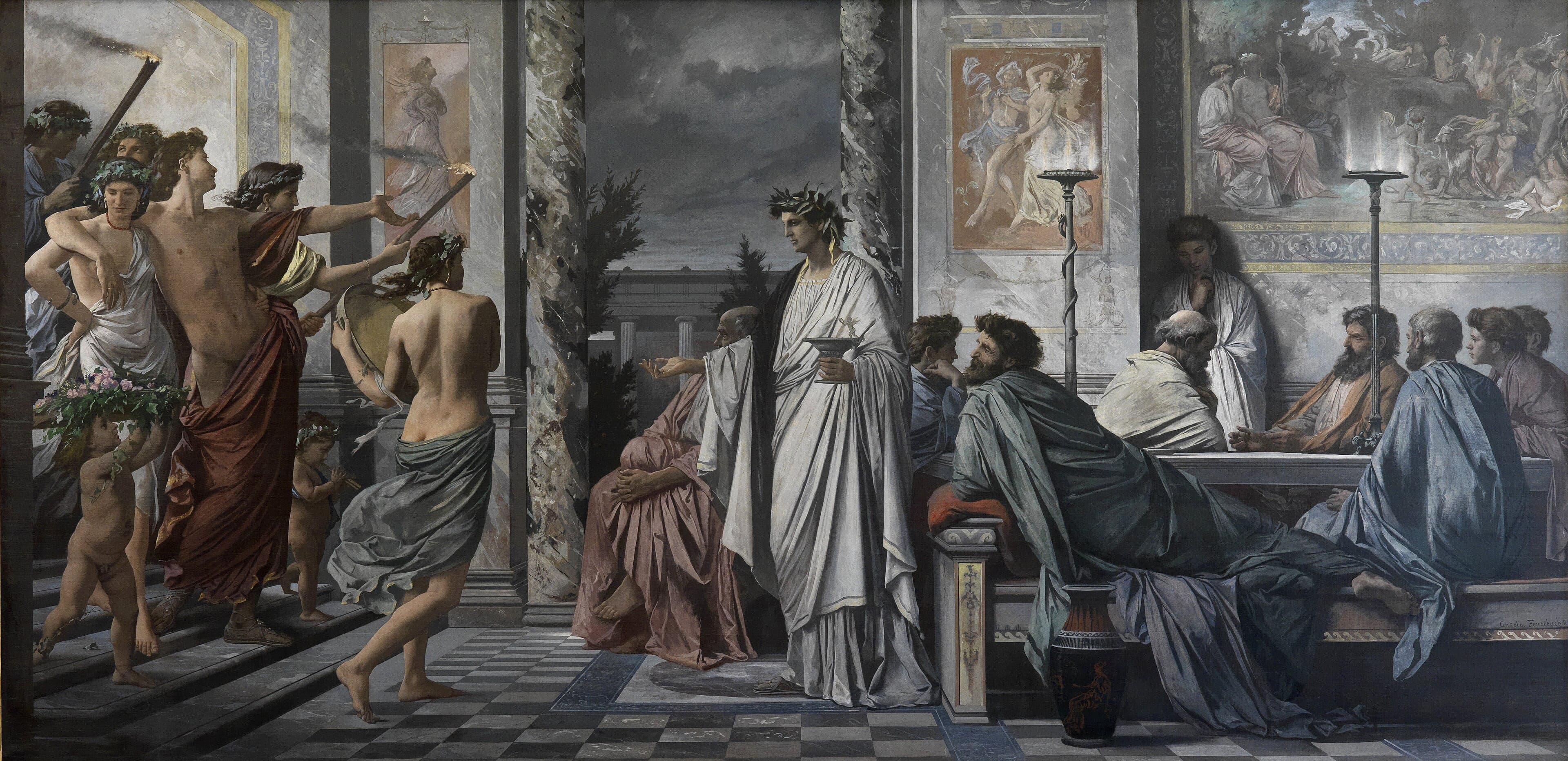
Alcibiades comes in half naked under a crown of ivy, with a woman’s arm around him. Torches and a drum are behind them. In Plato’s account he arrives too drunk to stand and then praises Socrates instead of love.
The tragedian Agathon threw a dinner in Athens in 416 BC, the day after his first play took the prize at the Lenaia. The guests settled in to drink and make speeches in praise of love. The evening would have vanished like every other dinner. One of the drinkers was Socrates, and Plato, still a boy when it happened, later wrote the night up as the dialogue we call the Symposium. A symposium was the second half of a Greek dinner, the drinking half, run by rules. The wine went into a great bowl, the krater, and was cut with water there before anyone touched it, often two or three parts water to one of wine. A man who drank it neat was marking himself a barbarian or a drunk. They had agreed to go easy, several of them nursing sore heads from Agathon’s victory party the night before, and to send the flute girl away and talk instead. The speeches climb toward Socrates. He says he will only repeat what a priestess named Diotima taught him. Love is a ladder: a soul climbs from one beautiful body to all of them, and then to beauty itself. Then the door bangs. Alcibiades arrives blind drunk, propped on a flute girl, ivy and violets falling off his head. He was the most dangerous charmer in Athens. Instead of praising love he praises Socrates. He tells the room how he once tried to seduce him and got a night of philosophy and nothing else. The man was worth the interruption. Alcibiades would soon talk Athens into the ruinous invasion of Sicily, then defect to Sparta when the city turned on him, then to Persia, then home again, wanted everywhere and trusted nowhere. On this night he is only the loudest guest at a good party. Plato ends it as a comedy of endurance. More revelers crash in, the drinking turns general, and the speech makers drop off one by one. Near dawn only three are still awake: Socrates is pressing a sleepy Agathon and the comic poet Aristophanes to admit that the same man ought to be able to write both tragedy and comedy. They nod off before conceding. Then Socrates gets up, washes, and goes about his ordinary day as if he had slept, the last man standing after a night that broke everyone younger than him. Anselm Feuerbach painted the scene twice. This is the first version, nearly 20 feet wide, finished in 1869 and now in Karlsruhe. He put the drunk Alcibiades and his torch bearers pouring in from the left, and Agathon in white waiting to receive them. On the floor at the foot of a couch he painted a small red figure wine jar.