Ancient Rome · c. 250 BC
The Man Who Went Back
A prisoner argues against his own ransom, then keeps his word
look closer
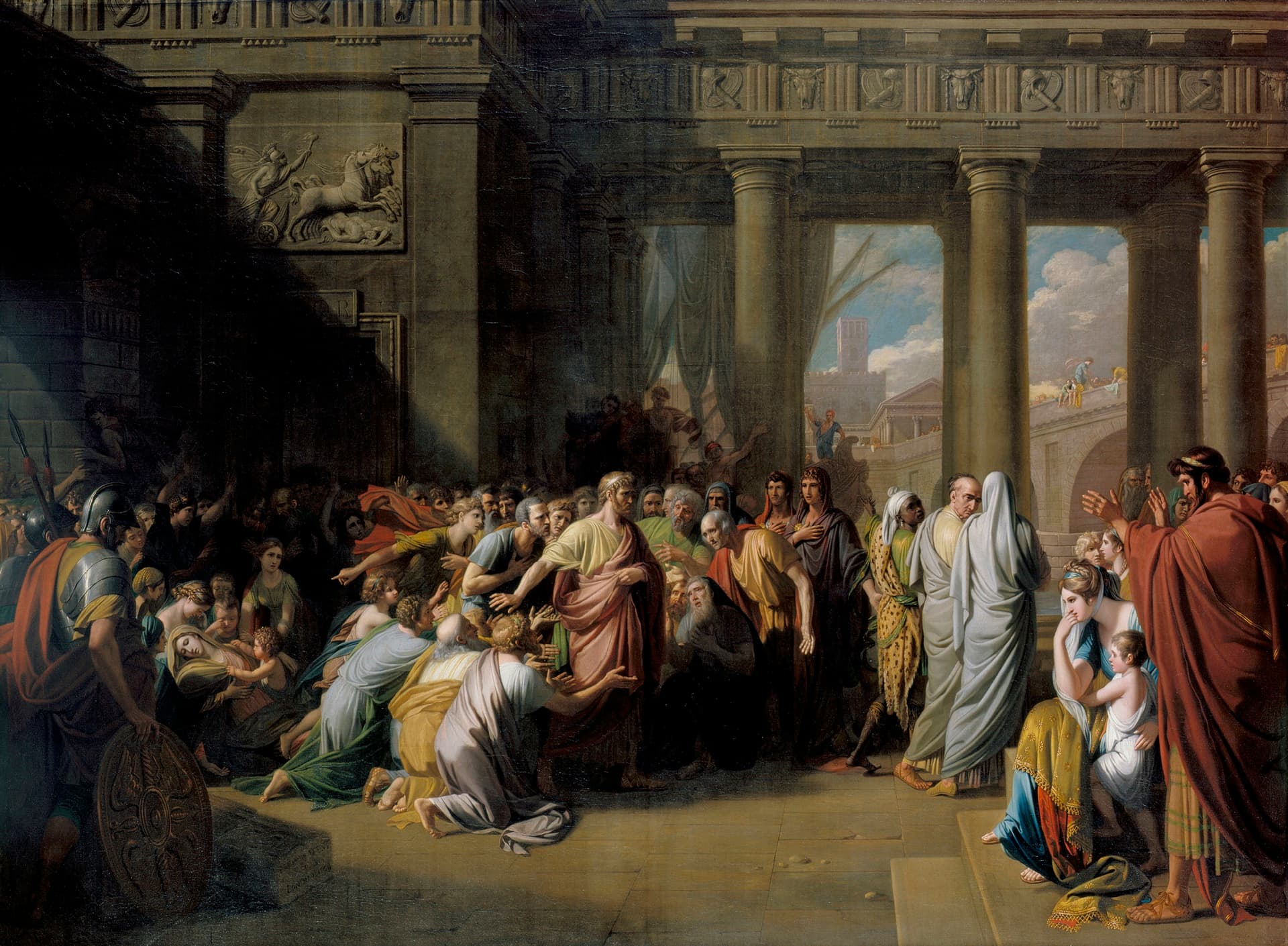
Regulus walks out bald and unhurried. A veiled figure stands at his shoulder, and hands still reach for him from the right. West gave all the panic in the room to the crowd and none to the man going back to his executioners.
Rome learned to sail in a single generation because Carthage left it no choice, and by 256 BC it felt confident enough to land an army in Africa. The consul who led it, Marcus Atilius Regulus, won a battle, seized a town a day's ride from Carthage, and offered peace terms so crushing that the enemy decided fighting on was cheaper. Carthage hired a Spartan drill-master named Xanthippus, who took one look at the Roman line and pointed his elephants at the flat ground. In the spring of 255 the invading army was destroyed on the Bagradas plain, and Regulus, the consul who had dictated terms, was marched into Carthage as a prisoner. Five years later, the tradition says, Carthage sent him to Rome on parole. He was to propose peace, or at least an exchange of prisoners; he swore an oath to return if he failed. What he did instead became the most famous act of bad diplomacy in Roman memory. Standing before the Senate, he argued against his own exchange. He told the senators that Carthage's captive officers were young and useful, that he was old and finished, and that Rome should trade nothing. Then, his oath being what it was, he said his goodbyes and boarded the ship back. Horace has him shrugging off his wife's kiss like a man already legally dead, hurrying, the poet says, as if leaving for a country weekend rather than for his executioners. The executioners are where the historians clear their throats. The stories of what Carthage did to him grew with each Roman telling: the cut eyelids, the sleepless days, the barrel lined with spikes. Polybius, the war's most careful historian, never mentions the return at all. Some scholars suspect the whole ordeal was invented to launder a nastier fact the sources preserve alongside it: that his widow tortured Carthaginian prisoners in Rome. True or built, the story did permanent work. When Cicero needed one name for the proposition that an oath binds even between enemies, the name was Regulus. Benjamin West, a Quaker from Pennsylvania who had become history painter to George III, took the departure as a royal commission. The king picked the subject himself in February 1768, after seeing West's Agrippina with the Ashes of Germanicus and asking him for another Roman one. The canvas hung in the Royal Academy's first exhibition, in 1769. It stages the story as a tug of war with one side not pulling. The crowd grasps, pleads, and faints around a man in a pale toga who has already, visibly, left. It has belonged to the crown ever since.