Ancient Egypt · A morning, c. 280 BC
The Memory of the World
Every ship that enters Alexandria surrenders its books to the scribes
look closer
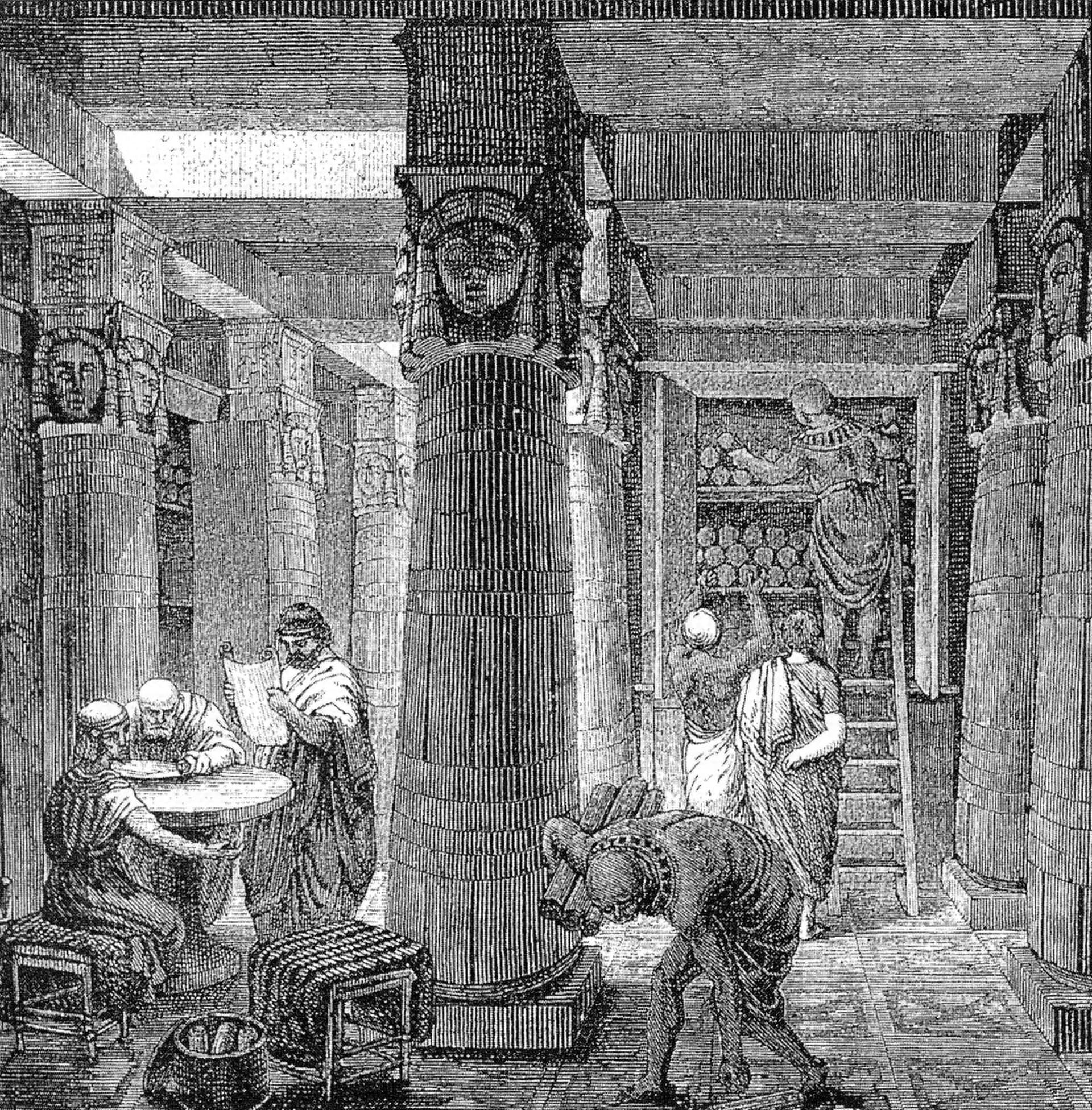
Scroll ends fill the pigeonholes row on row, and a librarian leans in over the top shelf. Callimachus catalogued this collection in 120 scrolls. It was the first bibliography anyone had made.
The rule is simple and outrageous: any ship that docks at Alexandria must hand over every book on board. Scribes copy the text, the library keeps the original, and the ship sails away with the duplicate; the confiscated scrolls are catalogued, without embarrassment, under the label from the ships. The city itself is barely older than its oldest residents. Alexander drew it in the sand and the Macedonian generals who inherited Egypt built it. The Ptolemies cannot buy Greece’s past, so they have decided to buy its mind. Their agents at the book markets of Athens and Rhodes purchase whole libraries; what cannot be purchased is borrowed, and what is borrowed does not always come back. The masterstroke of the collection is a swindle. Athens lends out its official state copies of Aeschylus, Sophocles, and Euripides, the texts against which all others are checked, against a deposit of 15 talents of silver, a fortune. Ptolemy keeps the originals, returns handsome copies, and tells Athens to keep the money. Inside, order is being invented because it has to be. A scholar-poet named Callimachus compiles the Pinakes, a catalogue of authors and works running to 120 scrolls, the first bibliography on earth. The librarians begin shelving by the first letter of the author’s name, which sounds like nothing and is the birth of alphabetical order as a tool. Inside the Mouseion, salaried scholars, the first in history to be paid simply to know things, argue in the colonnades. Euclid is assembling geometry into 13 books that will be taught for 2,000 years. Aristophanes of Byzantium, tired of readers guessing where sentences end, is inventing marks for punctuation and accents. Herophilus is opening the human body and finding that the brain, not the heart, does the thinking. Aristarchus of Samos has proposed, to general disbelief, that the earth circles the sun. And Eratosthenes, who will measure the circumference of the Earth with a well, a stick, and a shadow and be wrong by perhaps two percent, catalogues a collection aiming at half a million scrolls. It is the most ambitious idea of the ancient world: every book, in one place, forever. The rivalry it breeds is almost flattering. When the kings of Pergamum start a competing library, Egypt cuts off their papyrus. Pergamum, so the story goes, perfects writing on treated animal skin, which is why parchment carries that city’s name. The ending has no single villain, though history keeps auditioning them. A Ptolemy purges the scholars in 145 BC and the best minds scatter east. Caesar’s harbor fire in 48 BC burns warehoused books on the docks. Aurelian’s siege in the 270s wrecks the palace quarter where the collection lived; the Serapeum, its daughter library, is demolished by a Christian crowd in 391. The tidy stories of one great blaze were written centuries later. Forever is the only part they get wrong, and the burning, when it comes, will take centuries to finish.