The Machine Age · 1877
The New Boulevards
Paris rebuilt, painted by the man who paid for the exhibition
look closer
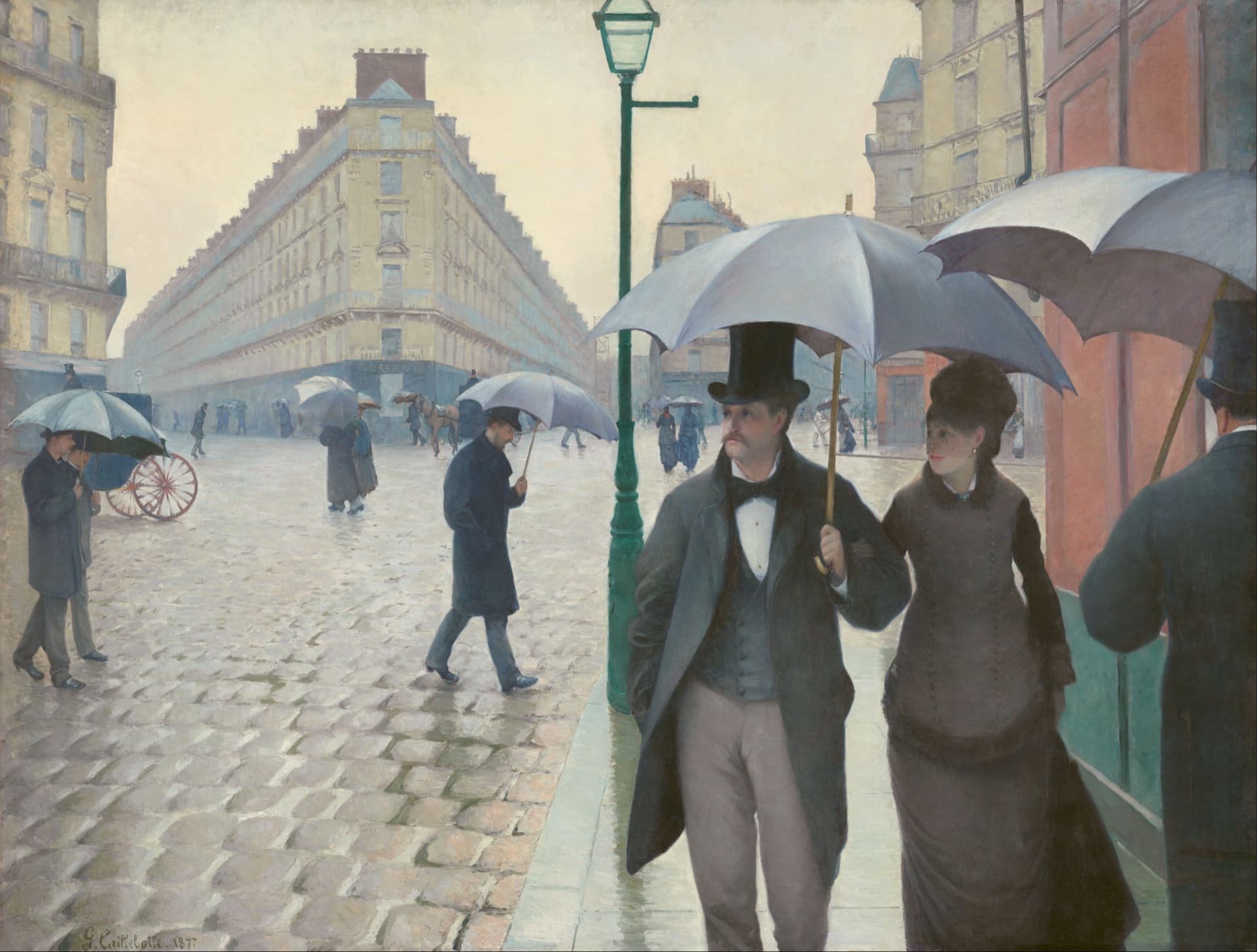
The couple comes straight out of the canvas arm in arm under one umbrella. Neither of them looks at the other, and neither looks where they are going.
The intersection is real and still standing: the Place de Dublin behind the Gare Saint-Lazare, one of the star-shaped crossings cut through the old city by Baron Haussmann on Napoleon III's orders. The work ran from 1853 to 1870. It pulled down nearly 20,000 buildings and put up 34,000, drove the boulevards straight through the medieval quarters, and installed the sewers, gaslight and pale stone facades that the word Paris now means. It also, as everyone at the time understood, made the streets too wide to barricade. Caillebotte painted the result 6 years after the last barricades of the Commune came down, and painted it empty of history: just wet cobbles, new stone, and people going somewhere. He built it like an engineer, which is what he trained as. The studies for it survive, the canvas squared off in a grid and the vanishing point pinned. The green lamppost splits the picture almost exactly down the middle. The cobbles are laid out in a perspective so controlled it can be measured. The couple on the right walk toward the viewer at a scale that puts them a step from colliding with the man entering at the frame's edge. Nobody looks at anybody. That is not an accident of the moment; it is the subject. The umbrella crowd of a modern city, sharing an intersection and nothing else. Caillebotte showed it as the centerpiece of the third Impressionist exhibition in 1877, which he also organized, hung and largely financed. He was rich, bought his friends' paintings when nobody else would, paid Monet's rent, and left the state 68 canvases by Degas, Manet, Monet, Renoir, Pissarro and Cézanne. The bequest caused a public fight; officials accepted only part of it, and the part they took became the core of France's Impressionist collection. For most of a century he was filed as the patron rather than the painter. The Art Institute of Chicago bought the picture in 1964, and its reputation caught up with it fast. On the sidewalk that afternoon the rain has already mostly stopped: the sky is pale, the shadows are gone, and the umbrellas are still up because nobody trusts it.