The Revolutionary Age · 10 April 1826
The Night They Walked Out
7,000 walk out through the siege lines in the dark
look closer
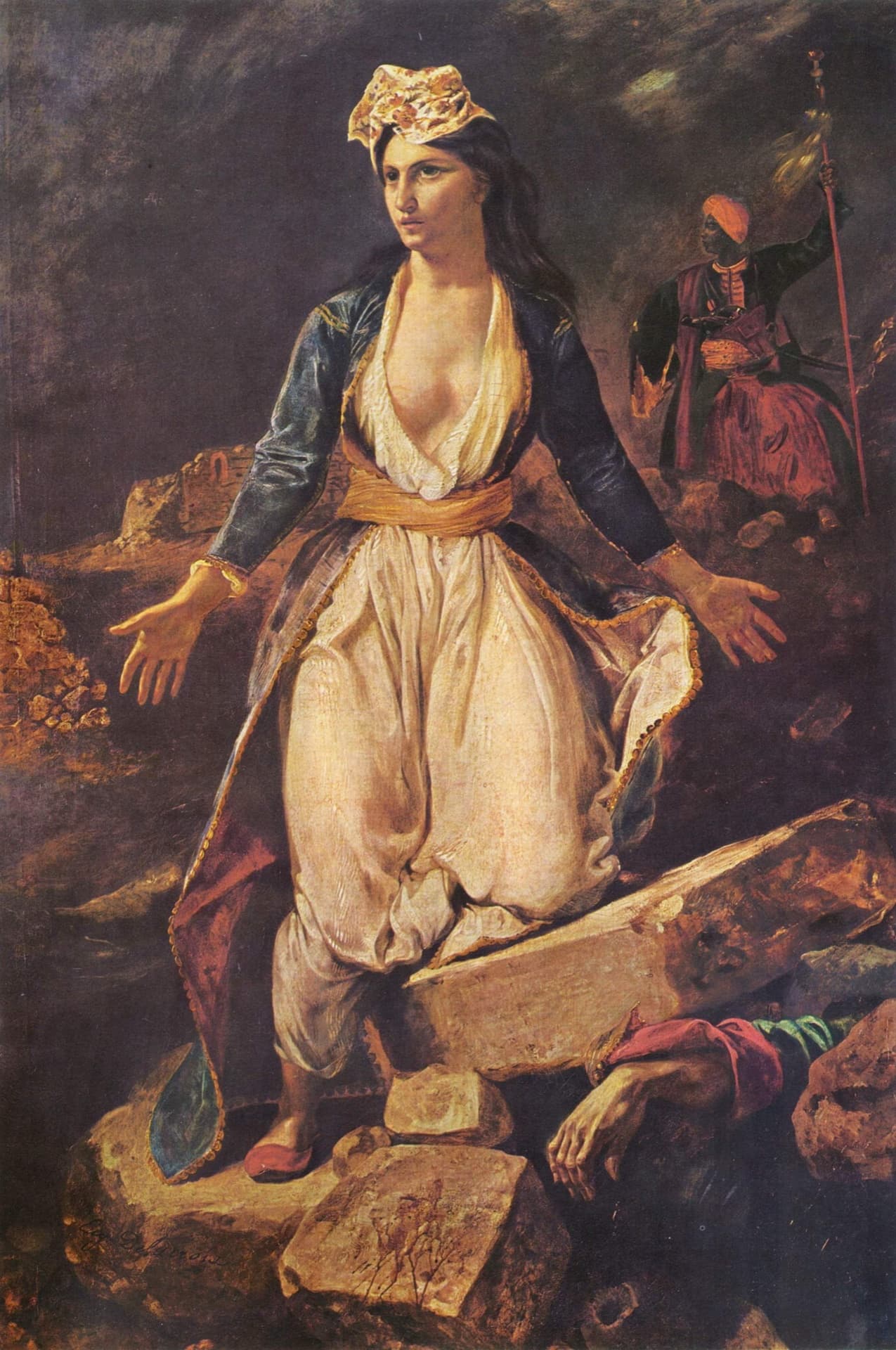
The woman holds herself upright and dry-eyed in the blue jacket and white dress of Greek costume. Delacroix's first sketches had her wild with fear. He painted her calm instead.
By the spring of 1826 Missolonghi had been under siege for a year. The little lagoon town was the most famous place in Europe, because Byron had died there two years earlier and the newspapers had never left. Inside the walls the food had run out. The town held about 9,000 people, and they had eaten the horses, then the mules, then the rats, then boiled hides and seaweed. Surrender to Ibrahim Pasha's army meant the slave markets. On the night of 10 April, the eve of Palm Sunday, they chose the third way out. Everyone strong enough would walk out through the siege lines in 3 columns, the fighters on the flanks and the families in the middle. That came to 7,000 of them. The plan needed silence, and deserters had already sold it. The guns were waiting. The clouds slid off the moon at the worst moment, somebody shouted the order to fall back, and the columns broke apart under fire in front of their own ditch. Of the 7,000 who went into the dark, about 1,000 reached safety. The sick and the wounded had stayed behind in houses packed with gunpowder, to light it themselves when the soldiers came through the door. The town that fell that night was mostly rubble and mostly empty, and the empire that took it won nothing anyone could spend. Europe had followed the siege week by week in the papers, and it turned the grief into subscriptions, concerts, committees and, at last, warships. The allied fleet that destroyed the Ottoman navy at Navarino the next year came out of that mood. In Paris, within months of the news, Delacroix put a canvas into a paying exhibition for the Greek cause: no battle and no massacre. A woman in Greek dress kneels on broken marble with her arms open. A single hand comes out of the rubble under the slab. Behind her an Ottoman soldier plants his standard among the stones. He called it Greece on the Ruins of Missolonghi, and it did for the Greek war what his Liberty would do for a French one 4 years later. It gave a cause a body. Both are propaganda in the only sense worth keeping, grief made impossible to ignore. The canvas is 213 centimetres tall and hangs at Bordeaux. The hand in the rubble was never given a name, which was the point.