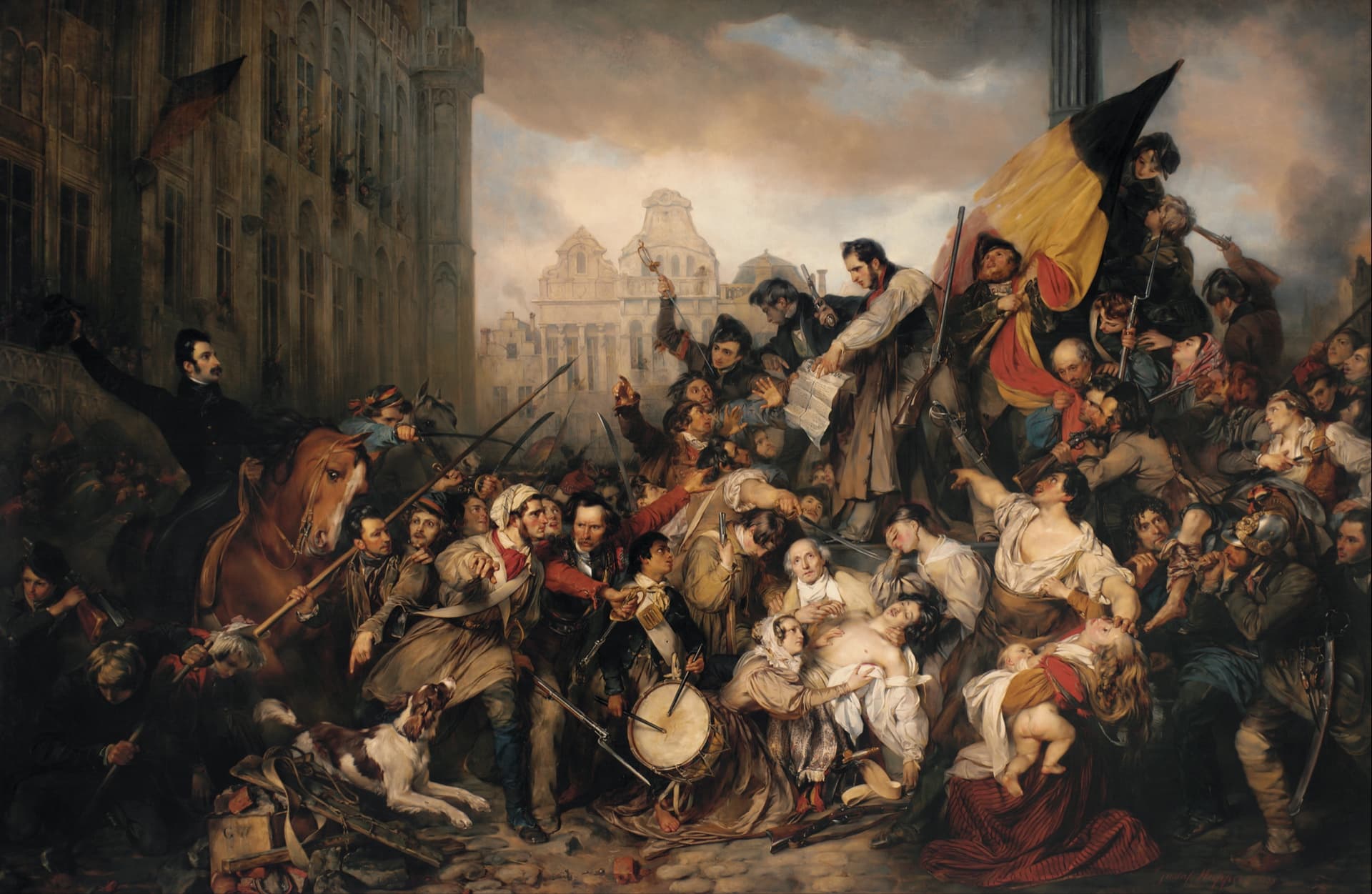
The Revolutionary Age · September 1830
An Opera Started It
A duet about tyranny empties the opera house into the street
look closer
The man in the white shirt hands the proclamation down into the crowd, and hands come up to take it. The Belgian government paid Wappers to paint this 4 years after the week it shows.
The Kingdom of the Netherlands was 15 years old in 1830, and it had been assembled like furniture. The powers at Vienna bolted the Catholic, half French-speaking south onto the Protestant Dutch north as a buffer against France. The bolts never stopped creaking. The south had more people and less power. Amsterdam held the debt and The Hague held the offices, and the king held to the idea that firmness was a policy. On the night of 25 August 1830 the Brussels opera house put on Auber's La Muette de Portici, about a fishermen's revolt in Naples. It was booked for the king's birthday celebrations, 4 weeks after Paris chased its own king out. At the second-act duet, Sacred love of the fatherland, the audience stood up singing, and by the aria's end the performance had moved into the street. The rioting that night wrecked the houses of unpopular ministers. The performance of it mattered as much as the grievances: revolution was the fashionable art form that summer. Through September the quarrel hardened. The king sent an army under his son to retake Brussels, and the city fought it for 4 days in the parks and squares. Those are the September Days in the painting's title. Volunteers walked in from Liège and the Walloon towns, the Dutch pulled out by night, and a provisional government declared Belgium independent on 4 October. By the next summer the new country had a constitution the liberals of Europe envied and an imported king, Leopold of Saxe-Coburg, uncle to a girl who would shortly be Queen Victoria. The powers guaranteed the new state's neutrality in a treaty signed at London in 1839. It was filed and forgotten until August 1914, when the German chancellor asked whether Britain would really go to war over a scrap of paper. The scrap was Belgium's birth certificate. It existed because an audience had walked out of an opera 9 years before. The Belgian government commissioned the painting in 1834, and Wappers delivered the founding week as official memory. The Grand-Place is under smoke, the proclamation goes out to the crowd, the flag hangs overhead, and a family grieves at the front, because founding stories need a price in the frame. The king made him court painter, and in 1839 he took over the Antwerp academy. The canvas hangs in Brussels: a country that started with an aria, painted at aria pitch.