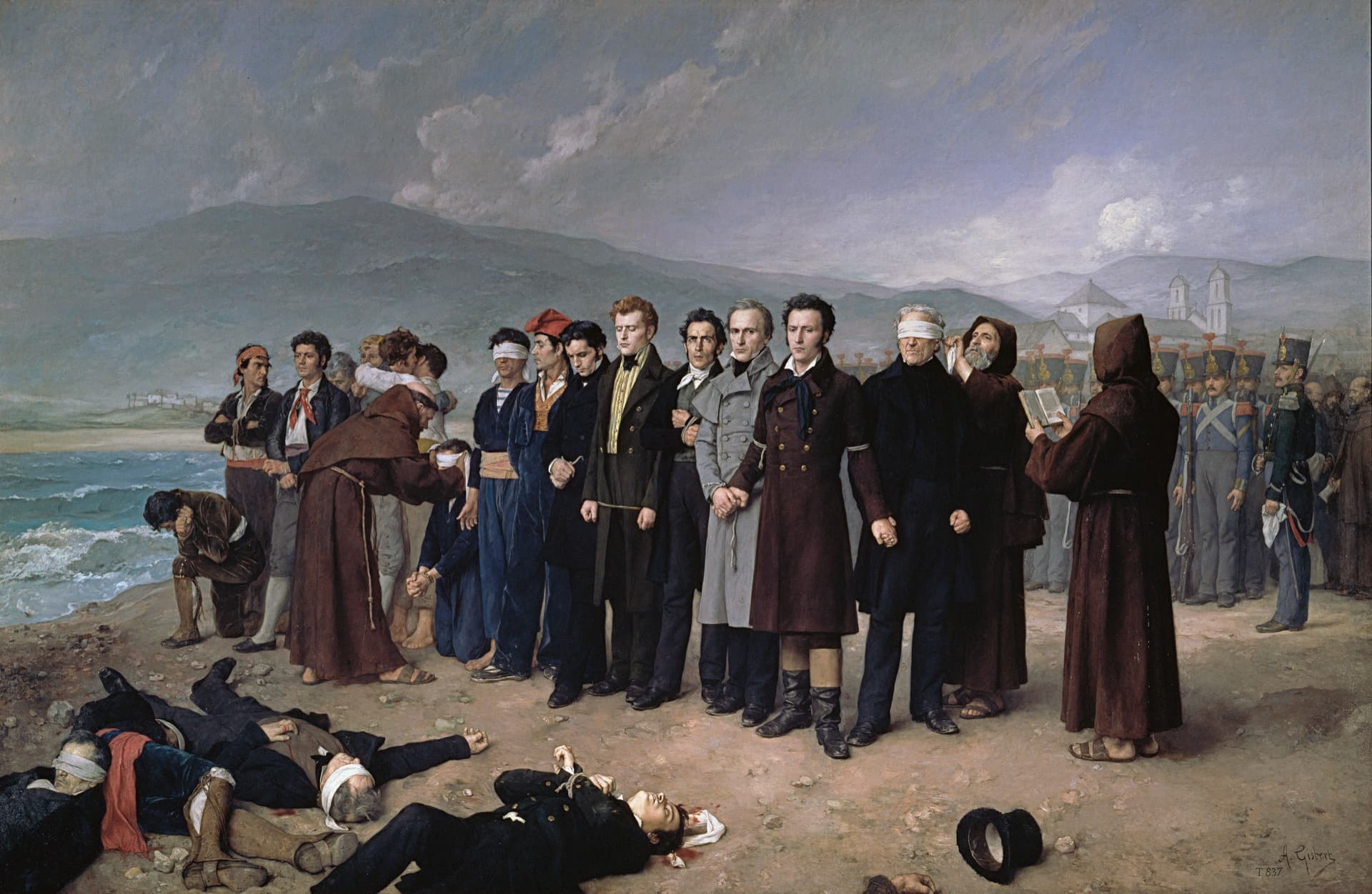
The Revolutionary Age · 11 December 1831
The Beach at Málaga
Torrijos and 48 men hold hands on the sand
look closer
A man in a dark red coat holds the hand of the man beside him in grey. They are Torrijos and Manuel Flores Calderón, and the cord is still on their wrists. Gisbert painted the row on a canvas 6 metres wide.
The liberal constitution of 1820 was crushed by French bayonets, sent in at the request of Spain's own king. Spain then entered what its historians call the Ominous Decade, and the liberals who survived worked from exile: London committees, Gibraltar safe houses, invasion plans on borrowed money. General José María Torrijos was the exiles' soldier, a man who had fought the French as a teenager and the absolutists ever after. In 1831 he prepared the landing that would raise Andalusia. The governor of Málaga, González Moreno, wrote to him secretly for months as a fellow conspirator, fixing signals, promising garrisons. It was bait from the first letter. Torrijos crossed from Gibraltar on 2 December with about 60 men. One of them was Robert Boyd, an Irish officer of 26 who had put his inheritance into the expedition. They were herded inland, surrounded, and taken without a fight. There was no trial of any kind. The royal order that came back from Madrid ran, in effect, to one line: shoot them all. On the morning of 11 December 1831, on the beach of San Andrés at Málaga, Torrijos and 48 companions were lined up on the sand with their hands bound. By the accounts the city kept, they held one another's hands down the row. Friars moved along the line with blindfolds. The volleys took them in batches. Boyd, a Protestant, was buried in the English cemetery in Málaga. The governor who had written the letters was promoted, and he carried the name the executioner of Málaga until his own violent death. Fernando VII died 2 years later. His widow ruled as regent for a queen not yet 3 years old, and she needed the liberals so badly that the dead of the beach became state martyrs almost overnight. An obelisk went up over the bones of the other 48, in the Plaza de la Merced, on the square where Picasso would be born. The painting took its time, and that is the second act. In 1886 the liberal government of Sagasta commissioned Gisbert to paint the executions as civic instruction, a canvas to remind Spaniards what absolutism costs. He finished it in 1888. It hung in the museum of modern art in Madrid until 1971, when it moved to the Prado. Gisbert kept the colours to sand, sea and black coats, and he put the viewer standing in the row. The next batch waits with their hands joined, and one top hat is already on the ground. Spanish schoolbooks have used the image ever since, which is what the contract asked, honestly delivered.