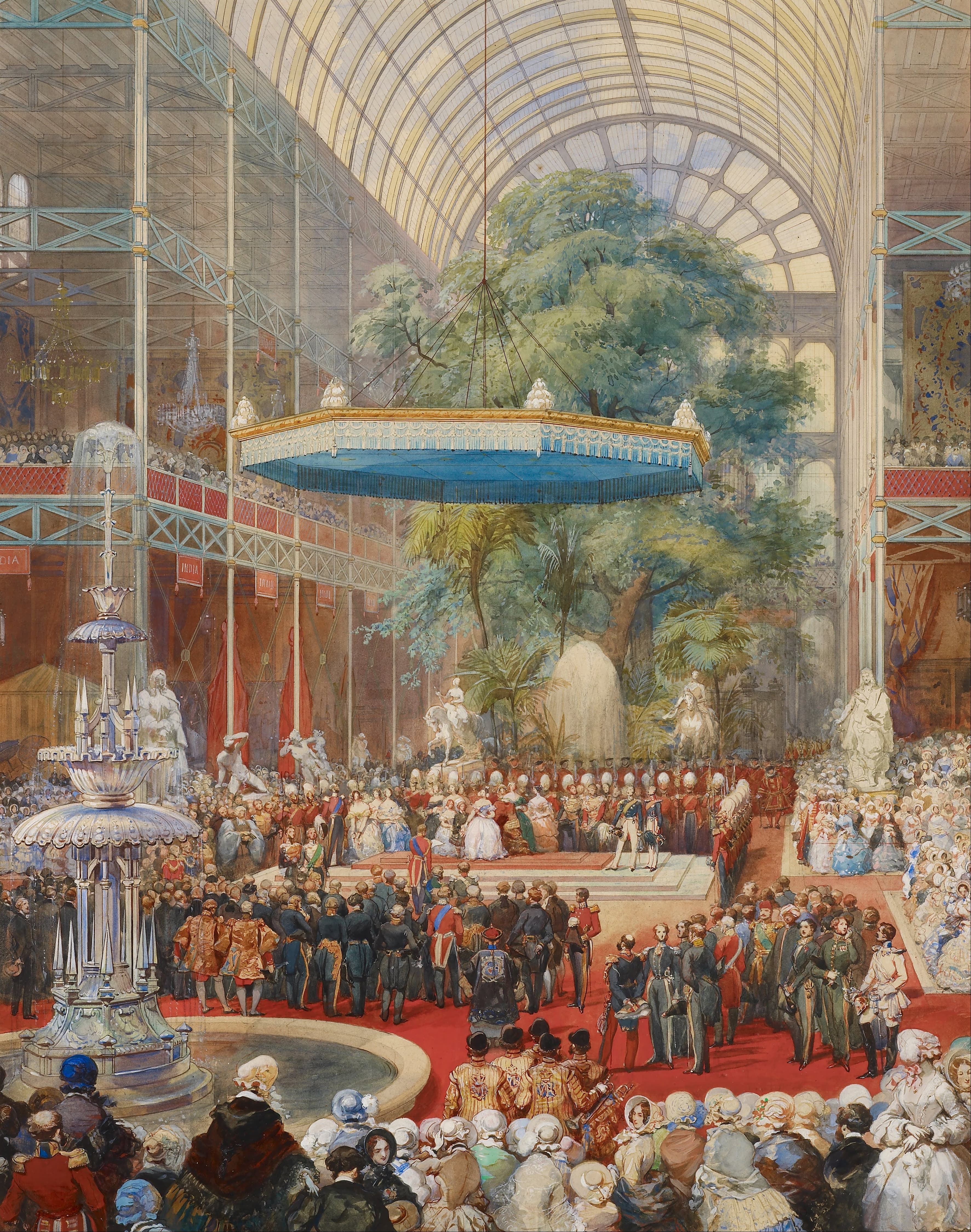
The Machine Age · 1 May 1851
The House of Glass
A gardener builds a palace of iron and glass to hold the whole world
look closer
The crystal fountain rises 27 feet in cut glass, and the crowd is packed to its foot. Two men in gold uniforms stand on the red carpet. It was the one landmark in a building 1,848 feet long, so visitors used it to arrange where to meet.
The building was designed by a man who had never built a building. Joseph Paxton ran the gardens at Chatsworth, where he had raised a giant water lily under a glass roof ribbed like its own leaf. The committee for the 1851 exhibition rejected 245 serious proposals and started to panic. Then Paxton sketched his answer on a sheet of pink blotting paper during a railway board meeting. It was a greenhouse the size of a cathedral. Iron columns, ready-made panes, no wet mortar, the whole thing bolted together from parts a factory could stamp by the thousand. The press named it the Crystal Palace before a single column stood. The site in Hyde Park held a row of full-grown elms that Londoners refused to let anyone cut down. Paxton simply arched a barrel-vaulted transept over them and built the trees inside, and sparrows moved into the branches and would not leave. The Duke of Wellington, in his eighties, is said to have suggested the cure that worked: sparrowhawks. On the first of May, 1851, Queen Victoria opened the fair under that roof, walked the aisles past some 100,000 objects, and wrote in her journal that it was the greatest day in our history. Over the next five months the gates counted 6 million admissions, close to a third of everyone then living in Britain. Inside stood the century showing off to itself. The Koh-i-Noor diamond behind bars, which most visitors found a disappointing lump. A folding piano for yachtsmen, a Sheffield knife that opened into dozens of blades, a bed that pitched its sleeper into a cold bath at a set hour. The American section arrived nearly empty and half-mocked, then Cyrus McCormick’s reaping machine cut a swath of English grass and stopped the laughing. The whole enterprise turned a large profit, and the money bought the land in South Kensington where the museums stand today. The watercolor of the opening is by Eugène Lami, a Frenchman who had painted battles for one king and parties for another. He built the scene the way a stage designer would: the great glass roof and the enclosed elm rising over a crystal fountain 27 feet high. The royal party is a small patch of red under a blue canopy, and the crowd is banked in the galleries. Two years later the Palace was taken apart pane by pane and rebuilt bigger on a hill at Sydenham, where it stood for 82 years as a pleasure ground. It burned in a single night in 1936, the glow visible across eight counties, and the iron that would not rot in the rain melted and ran.